A library is growing in Norway.
The Future Library is a time-capsule project, of sorts. A thousand trees were planted in a Norwegian forest this summer, to be harvested in a century's time. Every year until the day of the reaping, a different author will be invited to contribute a story to this library. The catch? The story will remain unread until these trees are made into the paper on which these works will be printed. The writers who contribute towards the beginning of the century won't likely live to see their books published. And that's sort of the point. In a hundred years, none of the originators of the project will be around to see its completion.
It'll be interesting to see what authors end up participating. It takes a certain sort of writer to produce a work that will likely be published posthumously, and to be happy with having completed it, without any notion of where it might stand in public opinion or among literary critics. It's fitting that the first contributor to the Future Library is Margaret Atwood; a science fiction writer is likely to agree with the notion of art as time capsule for future generations.
http://www.theguardian.com/books/2014/sep/05/margaret-atwood-new-work-unseen-century-future-library
Her story about the "lost" Haida manuscript in the above Guardian article is particularly apt. Who knows how language might change in a century? We certainly think differently than our ancestors did in the early 1900s. We find references to iceboxes and horse-drawn carriages archaic, for example, and there are many words that have disappeared from common usage in the past hundred years. It begs the question of whether authors who are consciously writing for the future, without the preconditions of a contemporary readership, would choose to write differently. To what extent, after all, does art demand and audience?
I am reminded (as I often am) of the Percy Shelley poem "Ozymandias," as well as of Faulkner's Nobel acceptance speech. The Future Library seems simultaneously an endeavour without ego and perhaps the greatest projection of self-preservation instinct an author can have.
I suppose we'll have to wait and see.
Showing posts with label language. Show all posts
Showing posts with label language. Show all posts
Sunday, October 19, 2014


Sunday, February 9, 2014
Sochi 2014: Where can I buy a rainbow flag?
I've been watching the Winter Olympics this weekend (mostly for the figure skating, which is wonderful). I've also been keeping abreast of Putin's crackdown on LGBT rights and the subsequent displays of pride and solidarity from other countries. Here's an excellent little video by The Guardian, wherein a number of British celebrities learn how to say "Where can I buy a rainbow flag?" in Russian:
http://www.theguardian.com/lifeandstyle/video/2014/feb/07/learn-russian-protest-anti-gay-laws-sochi-winter-olympics-video
Neil Gaiman! Stephen Fry!
Because damn it, Putin, you're not going to bring Russia into the twenty-first century without some twenty-first century values -- among which are equal rights for all citizens, including gay ones. (Yes, we have a ways to go on this issue in the US as well.)
http://www.theguardian.com/lifeandstyle/video/2014/feb/07/learn-russian-protest-anti-gay-laws-sochi-winter-olympics-video
Neil Gaiman! Stephen Fry!
Because damn it, Putin, you're not going to bring Russia into the twenty-first century without some twenty-first century values -- among which are equal rights for all citizens, including gay ones. (Yes, we have a ways to go on this issue in the US as well.)
Thursday, January 23, 2014
La Bohème at the Met Opera!
A few friends and I got rush tickets to the Metropolitan Opera's production of La Bohème yesterday. I've never seen it live before (even though I have three different recordings on my computer). It was absolutely worth the experience; the show was spectacular. I can't believe what I've been missing. (Rodolfo's character, especially, tugs at my heartstrings.)
It's always interesting listening to music with lyrics in a language I don't know, because so much more of my understanding depends on the vocalists' interpretations of their parts. (The Met Opera has electronic panels on the back of each seat displaying translations of the lyrics, but I tried not to rely on that, because watching the staging of the production is a huge part of the experience.) You can always get a rudimentary understanding of what's going on, because there's enough overlap between the various Romance languages (though that leaves German lyrics nigh impossible), but the nuances are really up to the vocalists, in their facial and body language down to the minute inflections of their lines. For instance, in this production, the audience could tell in the first act the exact moment when Benoît loses control of the situation at Rodolfo's apartment -- you could tell by his posture and the vocals of the other characters how inebriated he was getting.
Another element I've noticed: it's hard for any stage performance to adequately develop character, because it's constrained to about two hours, and there's only so much of each character that the audience gets to see. I do like how -- other than the marketplace scene -- Puccini doesn't include any group or choral numbers. The opera focuses narrowly on the lives of the six central characters -- and really only three or four of them are developed at any depth; the small cast lends it a sense of intimacy that you don't often see in some of the larger, more traditionally theatrical operas in the repertoire. It would be a good choice for an indie opera house -- I'm not surprised that Rent (a very creative update on La Bohème where everyone dies of AIDS instead of tuberculosis) remained an Off-Broadway production despite its success.
Now I really must see Rent. I missed both the original production, which closed when I was in high school, and the revival, which went dark quite recently. (I have the soundtrack to that, as well, and I do like how Jonathan Larson includes so many nods to Puccini.) I've heard mixed reviews of the film, but one of these same friends is organizing a screening of the original production -- I'm super excited! :-)
Wednesday, June 19, 2013
If I Used Twitter
tonight's post would be:

That is all.
2nd place at YPG spelling bee: winner got "quixotic;" my word not found in OED. Still, pretty cool consolation prize: tinyurl.com/oac7w92.
It's a very graphically interesting cover design:
That is all.
Thursday, March 28, 2013
English Major Armadillo, or, Memes I Wish Would Catch On
I started reading this tumblr recently...
http://fyeahenglishmajorarmadillo.tumblr.com
I am so very amused. Now, should the question arise, I can tell non-bibliophiles that I am an armadillo (not this kind of armadillo, mind you). If not a separate species, certainly we're a tribe unto ourselves, at least on the internet(s). Exhibit A: Geoffrey Chaucer Hath a Blog.
Someone please make one for history majors. How about History Major Kangaroo? Or History Major Hippopotamus (which has a nice alliterative ring to it)? (If there already is one, please do send it my way! One can never have too many nerdy web-humor sites bookmarked.)
Edit: There is one! It's called History Major Heraldic Beast, which is much cleverer than either kangaroo or hippopotamus.
http://fyeahenglishmajorarmadillo.tumblr.com
I am so very amused. Now, should the question arise, I can tell non-bibliophiles that I am an armadillo (not this kind of armadillo, mind you). If not a separate species, certainly we're a tribe unto ourselves, at least on the internet(s). Exhibit A: Geoffrey Chaucer Hath a Blog.
Someone please make one for history majors. How about History Major Kangaroo? Or History Major Hippopotamus (which has a nice alliterative ring to it)? (If there already is one, please do send it my way! One can never have too many nerdy web-humor sites bookmarked.)
Edit: There is one! It's called History Major Heraldic Beast, which is much cleverer than either kangaroo or hippopotamus.
Sunday, August 12, 2012
Why Grammar is Important (one of many reasons)
After reading this article, I feel vindicated in my grammar-and-vocabulary nitpicking (nitpickery?):
http://blogs.hbr.org/cs/2012/07/i_wont_hire_people_who_use_poo.html
(It's unfortunate that the URL abbreviates the way it does.)
I wouldn't hire someone who used poor grammar, either. Improper use of language, I think, bespeaks a disorderly mind. Mastery of words, elegance of expression, clarity -- these things are important. Spellcheck can only do so much, and even though I (like anyone else who writes in a word processor) use it too, it's a crutch that shouldn't be a substitute for a solid grasp of spelling and grammar. (I suspect that statisticians feel the same way about calculators.) Just because it exists, as a tool to be used sparingly, doesn't mean that it ought to be necessary.
http://blogs.hbr.org/cs/2012/07/i_wont_hire_people_who_use_poo.html
(It's unfortunate that the URL abbreviates the way it does.)
I wouldn't hire someone who used poor grammar, either. Improper use of language, I think, bespeaks a disorderly mind. Mastery of words, elegance of expression, clarity -- these things are important. Spellcheck can only do so much, and even though I (like anyone else who writes in a word processor) use it too, it's a crutch that shouldn't be a substitute for a solid grasp of spelling and grammar. (I suspect that statisticians feel the same way about calculators.) Just because it exists, as a tool to be used sparingly, doesn't mean that it ought to be necessary.
Tuesday, January 31, 2012
The Evolution of the English Language, as Demonstrated by Austen
I was reading the novel Emma for an English class, and happened upon the following phrase, which made me laugh:
What "a sudden freak" actually means is more along the lines of "a capricious fancy."
A sudden freak seemed to have seized him at breakfast... (Vol. II, Chapter 7)At first glance, it would appear that a character was kidnapped from the breakfast table by some sort of lunatic. (Yes, the use of "sudden" is a bit of a giveaway that something is amiss in this interpretation.) Not quite the sort of scene one would expect in a Jane Austen novel.
What "a sudden freak" actually means is more along the lines of "a capricious fancy."
Thursday, November 24, 2011
NYTimes: What's in a Name?
Seeing as it's Thanksgiving -- a celebration of family and loved ones -- I thought that this would be an appropriate article to post; it's an observation on an inevitable quandary in naming trends, given recent (within the past several decades) developments in gender equality and increasingly diverse modern familial structures:
http://www.nytimes.com/2011/11/24/fashion/babies-surnames-to-hyphenate-or-not.html?_r=1&ref=fashion?src=dayp
I've given this a fair bit of thought. As a heterosexual female, Western social customs would have me relinquish my surname in favor of my hypothetical husband's, if I were to marry at some point in my life. I'm not so keen on that, myself; I'm rather attached to my last name. It has a history behind it, a connection to generations of family and culture.
Ergo, one of my goals in life is to achieve a level of "success" (definition variable) such that if the time comes, it would appear to be logical (rather than vain or self-serving) to keep my surname. It's rather sad that society is still at a stage where a woman needs a reason to keep her maiden name, while a man may do so merely by virtue of his Y chromosome. I hope that someday, English-speaking society will have progressed such that women keep their own names as a matter of course, and some equitable system exists whereby children's surnames are evenly distributed between their sire and dam.
I'm not sure about hypothetical children (haven't given them much thought -- I'm many years too young for that!) but I imagine it would depend a lot on the ethnic origins of their father. Surnames in some languages lend themselves more readily to hyphenation than those in others. I'd want them to have a Chinese name, too. If the father were non-Chinese, I'd like to give them my own Chinese family name to use in contexts that would require it; phonetically deriving one from the father's surname seems a little cheap, next to a name with history and family.
Interestingly, in Chinese society, women retain the use of their maiden names throughout life; it's only when referring to them specifically as "wife of so-and-so" that they go by the equivalent of "Mrs." Gender equality is, in some respects (this is a pretty significant caveat), more apparent in modern Chinese society (i.e. beginning with my generation). I think it has a lot to do with the One Child Policy, in that if parents have only one child, they will give it the best they can in the way of opportunity and attention. There is much less opportunity for parents to favor sons over daughters (after the birth of the child; female infanticide is still a problem in some areas), because they typically only have one child to dote upon. The surname given to the child is still the father's, so it's not a perfect system, by any means, but in this specific practice, it's a bit closer to gender equality than in English-speaking countries.
http://www.nytimes.com/2011/11/24/fashion/babies-surnames-to-hyphenate-or-not.html?_r=1&ref=fashion?src=dayp
I've given this a fair bit of thought. As a heterosexual female, Western social customs would have me relinquish my surname in favor of my hypothetical husband's, if I were to marry at some point in my life. I'm not so keen on that, myself; I'm rather attached to my last name. It has a history behind it, a connection to generations of family and culture.
Ergo, one of my goals in life is to achieve a level of "success" (definition variable) such that if the time comes, it would appear to be logical (rather than vain or self-serving) to keep my surname. It's rather sad that society is still at a stage where a woman needs a reason to keep her maiden name, while a man may do so merely by virtue of his Y chromosome. I hope that someday, English-speaking society will have progressed such that women keep their own names as a matter of course, and some equitable system exists whereby children's surnames are evenly distributed between their sire and dam.
I'm not sure about hypothetical children (haven't given them much thought -- I'm many years too young for that!) but I imagine it would depend a lot on the ethnic origins of their father. Surnames in some languages lend themselves more readily to hyphenation than those in others. I'd want them to have a Chinese name, too. If the father were non-Chinese, I'd like to give them my own Chinese family name to use in contexts that would require it; phonetically deriving one from the father's surname seems a little cheap, next to a name with history and family.
Interestingly, in Chinese society, women retain the use of their maiden names throughout life; it's only when referring to them specifically as "wife of so-and-so" that they go by the equivalent of "Mrs." Gender equality is, in some respects (this is a pretty significant caveat), more apparent in modern Chinese society (i.e. beginning with my generation). I think it has a lot to do with the One Child Policy, in that if parents have only one child, they will give it the best they can in the way of opportunity and attention. There is much less opportunity for parents to favor sons over daughters (after the birth of the child; female infanticide is still a problem in some areas), because they typically only have one child to dote upon. The surname given to the child is still the father's, so it's not a perfect system, by any means, but in this specific practice, it's a bit closer to gender equality than in English-speaking countries.
Sunday, October 16, 2011
Today
is the 253rd birthday of Noah Webster, who is most famous for his contributions to education and language, especially for the contemporarily eponymous dictionary (formerly American Dictionary of the English Language). Like most prominent men of his day, he was involved in politics (particularly immediately post-Revolution), and was also a champion of a number of sociopolitical causes. While I would not want to understate his contributions to the country on that front, it's safe to say that his seminal work was in reforming and standardizing the usage of English. It was a phenomenal achievement, and well worth commemorating today.
Monday, October 10, 2011
Geoffrey Chaucer Hath a Blog
One of my English professors held a Middle English workshop last week, and showed us this:
http://houseoffame.blogspot.com/
It's brilliant and hilarious in a really nerdy, English-major-y way. (Chaucer himself was quite funny, and the blog does him justice.) I've been reading it a bit obsessively the past week. Go have a gander -- I promise you'll laugh. (If you have trouble with the Middle English, there are some translation resources in the sidebar.)
http://houseoffame.blogspot.com/
It's brilliant and hilarious in a really nerdy, English-major-y way. (Chaucer himself was quite funny, and the blog does him justice.) I've been reading it a bit obsessively the past week. Go have a gander -- I promise you'll laugh. (If you have trouble with the Middle English, there are some translation resources in the sidebar.)
Tuesday, October 4, 2011
Chinglish and Other Amusements from China
I realized that I never posted the various amusing and interesting pictures I took in China. (Many of them are of Chinglish bloopers.) Here are some of the funnier ones:
 This was taken in a mall in Hong Kong; I believe it was advertising an arcade or some such.
 The circular, UFO-like thing on the ground is an information booth. I suppose that's one way to attract attention!
 We found these in the shower of our hotel room. False excrement indeed (I should certainly hope so, given its intended use.)
 I had opened the drawer expecting a sewing kit, or perhaps a clothes-line. This... isn't quite string.
 I did not anticipate finding French fries or hash browns (especially smiley ones) in China, especially in the same box as chow mien and string beans. It reminds me of the cover of Watchmen, with the strategically-placed ketchup and all.
 Liquid yogurt is a rather common drink in China; "living fungus milk," however, is distinctly unappetizing.
 And this. I couldn't resist putting this up. It's my mother's big carry-on bag. Apparently it was a gift. (The arm in the picture is my father's.)


Tuesday, July 5, 2011
Adverbs, and the Killing Thereof
A humorous take on the not-so-funny problems with the way writing is taught in American grade schools:
http://www.therejectionist.com/2011/02/dear-superior-person_25.html
I remember, vaguely (it was a decade ago), the extremes to which grade school instructors went in instilling "show, don't tell" into the repertoires of their unsuspecting charges. It is, as with most rules, best applied in moderation. Fancy verbs and superfluous adverbs are annoying and frilly, and often make the text that much less readable. Beginner mistakes, to be sure, but ones that are utterly preventable -- and indeed, wouldn't crop up in the first place, if it weren't for these notions about grade school writing.
Mark Twain said it best: "If you see an adverb, kill it!"
http://www.therejectionist.com/2011/02/dear-superior-person_25.html
I remember, vaguely (it was a decade ago), the extremes to which grade school instructors went in instilling "show, don't tell" into the repertoires of their unsuspecting charges. It is, as with most rules, best applied in moderation. Fancy verbs and superfluous adverbs are annoying and frilly, and often make the text that much less readable. Beginner mistakes, to be sure, but ones that are utterly preventable -- and indeed, wouldn't crop up in the first place, if it weren't for these notions about grade school writing.
Mark Twain said it best: "If you see an adverb, kill it!"
Saturday, July 2, 2011
Unintentional Humor at the Chinese Supermarket, Part III
It's been a while since I posted some of these, and I've accumulated quite a few new photographs, so here's some supermarket Chinglish (and other strange Asian things) for your amusement:
 Umm... sounds gross. Like mud pies -- something little kids threw together that their parents would pretend to eat while tossing the thing in the trash.
 Crab lumps? And "special" meat. Sounds like public school cafeteria "mystery meat." That, or meat injected with hallucinogens. Maybe that's why it's $9.99.
 Is the bow supposed to somehow make the fan more appealing to shoppers?
 Amusing on a number of levels. Persian pickles grown in Mexico. Also, Persian pickles are actually a term for the teardrop shapes one finds in paisley patterns.
 And that is one huge apple. It's half the size of my sister's head! (Brett, this one's for you!)


Tuesday, January 18, 2011
NYTimes: Crafting the Perfect Crossword
I have a certain fondness for crosswords; I enjoy doing them, and I wrote a few (by hand, yes) for my high school paper (they were quite amateur, and I'm sure I would be embarrassed to see them again). A friend (John) and I would sometimes do New York Times crosswords together between classes; we wouldn't often finish, but it was fun nonetheless. And I've encountered crosswords in events like College Puzzle Challenge and Google Games; being the only fuzzy in a passel of techies does occasionally have its rewards.
Anyhow, a piece on crossword construction as a hobby and an art:
http://www.nytimes.com/2010/12/07/science/07construct.html?hpw
Anyhow, a piece on crossword construction as a hobby and an art:
http://www.nytimes.com/2010/12/07/science/07construct.html?hpw
Thursday, January 13, 2011
Boomerangs
Just something I found recently:
The game of life is the game of boomerangs. Our thoughts, deeds and words return to us sooner or later with astounding accuracy.
~ Florence Scovel ShinnIt's not a very complex thought; it's basically an eloquent explanation of karma, or causation. The line is most striking, methinks, in its use of language. There is a certain profoundness, a certain timelessness, to it, that is manifest in the use of that particular analogy.
Monday, December 20, 2010
Unintentional Humor at the Chinese Supermarket, Part II
One of the first things my family did, upon arrival in Los Angeles, was go to a Chinese supermarket and buy a week's worth of food. My sister and I wandered off after a while, and this is what we found:

This was in the cosmetics aisle. It says, if you can't quite make out the blurry lettering, "Smash Fixer". Well, if your face just got smashed, I'm not sure a pot of powder or whatever would do you much good.

This isn't so much Chinglish as just a "huh?" moment. It's like saying to someone, "Don't throw kiwis at stop signs", when the addressee is neither outdoors nor in possession of kiwis. Or something.

I am told by my sister, who is learning Spanish, that "bonita" means "pretty". The sign was on a display of rather unexceptional dead fish.

Only Asians would package dried mushrooms in flower-festooned cardboard boxes.

These are durians. They smell really bad, but actually taste pretty good. They also look like abnormally large hedgehogs. We were amused.

I'm not sure if crackers that are "cheerful" seem any more appetizing than crackers that are glum, or annoyed, or indifferent. Maybe they meant... cheer-inducing crackers? Errr...

Asian supermarkets seem to favor consistently poor choices of adjectives. "Silky" is no more palatable than "cheerful" -- perhaps less so.

Umm... "idiot" steak?

Well. It appeared to be body wash (or at least, it was in the section labeled as such).

Panda milk seems a little too exotic, not to mention, illegal.

And this is a watering can. Cute, if disturbingly so.

This was in the cosmetics aisle. It says, if you can't quite make out the blurry lettering, "Smash Fixer". Well, if your face just got smashed, I'm not sure a pot of powder or whatever would do you much good.

This isn't so much Chinglish as just a "huh?" moment. It's like saying to someone, "Don't throw kiwis at stop signs", when the addressee is neither outdoors nor in possession of kiwis. Or something.

I am told by my sister, who is learning Spanish, that "bonita" means "pretty". The sign was on a display of rather unexceptional dead fish.

Only Asians would package dried mushrooms in flower-festooned cardboard boxes.

These are durians. They smell really bad, but actually taste pretty good. They also look like abnormally large hedgehogs. We were amused.

I'm not sure if crackers that are "cheerful" seem any more appetizing than crackers that are glum, or annoyed, or indifferent. Maybe they meant... cheer-inducing crackers? Errr...

Asian supermarkets seem to favor consistently poor choices of adjectives. "Silky" is no more palatable than "cheerful" -- perhaps less so.

Umm... "idiot" steak?

Well. It appeared to be body wash (or at least, it was in the section labeled as such).

Panda milk seems a little too exotic, not to mention, illegal.

And this is a watering can. Cute, if disturbingly so.
Friday, October 15, 2010
Pax Vobiscum
My roommate, Wendy, and I were discussing valedictions to formal letters, and I mentioned that I'm in the habit of signing off with "Pax vobiscum", or simply "Pax" (meaning "Peace be with you" and "Peace", respectively, in Latin). I thought that perhaps I should vary it a bit. With minimal Googling, I found the following site, which lists the translations for "peace" in practically every (written) language out there:
http://www.columbia.edu/~fdc/pace/
I'm aware that "Pax vobiscum" is most often encountered within the Catholic Church, where it has the connotation of wishing God's grace and protection upon the recipient, a benediction, of sorts. It need not be imbued with any religious meaning, as the words themselves are purely secular. Latin in itself was not originally a religious language -- unlike, say, Hebrew.
http://www.columbia.edu/~fdc/pace/
I'm aware that "Pax vobiscum" is most often encountered within the Catholic Church, where it has the connotation of wishing God's grace and protection upon the recipient, a benediction, of sorts. It need not be imbued with any religious meaning, as the words themselves are purely secular. Latin in itself was not originally a religious language -- unlike, say, Hebrew.
Wednesday, September 29, 2010
Unintentional Humor at the Chinese Supermarket
A number of photographs I've taken of humorous Chinglish at Chinese supermarkets:
 |
| When I think "picnic", I'm expecting something along the lines of ham and cheese, not giant slabs of pork... |

 |
| It sounds like a squid-skinning competition. Do squids even have skins? |

 |
| Umm... they're heads, but not sheep heads. I Wikipedia'ed it, thinking perhaps "sheep head" might be the colloquial name for a type of fish, but it turns out it's a Wisconsin card game. Right. |

 | |||||||
| Perhaps the oddest one of all... I can't tell if they're Canadian (are American snails any different from Canadian ones?), but they certainly aren't lobsters! |


Friday, July 30, 2010
Unfortunate Advertising
I was in a shopping mall last weekend with my sister (shocking, I know -- the mall, not the sister), and spotted this:

"La mer" means "the ocean" in French, but perhaps the French don't know what "lamer" means in English...
Edit: My sister informs me that La Mer is actually a French brand of cosmetics. My mother uses it, apparently.

"La mer" means "the ocean" in French, but perhaps the French don't know what "lamer" means in English...
Edit: My sister informs me that La Mer is actually a French brand of cosmetics. My mother uses it, apparently.
Wednesday, July 28, 2010
xkcd: Antiquated Speech Patterns
It bothers me immensely when people think that Shakespeare wrote in Old English. (That was modern English, people!) A good example of Old English is Beowulf, of Middle English is Chaucer.
Anyhow, if several centuries of the evolution of the English language can be jumbled together in the modern consciousness, the scenario below is perfectly plausible, given the passage of another century or two:
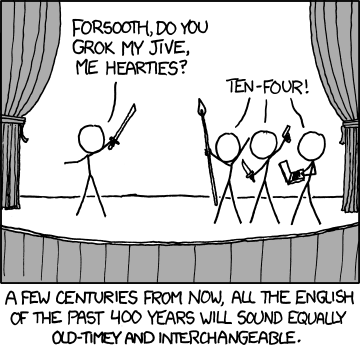
http://xkcd.com/771/
I am amused.
Anyhow, if several centuries of the evolution of the English language can be jumbled together in the modern consciousness, the scenario below is perfectly plausible, given the passage of another century or two:
http://xkcd.com/771/
I am amused.
Subscribe to:
Posts (Atom)