Sunday, June 10, 2012

Candy Heart

This is wonderful:


http://scienceroll.com/2007/11/26/anatomical-heart-made-from-candy-hearts/

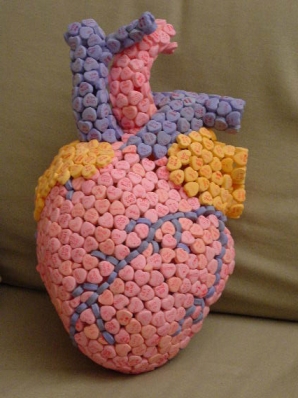
It's a model heart made from (if you can't tell from the picture) those candy hearts with the pink messages on them.

Is it just me, or does anyone else think that this would make a really cute St. Valentine's Day present (especially in the case of broke college students)? (Of course, there's the question of what to do with such an object. If it were made of entirely edible materials, I suppose one could eat it.)

Edit: And here's how to actually make something along these lines (especially with regard to preservation of the specimen) -- http://makeprojects.com/Project/How-to-Preserve-a-Candy-Portrait/395/1#.T9cQ6uLMAys

Saturday, June 9, 2012

R.I.P. Ray Bradbury

He died this week (on the 5th). The New York Times obituary:
http://www.nytimes.com/2012/06/07/books/ray-bradbury-popularizer-of-science-fiction-dies-at-91.html?_r=1&ref=arts&gwh=DAB304701677810DA93A673A1510F1D2

I first learned of it from Neil Gaiman's blog, actually. He was tapped to write a tribute piece in The Guardian, and he paints a beautiful portrait of this science fiction maestro:
http://www.guardian.co.uk/books/2012/jun/06/ray-bradbury-neil-gaiman-appreciation

We all knew that Bradbury was a pioneer of the genre. We all admired his skill, his imagination, his understanding of human nature. This reveals a side of him that, sadly, many of us never encountered -- the genuine, kind human being. People like that are precious.

Here's another:
http://www.bbc.com/future/story/20120608-meeting-the-master-ray-bradbury

I love his devotion to the book as an object (something I'm more than a little afraid that e-readers will kill off), especially seeing as he was a science fiction writer. (I have an e-reader, but I feel the same way about books, which increasingly makes me appear a troglodyte among my peers.) I love his enthusiasm. And of course, as Gaiman so eloquently depicted it, his kindness.

Rest in peace, Mr. Bradbury.

Tuesday, June 5, 2012

BBC: The Japanese Quest for the Perfect Fruit

Asian gifting (and general social niceties) taken to a horticultural extreme:
http://www.bbc.co.uk/news/world-radio-and-tv-17352173

It's an interesting social phenomenon, but seriously, that technology and effort could be put to so much better use! If horticulturalists in Japan had only chosen to attempt, say, breeding better crop plants and alleviating hunger in the developing world, imagine all the good they could be doing. It reminds me a little of the way the Japanese electronics industry developed; for a long time, they were among the most reliable manufacturers of electronics in the world, and yet, they stuck to making things like televisions, and kitchen appliances, and little toy robot things. They innovated, of course, but it was mostly on a small scale -- how to make a better circuit board and the like -- rather than dreaming big, as big as they could have. And now, given the way the Japanese economy's looking, it might be just a little too late.

Anyhow, I don't know how that turned from "look at this interesting, slightly ridiculous cultural quirk" to "let's solve all the world's problems." But -- just look at all those melons in a row!

Saturday, June 2, 2012

The Oven Bird (by Robert Frost)

I'm taking a Poetry and Poetics course this quarter, and I just finished writing a paper on this particular Frost poem. I'd never read it before this class, but I've come to really like it. (That's the funny thing about papers/assignments; by the end, you come to either love or hate whatever it is you've been working on.) Anyhow, I thought I'd share:

The Oven Bird
by Robert Frost (1916)

There is a singer everyone has heard,
Loud, a mid-summer and a mid-wood bird,
Who makes the solid tree trunks sound again.
He says that leaves are old and that for flowers
Mid-summer is to spring as one to ten.
He says the early petal-fall is past
When pear and cherry bloom went down in showers
On sunny days a moment overcast;
And comes that other fall we name the fall.
He says the highway dust is over all.
The bird would cease and be as other birds
But that he knows in singing not to sing.
The question that he frames in all but words
Is what to make of a diminished thing.

Frost, here, is lamenting the end of an era, which I thought was eminently appropriate to our impending graduation. (Does putting it in writing make it real?) Perhaps that's why the poem resonated with me so, more so than it might have at another point in my life. I know well that Frost is writing about being a middle-aged poet, thinking he's past his prime or being eclipsed by the younger generation of more experimental contemporary poets, but it's a similar sentiment. There's this sinking feeling that accompanies the idea of leaving the Stanford bubble, of being a continent away from the people I've come to know and love. It does feel like the best few years of my life might be slipping through my fingers -- though of course, I hope I'll do greater things with myself in future. I have regrets, I have anxieties, and I have the deep-seated, overwhelming sense of nostalgia for a passing age that Frost portrays so well in "The Oven Bird."