If you're a bibliophile like I am, you might have noticed that the endpapers of hardcover editions usually include a note about the typefaces used in the book. (For a more general layman's overview of the history of typography, I recommend the book Just My Type by Simon Garfield.) While the origin stories of typefaces might seem a relatively dry topic, they sometimes make for fascinating tales of adventure and intrigue. To wit, that of the Doves Type, one of the most influential typefaces of the past couple of centuries:
http://creativereview.co.uk/cr-blog/2015/february/recovering-the-doves-type
The improbable saga of their recovery seems like something straight out of a Sherlock Holmes novel! (If compelled to choose one, I'd compare it to The Sign of the Four.) But it's the ending that strikes me; after such a journey, the "treasure hunter" and type designer Robert Green notes that he'll never sell the portion of the typeface that he kept for himself, saying, "It’s too precious. I feel very attached to it now I’ve retraced Cobden-Sanderson’s steps and stood on that very same spot of the bridge." I can sympathize with a sentimental attachment to a piece of history that becomes an obsession! It's fundamentally human to assign value to artifacts of culture, even those that seem a small and incidental portion of a more significant work.
Showing posts with label art history. Show all posts
Showing posts with label art history. Show all posts
Sunday, March 22, 2015


Monday, October 14, 2013
Knights vs. Snail in Medieval England
A whimsical curiosity from the British Library's medieval manuscripts blog (the librarians post some fascinating stuff -- the rest of the blog is definitely worth a peek too):
http://britishlibrary.typepad.co.uk/digitisedmanuscripts/2013/09/knight-v-snail.html
The motif of knights fighting giant snails is apparently quite common in medieval illuminated manuscripts, though nobody knows why, or what it was supposed to have signified. (There's even snail jousting! And monkeys!) Was it all just marginalia? Bored monks -- who were only human, after all -- having a bit of fun with their transcription? Did snails moonlight as agents of Satan when not making nuisances of themselves in the monastery vegetable patches? Even among the eminent scholars at the British Library, nobody knows.
While the world of medieval archivists puzzles over this mystery, the rest of us get some Easter eggs in our manuscripts. Happy Monday, everyone!
http://britishlibrary.typepad.co.uk/digitisedmanuscripts/2013/09/knight-v-snail.html
The motif of knights fighting giant snails is apparently quite common in medieval illuminated manuscripts, though nobody knows why, or what it was supposed to have signified. (There's even snail jousting! And monkeys!) Was it all just marginalia? Bored monks -- who were only human, after all -- having a bit of fun with their transcription? Did snails moonlight as agents of Satan when not making nuisances of themselves in the monastery vegetable patches? Even among the eminent scholars at the British Library, nobody knows.
While the world of medieval archivists puzzles over this mystery, the rest of us get some Easter eggs in our manuscripts. Happy Monday, everyone!
Friday, March 15, 2013
The Economist: Piero della Francesca at the Frick
I saw this article about the Piero della Francesca exhibition at the Frick, and went to see it over the weekend:
http://www.economist.com/news/books-and-arts/21571857-introducing-early-renaissance-master-american-audiences-divine-splendour
The show is well worth seeing, though I admit to being somewhat biased because I'm a fan of the Frick. It's one of those small, very specifically curated museums that a visitor can see in its entirety in just a few hours. It's worth visiting more than once if you live in New York, though -- there are always a few special installations (often pieces on loan from other countries, such as the above) -- and it's the sort of place one visits to soak in the ambiance. It has this beautiful central courtyard vaguely reminiscent of the villas of Classical Rome (covered, though), and a few surprisingly well-known works, including some lesser-known works of rather famous artists.
Anyhow, the Piero della Francesca exhibit. If you're at all interested in Renaissance art history, and you're in the City, go see it.
http://www.economist.com/news/books-and-arts/21571857-introducing-early-renaissance-master-american-audiences-divine-splendour
The show is well worth seeing, though I admit to being somewhat biased because I'm a fan of the Frick. It's one of those small, very specifically curated museums that a visitor can see in its entirety in just a few hours. It's worth visiting more than once if you live in New York, though -- there are always a few special installations (often pieces on loan from other countries, such as the above) -- and it's the sort of place one visits to soak in the ambiance. It has this beautiful central courtyard vaguely reminiscent of the villas of Classical Rome (covered, though), and a few surprisingly well-known works, including some lesser-known works of rather famous artists.
Anyhow, the Piero della Francesca exhibit. If you're at all interested in Renaissance art history, and you're in the City, go see it.
Sunday, November 18, 2012
A Dispatch from the Garret (a.k.a. NaNoWriMo 2012)
As most of you know -- and if you didn't before, you probably noticed the widget in the sidebar here -- I'm doing NaNoWriMo again this year.
This is my first time really doing NaNoWriMo in New York. My first two years of it were during high school, which I attended here in the City, but this is the first year in which I'm really participating in the community and its range of social activities (mostly meeting other writers and pounding away at our laptops in coffeeshops, which is actually social in a weird way). It's been a lot of fun -- I hope the community doesn't dissolve after November, which I'm told often happens. I hope to make some friends by the end of this.
I'm also quite excited about my novel. I'm trying something new this year. I've done a lot of fantasy novels of various stripes; this year's is historical fiction, which entails a lot of research. I didn't do nearly enough before the month started, as I realized by the second week or so; I expect to spend quite a bit of time the next few months reading up on the construction of early Gothic cathedrals, and British evacuees during the Blitzkrieg, and the inner workings of art museums. I can't wait! I've got this lovely old textbook on medieval English sculpture waiting on my desk.
And so, back to writing. (I'm already behind!)
This is my first time really doing NaNoWriMo in New York. My first two years of it were during high school, which I attended here in the City, but this is the first year in which I'm really participating in the community and its range of social activities (mostly meeting other writers and pounding away at our laptops in coffeeshops, which is actually social in a weird way). It's been a lot of fun -- I hope the community doesn't dissolve after November, which I'm told often happens. I hope to make some friends by the end of this.
I'm also quite excited about my novel. I'm trying something new this year. I've done a lot of fantasy novels of various stripes; this year's is historical fiction, which entails a lot of research. I didn't do nearly enough before the month started, as I realized by the second week or so; I expect to spend quite a bit of time the next few months reading up on the construction of early Gothic cathedrals, and British evacuees during the Blitzkrieg, and the inner workings of art museums. I can't wait! I've got this lovely old textbook on medieval English sculpture waiting on my desk.
And so, back to writing. (I'm already behind!)
Thursday, December 29, 2011
NYTimes: Medieval Chess Sets at the Cloister
These look really awesome:
http://www.nytimes.com/2011/11/18/arts/design/the-game-of-kings-medieval-ivory-chessmen-from-the-isle-of-lewis-at-the-cloisters.html?_r=1&src=dayp
I'm in New York for another week or so. Anyone want to go see them with me?
Edit: I didn't actually end up going (I'm coming home for spring break, though!), but I was reading the exhibit blog, which is fascinating.
http://metmuseum.org/exhibitions/listings/2011/the-game-of-kings-medieval-ivory-chessmen-from-the-isle-of-lewis/exhibition-blog
http://www.nytimes.com/2011/11/18/arts/design/the-game-of-kings-medieval-ivory-chessmen-from-the-isle-of-lewis-at-the-cloisters.html?_r=1&src=dayp
I'm in New York for another week or so. Anyone want to go see them with me?
Edit: I didn't actually end up going (I'm coming home for spring break, though!), but I was reading the exhibit blog, which is fascinating.
http://metmuseum.org/exhibitions/listings/2011/the-game-of-kings-medieval-ivory-chessmen-from-the-isle-of-lewis/exhibition-blog
Wednesday, October 26, 2011
io9: Vegetable Orchestra
A strange, wonderful idea:
http://io9.com/5817756/vegetable-orchestra-grow-your-own-guitar
It takes some imagination to come up with such a thing -- it sounds like something out of a children's book, or a Greek myth. It reminds me of those Giuseppe Arcimboldo paintings of vegetable men, like this one, which I believe is one of his most famous:
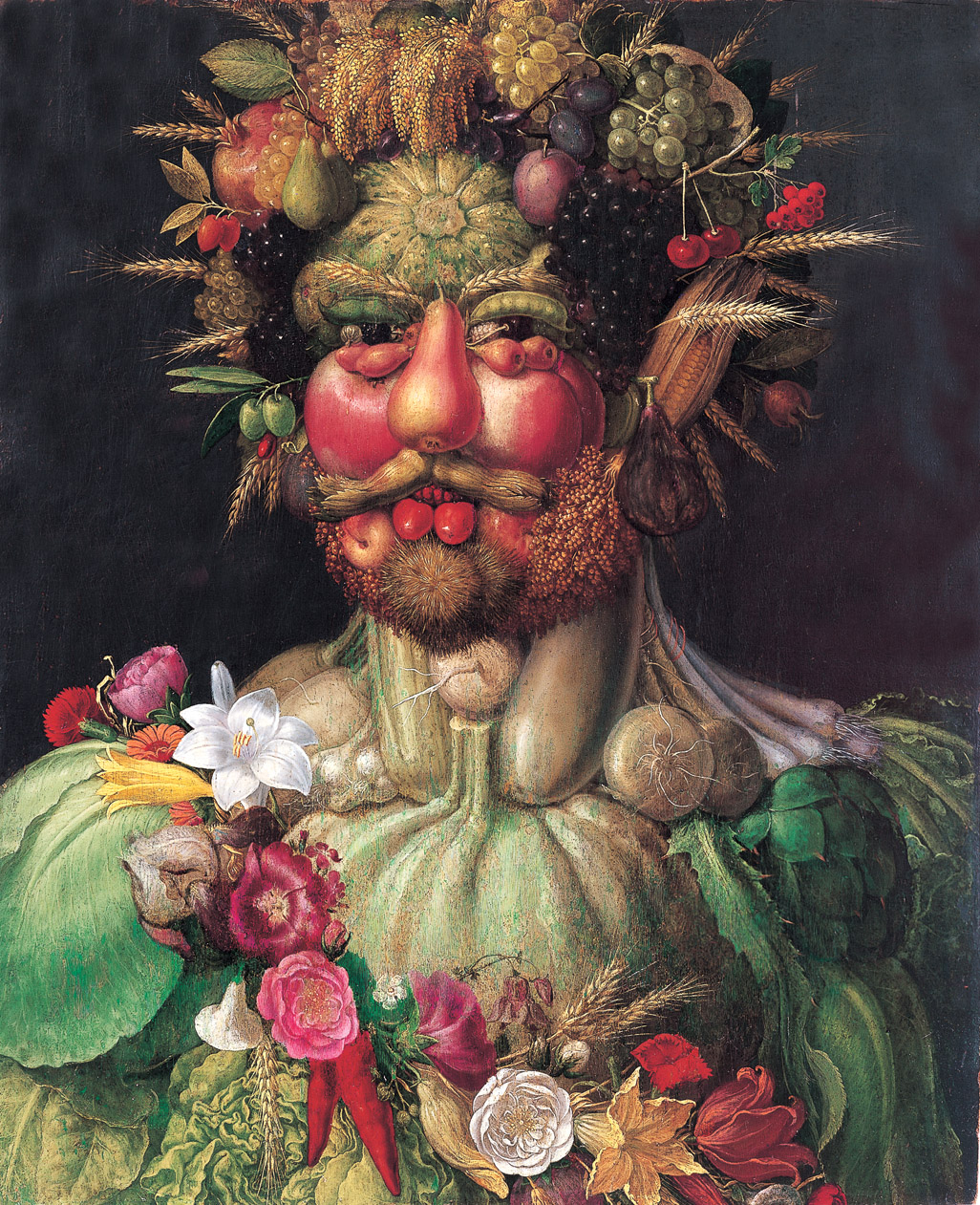
I kind of want to make a vegetable instrument (though I imagine it's much harder than it looks). Another experiment to try in our kitchen, perhaps?
http://io9.com/5817756/vegetable-orchestra-grow-your-own-guitar
It takes some imagination to come up with such a thing -- it sounds like something out of a children's book, or a Greek myth. It reminds me of those Giuseppe Arcimboldo paintings of vegetable men, like this one, which I believe is one of his most famous:
I kind of want to make a vegetable instrument (though I imagine it's much harder than it looks). Another experiment to try in our kitchen, perhaps?
Thursday, June 9, 2011
Finals are over!
An eminently appropriate HistoricLOL:

All I have left is packing, storage, things of that nature. I'm flying home on Friday.

All I have left is packing, storage, things of that nature. I'm flying home on Friday.
Friday, February 18, 2011
The Google Art Project
My sister sent this to me last week, and it's just about the coolest thing I've seen in a while (yes, I'm a museum geek):
http://maps.google.com/maps?
An article about it (from The Atlantic):
http://www.theatlantic.com/technology/archive/2011/02/the-google-art-project-makes-masterpieces-accessible-to-all/70634/
Basically, it's bringing Google Maps Street View into some of the world's most famous and amazing museums. How awesome is that?
http://maps.google.com/maps?
An article about it (from The Atlantic):
http://www.theatlantic.com/technology/archive/2011/02/the-google-art-project-makes-masterpieces-accessible-to-all/70634/
Basically, it's bringing Google Maps Street View into some of the world's most famous and amazing museums. How awesome is that?
Saturday, January 15, 2011
The Original Snuggies
This is, of course, Raphael's "The School of Athens". I have a photograph of the original in its entirety in an earlier post. The speakers depicted are Plato and Aristotle, which makes it even better.
Friday, December 3, 2010
NYTimes: Pompeii -- Archaeologists' Dream, Conservationists' Failure
And now, back to our regularly scheduled programming:
This is scary. Really scary. For a historian and a (lapsed) Latin student, and an avid museum-goer, the idea of such artifacts, such a goldmine of Roman archaeology, being destroyed simply because of human incompetence and negligence, is a travesty:
http://artsbeat.blogs.nytimes.com/2010/11/30/another-collapse-at-pompeii-renews-calls-for-better-care
I want to go to Pompeii sometime. I've never been, and I hope that by the time the opportunity arises, it won't be too late.
This is scary. Really scary. For a historian and a (lapsed) Latin student, and an avid museum-goer, the idea of such artifacts, such a goldmine of Roman archaeology, being destroyed simply because of human incompetence and negligence, is a travesty:
http://artsbeat.blogs.nytimes.com/2010/11/30/another-collapse-at-pompeii-renews-calls-for-better-care
I want to go to Pompeii sometime. I've never been, and I hope that by the time the opportunity arises, it won't be too late.
Tuesday, September 14, 2010
Italy Travelogue, Part 3: Vatican City
If you're ever in Rome, the Vatican is definitely worth seeing. It'll take a day, at least, but do go. It's chock-full of centuries of artwork and architecture, and not all of it is Catholic; some of the most famous classical sculptures are there. The pièce de résistance, of course, is the Sistine Chapel; disappointingly, but understandably, we were not allowed to photograph it. We did take pictures of lots of other things...
The Vatican Museums are home to some of the greatest artistic treasures in the world. Exhibit A -- Here's the marble of Laocoön and sons being strangled by Athena's sea serpents, the one that Pliny the Elder wrote about (Yes, I took Latin in high school, why do you ask?), one of the most celebrated statues from antiquity:

The story goes, Laocoön was a Trojan priest of Poseidon, who was in Poseidon's bad books because he took a wife and sired children (this is relevant only because his terrible luck and grisly death is sometimes attributed to the god's displeasure). Anyhow, he was one of the few Trojans who suspected that the Trojan horse was a ruse, and proposed that they set it on fire. Athena summoned a pair of giant snakes to strangle him and his sons. The Trojans then assumed that the horse was sacred (and that anyone who dared to harm it would meet a similarly nasty end), and so they brought the horse into Troy. I'm not sure who had it worse, Laocoön or Cassandra.
We also saw Raphael's even more famous The School of Athens:

This is often considered to be not only Raphael's finest piece, but also the very spirit of the Renaissance in painted form. The term itself, "Renaissance", means "rebirth", and the great artists and thinkers of the Renaissance felt a deep intellectual kinship with their Greco-Roman peers. It is only fitting that the spirit of the era is captured as Greek institution.
I had fun squinting up at it and trying to identify all the people in the painting, but I didn't get very far. The two figures in the middle (under the central arch) are Plato and Aristotle, in the red and blue mantles, respectively. Plato is supposed to be modeled on Leonardo da Vinci (and with that beard, I can see the resemblance). Michelangelo is in the middle on the bottom step (purple shirt and red pants, with his elbow on a box, looking bored), as a Greek painter (what else) of some importance. Raphael painted himself in, too, though I didn't find him until we got home. He's in the upper right, where the bottom of the arch meets the top of the pillar, next to the old man in the green cloak (he's wearing red and purple, too).
Fast-forwarding several centuries in art history, we come to Canova's Perseus, who is depicted in the style of the classical hero (read: naked), holding up the head of his slain foe (Medusa). Here he is:

I thought he looked rather familiar, and that's because he is. Canova made another Perseus, which is almost identical, and that one resides in the Metropolitan Museum of Art, so I've seen it before.
Canova's Perseus is one of the few post-Renaissance marbles to be exhibited so prominently in the Vatican Museums, and rightly so. He sculpted Perseus in the tail end of the Baroque era, when everything was excessively embellished (to the point of seeming nauseatingly garish), and manages to capture the hero triumphant, simple and clothed in little besides his own achievement.
The Vatican Museums also house a collection of artifacts of non-European antiquity. They have an excellent Egyptian wing, and also one with Near Eastern art. My sister and I were much amused to find, in the Assyrian section, this piece:

It's Birdman! (My sister is a better bird(wo)man than I am, I know; I have a terrible poker face.)
It's one of many long-standing points of reference for us. She currently attends the same middle school I did, and one of our favorite teachers is the inimitable Ms. Springer, archaeologist and historian extraordinare, who taught us sixth grade history. (She did a wonderful job of it, too; I was immensely surprised to find, in my Ancient Empires course reader, a passage from "Wen-Amon Goes to Phoenicia", which we read in sixth grade.)
Birdman was one of the most memorable characters from our Assyria unit. I still remember taking a field trip to the Met to see him; I thought he was enormous, back then. I spotted him in the Vatican all these years later, and we couldn't resist.
Of course, no trip to the Vatican is complete without a visit to St. Peter's Basilica. The lines were not as terrible as we'd feared (thank goodness!), and the inside was every bit as spectacularly grand as we'd imagined. I made a beeline for Michelangelo's most famous Pietà:

You'll have to click on it to get a closer view, and even then, it's still quite small; I was pressed up against the plexiglas wall, but I was still about a dozen feet away from it. Apparently, some crazy person tried to attack it with a hammer, and ended up chipping off Mary's nose, and so they won't let anyone get anywhere near it anymore. (Something similar happened to the David (who lost a few toes), and so there's a plexiglas shield around him, too.)
One of the first things anyone notices about the work is that Mary looks incredibly young. There's some debate about why this is; we know that Michelangelo made her deliberately so. Some say that it's an indication of her purity and favor with God; others say that she's actually supposed to be a young mother, and that she's holding her baby and having a premonition of her son's fate.
On the subject of Pietàs, I edited the Florence part to include some pictures from the Museo dell'Opera del Duomo that I oddly couldn't find the first time around, so scroll down if you're interested in one of Michelangelo's other Pietàs.
Well, that's Italy. It was a lot of fun (and a historian/erstwhile Latin student's dream). There was plenty we didn't get to see this time around, so I'd definitely want to go back sometime in the future!
The Vatican Museums are home to some of the greatest artistic treasures in the world. Exhibit A -- Here's the marble of Laocoön and sons being strangled by Athena's sea serpents, the one that Pliny the Elder wrote about (Yes, I took Latin in high school, why do you ask?), one of the most celebrated statues from antiquity:

The story goes, Laocoön was a Trojan priest of Poseidon, who was in Poseidon's bad books because he took a wife and sired children (this is relevant only because his terrible luck and grisly death is sometimes attributed to the god's displeasure). Anyhow, he was one of the few Trojans who suspected that the Trojan horse was a ruse, and proposed that they set it on fire. Athena summoned a pair of giant snakes to strangle him and his sons. The Trojans then assumed that the horse was sacred (and that anyone who dared to harm it would meet a similarly nasty end), and so they brought the horse into Troy. I'm not sure who had it worse, Laocoön or Cassandra.
We also saw Raphael's even more famous The School of Athens:

This is often considered to be not only Raphael's finest piece, but also the very spirit of the Renaissance in painted form. The term itself, "Renaissance", means "rebirth", and the great artists and thinkers of the Renaissance felt a deep intellectual kinship with their Greco-Roman peers. It is only fitting that the spirit of the era is captured as Greek institution.
I had fun squinting up at it and trying to identify all the people in the painting, but I didn't get very far. The two figures in the middle (under the central arch) are Plato and Aristotle, in the red and blue mantles, respectively. Plato is supposed to be modeled on Leonardo da Vinci (and with that beard, I can see the resemblance). Michelangelo is in the middle on the bottom step (purple shirt and red pants, with his elbow on a box, looking bored), as a Greek painter (what else) of some importance. Raphael painted himself in, too, though I didn't find him until we got home. He's in the upper right, where the bottom of the arch meets the top of the pillar, next to the old man in the green cloak (he's wearing red and purple, too).
Fast-forwarding several centuries in art history, we come to Canova's Perseus, who is depicted in the style of the classical hero (read: naked), holding up the head of his slain foe (Medusa). Here he is:

I thought he looked rather familiar, and that's because he is. Canova made another Perseus, which is almost identical, and that one resides in the Metropolitan Museum of Art, so I've seen it before.
Canova's Perseus is one of the few post-Renaissance marbles to be exhibited so prominently in the Vatican Museums, and rightly so. He sculpted Perseus in the tail end of the Baroque era, when everything was excessively embellished (to the point of seeming nauseatingly garish), and manages to capture the hero triumphant, simple and clothed in little besides his own achievement.
The Vatican Museums also house a collection of artifacts of non-European antiquity. They have an excellent Egyptian wing, and also one with Near Eastern art. My sister and I were much amused to find, in the Assyrian section, this piece:

It's Birdman! (My sister is a better bird(wo)man than I am, I know; I have a terrible poker face.)
It's one of many long-standing points of reference for us. She currently attends the same middle school I did, and one of our favorite teachers is the inimitable Ms. Springer, archaeologist and historian extraordinare, who taught us sixth grade history. (She did a wonderful job of it, too; I was immensely surprised to find, in my Ancient Empires course reader, a passage from "Wen-Amon Goes to Phoenicia", which we read in sixth grade.)
Birdman was one of the most memorable characters from our Assyria unit. I still remember taking a field trip to the Met to see him; I thought he was enormous, back then. I spotted him in the Vatican all these years later, and we couldn't resist.
Of course, no trip to the Vatican is complete without a visit to St. Peter's Basilica. The lines were not as terrible as we'd feared (thank goodness!), and the inside was every bit as spectacularly grand as we'd imagined. I made a beeline for Michelangelo's most famous Pietà:

You'll have to click on it to get a closer view, and even then, it's still quite small; I was pressed up against the plexiglas wall, but I was still about a dozen feet away from it. Apparently, some crazy person tried to attack it with a hammer, and ended up chipping off Mary's nose, and so they won't let anyone get anywhere near it anymore. (Something similar happened to the David (who lost a few toes), and so there's a plexiglas shield around him, too.)
One of the first things anyone notices about the work is that Mary looks incredibly young. There's some debate about why this is; we know that Michelangelo made her deliberately so. Some say that it's an indication of her purity and favor with God; others say that she's actually supposed to be a young mother, and that she's holding her baby and having a premonition of her son's fate.
On the subject of Pietàs, I edited the Florence part to include some pictures from the Museo dell'Opera del Duomo that I oddly couldn't find the first time around, so scroll down if you're interested in one of Michelangelo's other Pietàs.
Well, that's Italy. It was a lot of fun (and a historian/erstwhile Latin student's dream). There was plenty we didn't get to see this time around, so I'd definitely want to go back sometime in the future!
Monday, September 13, 2010
Italy Travelogue, Part 2: Rome
Rome is big. Not quite as big as New York (what is?), but after Florence, Rome seemed huge. Of course, it was the place to be (in Europe, at least) for several centuries, way before any of the other major metropolises even existed. We procured four Roma Passes, which are designed for tourists and include discounts to major attractions (museum tickets are expensive!) and free public transit, valid for three consecutive days.
Four days in Rome was definitely not enough (especially since one of them was spent outside of Rome, technically, in the Vatican). Unlike Florence, which rose to prominence in the Middle Ages, Rome was the center of a vast empire in antiquity, and has several millennia of history on Florence. (Huzzah for Ancient Empires!)
The afternoon we get there, I drag them to see the Pantheon. (I'm a sucker for Greco-Roman mythology, but this one's really worth seeing.) It also houses the work of several Renaissance masters, as well as several of their graves, most notably that of Raphael. This is an interior view of its dome:

The Romans were really architectural geniuses, given their level of technology. It's incredible that the Pantheon survived several regime changes and wars. Of course, one of the reasons it wasn't quarried for marble or anything was that it was converted to a church in honor of the Virgin Mary and assorted Christian martyrs. It stands in stark contrast to many of the temples in the Roman Forum (dating from the days of the Republic) and the later Imperial fora; most of those now lie in ruins, much of their marble facing carted off to adorn other facades. Even so, the Roman Forum is well worth seeing. Here is a photograph of the Temple of Romulus:

This was one of the most intact of the temples in the Forum (and indeed, in all of Rome), mostly because it was converted to a church, that of the saints Cosmas and Damian, two Greek brothers, to stand in stark contrast to the Temple of Castor and Pollux, also in the Forum. This is, unfortunately, all that's left of the latter:

Freestanding monuments and buildings not constructed of marble were also generally in better repair; take, for instance, this photograph of the northwestern corner of the Forum:

In the middle of the picture is the Arch of Septimus Severus, commemorating the emperor's victories against the Parthians. He was a strong leader and a military man, which was good for Rome, given the corruption and political disunity of the preceding reigns. He also sponsored numerous public works, among which were several arches like this one.
The brownish building on the right (the one with three windows above its main entrance) is the Curia Julia, the Senate building built by (somewhat ironically) Julius Caesar. (He never saw it in its current form, as it was completed during the reign of Augustus.) The height of its ceiling is particularly impressive from the inside.
While I'm at it, here's another Augustan monument:

My sister and I are standing in front of the Ara Pacis (English: Altar of Peace). It was built by the Senate on the occasion of Augustus's subjugation of Gaul and Hispania, to celebrate the Pax Augusta, the peace that the emperor brought about by uniting various far-flung European peoples under imperial rule. My father, when I explained the altar's history, aptly remarked that Augustus was rather like the first Qin (秦) Emperor of China, Qin Shi Huang (秦始皇), who unified China. (Personally, I think Augustus was a lot friendlier. Also, Augustus's overall geopolitical achievement was probably somewhat less impressive, given that he was building upon Julius Caesar's successful military campaigns, whereas the Qin Emperor had to conquer the other six Chinese states, which were more or less equal in power to his at the start of his campaigns. Not to say that Augustus wasn't awesome, because he was.)
We also spent an afternoon at the Capitoline Museum, where there is a great glass-roofed hall housing some remarkable and historic bronzes. This one is the very famous equestrian statue of Marcus Aurelius, the only such statue of a pre-Christian emperor still in existence. It survived the Christian fanaticism of the Middle Ages mainly because it was thought to depict the Christian Constantine; this sort of imperial statue was quite common in the Roman Empire, but all the others were melted down.

It's greenish because it used to be prominently displayed on a pedestal outdoors, but then people moved it inside and put up a replica instead, because of precipitation damage.
This one, from the same hall, is the equally well-known bronze of the Capitoline Wolf, with Romulus and Remus as suckling infants:

Its origins are still uncertain, with some art historians contending that the wolf was first cast in the Etruscan era and others (a minority) arguing that it was made in the 13th century (both parties agree that the twins were a later addition). Either way, it's an iconic sculpture in the modern consciousness, where Rome is concerned.
This is getting ridiculously long. I'll write a third post on the Vatican, and lump in the Renaissance stuff with it. Stay tuned for travelogue part 3!
Four days in Rome was definitely not enough (especially since one of them was spent outside of Rome, technically, in the Vatican). Unlike Florence, which rose to prominence in the Middle Ages, Rome was the center of a vast empire in antiquity, and has several millennia of history on Florence. (Huzzah for Ancient Empires!)
The afternoon we get there, I drag them to see the Pantheon. (I'm a sucker for Greco-Roman mythology, but this one's really worth seeing.) It also houses the work of several Renaissance masters, as well as several of their graves, most notably that of Raphael. This is an interior view of its dome:

The Romans were really architectural geniuses, given their level of technology. It's incredible that the Pantheon survived several regime changes and wars. Of course, one of the reasons it wasn't quarried for marble or anything was that it was converted to a church in honor of the Virgin Mary and assorted Christian martyrs. It stands in stark contrast to many of the temples in the Roman Forum (dating from the days of the Republic) and the later Imperial fora; most of those now lie in ruins, much of their marble facing carted off to adorn other facades. Even so, the Roman Forum is well worth seeing. Here is a photograph of the Temple of Romulus:

This was one of the most intact of the temples in the Forum (and indeed, in all of Rome), mostly because it was converted to a church, that of the saints Cosmas and Damian, two Greek brothers, to stand in stark contrast to the Temple of Castor and Pollux, also in the Forum. This is, unfortunately, all that's left of the latter:

Freestanding monuments and buildings not constructed of marble were also generally in better repair; take, for instance, this photograph of the northwestern corner of the Forum:

In the middle of the picture is the Arch of Septimus Severus, commemorating the emperor's victories against the Parthians. He was a strong leader and a military man, which was good for Rome, given the corruption and political disunity of the preceding reigns. He also sponsored numerous public works, among which were several arches like this one.
The brownish building on the right (the one with three windows above its main entrance) is the Curia Julia, the Senate building built by (somewhat ironically) Julius Caesar. (He never saw it in its current form, as it was completed during the reign of Augustus.) The height of its ceiling is particularly impressive from the inside.
While I'm at it, here's another Augustan monument:

My sister and I are standing in front of the Ara Pacis (English: Altar of Peace). It was built by the Senate on the occasion of Augustus's subjugation of Gaul and Hispania, to celebrate the Pax Augusta, the peace that the emperor brought about by uniting various far-flung European peoples under imperial rule. My father, when I explained the altar's history, aptly remarked that Augustus was rather like the first Qin (秦) Emperor of China, Qin Shi Huang (秦始皇), who unified China. (Personally, I think Augustus was a lot friendlier. Also, Augustus's overall geopolitical achievement was probably somewhat less impressive, given that he was building upon Julius Caesar's successful military campaigns, whereas the Qin Emperor had to conquer the other six Chinese states, which were more or less equal in power to his at the start of his campaigns. Not to say that Augustus wasn't awesome, because he was.)
We also spent an afternoon at the Capitoline Museum, where there is a great glass-roofed hall housing some remarkable and historic bronzes. This one is the very famous equestrian statue of Marcus Aurelius, the only such statue of a pre-Christian emperor still in existence. It survived the Christian fanaticism of the Middle Ages mainly because it was thought to depict the Christian Constantine; this sort of imperial statue was quite common in the Roman Empire, but all the others were melted down.

It's greenish because it used to be prominently displayed on a pedestal outdoors, but then people moved it inside and put up a replica instead, because of precipitation damage.
This one, from the same hall, is the equally well-known bronze of the Capitoline Wolf, with Romulus and Remus as suckling infants:

Its origins are still uncertain, with some art historians contending that the wolf was first cast in the Etruscan era and others (a minority) arguing that it was made in the 13th century (both parties agree that the twins were a later addition). Either way, it's an iconic sculpture in the modern consciousness, where Rome is concerned.
This is getting ridiculously long. I'll write a third post on the Vatican, and lump in the Renaissance stuff with it. Stay tuned for travelogue part 3!
Saturday, September 11, 2010
Italy Travelogue, Part 1: Florence
I'm back! And as promised, highlights of the first leg of the trip:
Upon arrival in Florence, my father, my sister, and I decide to explore the neighborhood to scope out nearby sources of food and to pick up some essentials at the supermarket. We encounter a strange public service announcement spray-painted on a building. We aren't quite sure what it is all about, so we decide to take it very literally:

Anyhow, on to items of actual historical significance. These are the east doors of the Baptistery of St. John, which Michelangelo famously dubbed "the Gates of Paradise", because they are so beautiful. (They're actually a faithful replica; the real ones are in restoration.)

The first set of Ghiberti doors was actually commissioned for the north-facing entrance in a competition sponsored by the Florentine guild of wool merchants. He and Filippo Brunelleschi were tied for the commission, but Ghiberti, through sheer persistence (and Brunelleschi's temper didn't help), eventually won out. Brunelleschi swore off sculpture in a fit of spite, and took up architecture and engineering instead (and was astoundingly talented at both); he designed the famous dome of the Florentine cathedral Santa Maria Del Fiore, one of the architectural marvels of the Renaissance:

Further reading on the subject, if you're so inclined: Brunelleschi's Dome, by Ross King. It was an assigned reading for a course I took in freshman year on Renaissance machine design (the system of pulleys, cranes, and other machines that Brunelleschi created in the process of constructing his dome is quite amazing), and it's a wonderful (and short) read on its own.
We also went to the Museo dell Opera del Duomo, where the real Gates of Paradise are currently housed. That particular museum is a treasure trove of amazing works by famous Renaissance masters. Among them is the understated, somewhat mysterious Magdalene Penitent by Donatello:

It's most striking, methinks, in its depth of emotion. She's not particularly beautiful, but she's wonderfully tragic.
Also in the Museo dell Opera del Duomo is the second-most famous Michelangelo Pietà, where instead of the Virgin Mary (as is customary), he depicts Joseph of Arimathea holding the body of Jesus:

It's believed that this Joseph was actually a self-portrait; Michelangelo originally intended this sculpture to be placed at his own gravesite. It's beautiful, and unlike many of the other really famous masterpieces, there isn't any plexiglas or a ten-foot fence, so we could walk right up to it to admire it.
We saw a lot of other things, too, like the David (I trust you don't need another picture of him) and some of the Medici palaces and private chapels (some of these restricted photography, to preserve the artwork). Florence basically belonged to the Medicis during the Renaissance, so half the sites in the city from that era were Medici-related in some way.
Florence was smaller than I'd expected; given its prominence during the Renaissance, I had thought it would be much bigger. I'd forgotten that cities in general were smaller back then (comes of being a New Yorker, methinks). We could basically get everywhere on foot -- no public transportation adventures there!
Rome is next.
Upon arrival in Florence, my father, my sister, and I decide to explore the neighborhood to scope out nearby sources of food and to pick up some essentials at the supermarket. We encounter a strange public service announcement spray-painted on a building. We aren't quite sure what it is all about, so we decide to take it very literally:

Anyhow, on to items of actual historical significance. These are the east doors of the Baptistery of St. John, which Michelangelo famously dubbed "the Gates of Paradise", because they are so beautiful. (They're actually a faithful replica; the real ones are in restoration.)

The first set of Ghiberti doors was actually commissioned for the north-facing entrance in a competition sponsored by the Florentine guild of wool merchants. He and Filippo Brunelleschi were tied for the commission, but Ghiberti, through sheer persistence (and Brunelleschi's temper didn't help), eventually won out. Brunelleschi swore off sculpture in a fit of spite, and took up architecture and engineering instead (and was astoundingly talented at both); he designed the famous dome of the Florentine cathedral Santa Maria Del Fiore, one of the architectural marvels of the Renaissance:

Further reading on the subject, if you're so inclined: Brunelleschi's Dome, by Ross King. It was an assigned reading for a course I took in freshman year on Renaissance machine design (the system of pulleys, cranes, and other machines that Brunelleschi created in the process of constructing his dome is quite amazing), and it's a wonderful (and short) read on its own.
We also went to the Museo dell Opera del Duomo, where the real Gates of Paradise are currently housed. That particular museum is a treasure trove of amazing works by famous Renaissance masters. Among them is the understated, somewhat mysterious Magdalene Penitent by Donatello:

It's most striking, methinks, in its depth of emotion. She's not particularly beautiful, but she's wonderfully tragic.
Also in the Museo dell Opera del Duomo is the second-most famous Michelangelo Pietà, where instead of the Virgin Mary (as is customary), he depicts Joseph of Arimathea holding the body of Jesus:

It's believed that this Joseph was actually a self-portrait; Michelangelo originally intended this sculpture to be placed at his own gravesite. It's beautiful, and unlike many of the other really famous masterpieces, there isn't any plexiglas or a ten-foot fence, so we could walk right up to it to admire it.
We saw a lot of other things, too, like the David (I trust you don't need another picture of him) and some of the Medici palaces and private chapels (some of these restricted photography, to preserve the artwork). Florence basically belonged to the Medicis during the Renaissance, so half the sites in the city from that era were Medici-related in some way.
Florence was smaller than I'd expected; given its prominence during the Renaissance, I had thought it would be much bigger. I'd forgotten that cities in general were smaller back then (comes of being a New Yorker, methinks). We could basically get everywhere on foot -- no public transportation adventures there!
Rome is next.
Wednesday, August 11, 2010
NYTimes: Being Short isn't as Bad as You Think It Is
I was very small for most of my minority; those of you who knew me before college undoubtedly remember this. I was consistently both the shortest and skinniest kid in my class throughout middle school. I used to be able to comfortably fit into all sorts of tight spaces, including half-sized lockers, suitcases, dresser drawers, laundry hampers, &c. Needless to say, I was very good at hide and seek.
My parents, however, were understandably concerned, both about my outward appearance and about any psychological conditions that might have arisen, perhaps from poor self-esteem or ridicule by my peers. (I was admittedly a very odd child regardless, so I wasn't particularly affected by my classmates' opinions of me.)
Anyhow, this article ought to alleviate most of their concerns. Not to mention that I'm a very normal 5'4" (and a bit more on good days) nowadays, so this is all in the past. Mostly. I have way too many friends who are 5'10" and up (though they're mostly boys, so perhaps it's not as relevant).
http://www.nytimes.com/2010/05/11/health/11brod.html?src=me&ref=health
Some of the most interesting and influential people in history have been very short. Here are two partial lists of famous short people; they include some of the world's most awesome people, such as Beethoven, Napoleon, Faulkner, F. Scott Fitzgerald, Keats, Tolkien, Genghis Khan, Gandhi, Voltaire, Picasso, and James Madison. What a list!
http://www.tallmenshoes.com/heoffashpe.html
http://www.buzzle.com/articles/famous-short-people.html
My parents, however, were understandably concerned, both about my outward appearance and about any psychological conditions that might have arisen, perhaps from poor self-esteem or ridicule by my peers. (I was admittedly a very odd child regardless, so I wasn't particularly affected by my classmates' opinions of me.)
Anyhow, this article ought to alleviate most of their concerns. Not to mention that I'm a very normal 5'4" (and a bit more on good days) nowadays, so this is all in the past. Mostly. I have way too many friends who are 5'10" and up (though they're mostly boys, so perhaps it's not as relevant).
http://www.nytimes.com/2010/05/11/health/11brod.html?src=me&ref=health
Some of the most interesting and influential people in history have been very short. Here are two partial lists of famous short people; they include some of the world's most awesome people, such as Beethoven, Napoleon, Faulkner, F. Scott Fitzgerald, Keats, Tolkien, Genghis Khan, Gandhi, Voltaire, Picasso, and James Madison. What a list!
http://www.tallmenshoes.com/heoffashpe.html
http://www.buzzle.com/articles/famous-short-people.html
Thursday, August 5, 2010
Having an O'Keefe Moment...
I have wonderful friends (Amy and Cindy) who decided that the perfect joint (with Weily) early birthday celebration would be a picnic in Central Park, and the perfect gifts would include adorable cards and this stunning rose:

It is even more beautiful in real life; the orange-ish bits are actually a jewel-shade of magenta.
You guys are the best! Thank you!

It is even more beautiful in real life; the orange-ish bits are actually a jewel-shade of magenta.
You guys are the best! Thank you!
Friday, July 16, 2010
Phiala's String Page
For all the computer scientists of my acquaintance, this has nothing to do with the sort of strings you guys know. This is a great page on medieval fiber arts:
http://www.stringpage.com
I've done a bit of tablet weaving, and quite a bit of braiding, and have ambitions to try some of the other types of weaving, &c. on the page. I also knit, but that's almost out of period, having originated in its recognizable form around the Renaissance, I believe.
http://www.stringpage.com
I've done a bit of tablet weaving, and quite a bit of braiding, and have ambitions to try some of the other types of weaving, &c. on the page. I also knit, but that's almost out of period, having originated in its recognizable form around the Renaissance, I believe.
Thursday, July 1, 2010
NYTimes: Hitler's Art Collection
Hitler: dictator, mass murderer, sociopath, art collector.
http://www.nytimes.com/2010/05/19/arts/design/19abroad.html?hpw
The story goes: if he hadn't been rejected from art school, the Holocaust might not have happened. His racial politics were in part fueled by his distorted perception of art history. The Jews, in particular, did not have much of a tradition of visual art, given their religious proscription of graven images.
Ironic, perhaps?
http://www.nytimes.com/2010/05/19/arts/design/19abroad.html?hpw
The story goes: if he hadn't been rejected from art school, the Holocaust might not have happened. His racial politics were in part fueled by his distorted perception of art history. The Jews, in particular, did not have much of a tradition of visual art, given their religious proscription of graven images.
Ironic, perhaps?
Saturday, June 26, 2010
Romantic Gardens Exhibit at the Morgan Museum
I do believe I've mentioned the Morgan Museum before. It was the private estate of the millionaire banker J. P. Morgan before he bequeathed it, in his will, unto the people of New York as a museum. It always has interesting exhibits, even though it's much smaller than, say, the Met. There's one in particular that's showing this summer, that I especially want to see. It's on the landscaping and outdoor architecture of manor estates during the Romantic period:
http://www.themorgan.org/exhibitions/exhibition.asp?id=27
http://www.themorgan.org/exhibitions/exhibition.asp?id=27
Wednesday, June 2, 2010
Historic LOLs
LOLcats for history buffs:
http://historiclols.cheezburger.com
I think it's wonderfully funny. Your mileage may vary.
(Yes, I'm in a bit of a LOLcats mood.)
http://historiclols.cheezburger.com
I think it's wonderfully funny. Your mileage may vary.
(Yes, I'm in a bit of a LOLcats mood.)
Friday, May 28, 2010
BBC: The Seine, a Memoir
Historically, most of the world's greatest cities were built on rivers, for the many obvious (and often life-sustaining) benefits a river contributes to any settlement. Rivers are colorful backdrops, facilitators, and even participants in major historical events. Here is a modern perspective on one of the most important rivers in the world, the Seine:
http://news.bbc.co.uk/2/hi/programmes/from_our_own_correspondent/8695476.stm
http://news.bbc.co.uk/2/hi/programmes/from_our_own_correspondent/8695476.stm
Subscribe to:
Posts (Atom)