It's 2014, and I haven't posted fifty-two covers yet... so I figured I'd just keep making these videos! This one's belatedly holiday-themed...
http://youtu.be/eHQxDfC39BY
Also, given the previous post, I thought it rather appropriate. :-)
Showing posts with label theater. Show all posts
Showing posts with label theater. Show all posts
Monday, January 27, 2014


Thursday, January 23, 2014
La Bohème at the Met Opera!
A few friends and I got rush tickets to the Metropolitan Opera's production of La Bohème yesterday. I've never seen it live before (even though I have three different recordings on my computer). It was absolutely worth the experience; the show was spectacular. I can't believe what I've been missing. (Rodolfo's character, especially, tugs at my heartstrings.)
It's always interesting listening to music with lyrics in a language I don't know, because so much more of my understanding depends on the vocalists' interpretations of their parts. (The Met Opera has electronic panels on the back of each seat displaying translations of the lyrics, but I tried not to rely on that, because watching the staging of the production is a huge part of the experience.) You can always get a rudimentary understanding of what's going on, because there's enough overlap between the various Romance languages (though that leaves German lyrics nigh impossible), but the nuances are really up to the vocalists, in their facial and body language down to the minute inflections of their lines. For instance, in this production, the audience could tell in the first act the exact moment when Benoît loses control of the situation at Rodolfo's apartment -- you could tell by his posture and the vocals of the other characters how inebriated he was getting.
Another element I've noticed: it's hard for any stage performance to adequately develop character, because it's constrained to about two hours, and there's only so much of each character that the audience gets to see. I do like how -- other than the marketplace scene -- Puccini doesn't include any group or choral numbers. The opera focuses narrowly on the lives of the six central characters -- and really only three or four of them are developed at any depth; the small cast lends it a sense of intimacy that you don't often see in some of the larger, more traditionally theatrical operas in the repertoire. It would be a good choice for an indie opera house -- I'm not surprised that Rent (a very creative update on La Bohème where everyone dies of AIDS instead of tuberculosis) remained an Off-Broadway production despite its success.
Now I really must see Rent. I missed both the original production, which closed when I was in high school, and the revival, which went dark quite recently. (I have the soundtrack to that, as well, and I do like how Jonathan Larson includes so many nods to Puccini.) I've heard mixed reviews of the film, but one of these same friends is organizing a screening of the original production -- I'm super excited! :-)
Sunday, September 15, 2013
Reality, Relativity, and Light
I read José Saramago's The History of the Siege of Lisbon last week -- in translation, of course, since I don't read Portuguese. It's excellent, and somewhat stylistically and structurally unusual. But I was struck, in particular, by this line, spoken to the protagonist by his lover (the relationship is rather more complicated than that, of course):
This is especially relevant to the subject matter because the 1147 Siege of Lisbon, about which the protagonist writes, was a manifestation of a centuries-old clash of cultures and religions, a battle between two peoples who understood the same God through different scriptures and different prophets. Elizabeth I once said, in another century about another religious conflict, "I would not open windows into men's souls." Such windows can only be approximated, even in the best of circumstances.
I'm also taken by the Saramago's use of light in this scene -- something one normally associates with visual art rather than with prose. It's ripe with symbolism; the notion of shedding light on something intangible, that our eyes can tell us about reality between two people, &c. I'm reminded of two things:
The second thing is Plato's Allegory of the Cave. Our understanding of what goes on inside another person's mind is rather like to the prisoners' understanding of the shadows on the wall. Another person's reality undergoes several layers of translation before it becomes comprehensible to us; the "truth" is distorted by their perception, interpreted by their mind, conveyed by their words, filtered by our ears, and only then is it analyzed by our minds. Plato's prisoners are eventually unchained, but there is no way for any of us to overcome this process of interpretation. The amount that must get lost in translation is mind-boggling. It makes me wonder what a society of perfect communication (of telepathy, essentially) would look like.
Edit: Soon after writing this post, I chanced upon an io9 article about philosophical thought experiments: http://io9.com/9-philosophical-thought-experiments-that-will-keep-you-1340952809@AnnaleeNewitz. The third entry therein, "The Beetle in the Box" (aka the Private Language Argument), is very much like what I discuss above. The second entry, "Mary the Colorblind Neuroscientist" (aka the Inverted Spectrum Problem), is also quite similar to the Allegory of the Cave. It's well worth reading.
Switch on the light, she said, I want to know if this is real. (p264)The relationship between any two people -- even within family, even between people who might have known each other their whole lives -- is a fragile thing. Within that relationship, there are layers of reality, of perception. It's a sort of relativity, even -- one that isn't governed by any laws of physics. His reality and hers could be completely different, and each moment's reality different from the next. It's odd to think that we can never know what another person's reality looks like; the closest we can come is to achieve an understanding of how our reality compares to what we perceive to be their reality, with full awareness that our vantage point colours our reading.
This is especially relevant to the subject matter because the 1147 Siege of Lisbon, about which the protagonist writes, was a manifestation of a centuries-old clash of cultures and religions, a battle between two peoples who understood the same God through different scriptures and different prophets. Elizabeth I once said, in another century about another religious conflict, "I would not open windows into men's souls." Such windows can only be approximated, even in the best of circumstances.
I'm also taken by the Saramago's use of light in this scene -- something one normally associates with visual art rather than with prose. It's ripe with symbolism; the notion of shedding light on something intangible, that our eyes can tell us about reality between two people, &c. I'm reminded of two things:
Perhaps we may frighten away the ghost of so many years ago with a little illumination...So many years after the events of "The Phantom of the Opera," the very chandelier that was associated with the disaster perpetrated by the Phantom is now a source of illumination -- both as a refurbished light fixture, and as a window into the murky past, the audience's introduction to the story. Because it is an inanimate object with a lofty vantage point, it is, in a fashion, the impartial observer of the story. And yet, it is also a crucial "participant" in the story. Its impartiality is not so much due to its placement, a lamp hanging high above the human characters, but rather because it has no free will, no desires or motivations of its own.
~ "The Phantom of the Opera," Act I, Scene 1
The second thing is Plato's Allegory of the Cave. Our understanding of what goes on inside another person's mind is rather like to the prisoners' understanding of the shadows on the wall. Another person's reality undergoes several layers of translation before it becomes comprehensible to us; the "truth" is distorted by their perception, interpreted by their mind, conveyed by their words, filtered by our ears, and only then is it analyzed by our minds. Plato's prisoners are eventually unchained, but there is no way for any of us to overcome this process of interpretation. The amount that must get lost in translation is mind-boggling. It makes me wonder what a society of perfect communication (of telepathy, essentially) would look like.
Edit: Soon after writing this post, I chanced upon an io9 article about philosophical thought experiments: http://io9.com/9-philosophical-thought-experiments-that-will-keep-you-1340952809@AnnaleeNewitz. The third entry therein, "The Beetle in the Box" (aka the Private Language Argument), is very much like what I discuss above. The second entry, "Mary the Colorblind Neuroscientist" (aka the Inverted Spectrum Problem), is also quite similar to the Allegory of the Cave. It's well worth reading.
Saturday, July 28, 2012
Thoughts on the Past Four Years, Part 2
It's rare, I think, to encounter a person who recalls her college years with no regrets whatsoever. (Of course, it is often said that mistakes are learning experiences, that what doesn't kill you makes you stronger, &c. I have no quarrel with such statements.) Most regrets, and certainly most of mine, are results of omission -- things I wish I'd done, or wish I'd done sooner, and didn't. I describe them here mostly to set my own thoughts in order, but also in hopes that it might prove instructive for readers, in any stage of life. To wit...
I wish I'd decided on the humanities earlier. I sometimes tell people that I "wasted" four quarters (that's about 1.3 academic years, for those of you more familiar with semester schools) on pre-med, that I wish I hadn't waited until the middle of my sophomore year to switch to a history major. I put the verb "waste" in quotation marks because I think, of course, that medicine as a profession or a field of study is itself eminently worthwhile -- and in general, science for its own sake is a wonderful thing. I only mean it in the most pragmatic of terms for myself; I had a finite number of quarters at university, and the sooner I chose my major(s), the sooner I could begin immersing myself in the classes and community that comes with them. There were quite a few humanities classes that I wish I could have taken, but I never had the time for, because I had to be very careful with intra-major distribution requirements and such (seeing as I knew it would be a very close call trying to essentially complete two majors in fewer than three years). Declaring my major as late in the game as I did -- I declared my first major literally a week before the absolute final deadline year -- led to a few other regrets...
I wish I'd made more friends in the humanities. My friend circle(s), in university, were populated largely by engineers and other techies. A majority of them are computer scientists, with somewhat overlapping swaths of mathematicians, physicists, and mechanical engineers. I was -- only somewhat jokingly, methinks -- designated the group's "token fuzzy." This was largely due to circumstance. Because I had been taking a lot of math and science as a freshman, I ended up meeting most of my friends in those classes, and through them meeting more engineers, and so on. (Another common source of college friends is one's freshman dorm, but the majority of my dorm enjoyed alcohol, parties in loud and dark rooms, and other social pursuits that didn't interest me.) By the time I'd "turned fuzzy" in the middle of sophomore year, most of my classmates already had established friend groups, as did I.
It's not that I wish I had a different group of friends, or that I would somehow "trade" them for others, if I could -- I am very glad of the friends I have made. It's merely that it got tiring, or isolating, sometimes, to be with people who talked mostly about the intricacies of computer science and such over dinner -- which would often fly right over my head, because my friends are incredible at what they do, and even if they weren't, I would have been hard-pressed tell. I occasionally got lonely for people who appreciated the beauty of not only well-written proofs and elegant code, but also particular turns of phrase or feats of argumentative brilliance. It sometimes seemed that we didn't have enough in common for me to converse with them as meaningfully as they did amongst themselves; I sometimes feared that I didn't -- couldn't -- know them in the way that they knew each other, and that perhaps the reverse was true as well. ("Sometimes" is the operative word, here; my social experience was by and large a happy one.)
I wish I'd stepped down my involvement in the debate team earlier. To be clear -- I really enjoy debate. As anyone who knows me can attest, I can be argumentative at the drop of a hat, often for the sheer fun of it. That's why I stayed with the team for so long. I'd been considering -- and waffling about -- quitting in part because I wasn't sure where else I could get the same quality of discussion of, and intellectual engagement with, the type of topics that debaters so love. (See the above point about divergent interests. Techies by and large don't consider political/legal theory good dinner conversation.) But by the end of junior year, I was quite burnt out. Travelling for debate tournaments meant that I was off-campus from Thursday evening to Sunday morning two or three times a quarter, which meant that I often forwent fun weekend activities (like dancing and films) with my largely non-debating friends. I'd been a debater since high school, and I'd felt the onset of debate fatigue since the beginning of junior year. I hung in there for another year more out of habit and sunk-cost syndrome (which is a psychological factor, as any economist can tell you) than out of true passion. In retrospect, if I hadn't done debate in college, or even if I had quit earlier, I would have been forced (by my own restlessness) to find other activities, and might have ended up involved in several that I rather wish I'd done more of while I had the chance. (Of course, debate wasn't the only reason for my not doing some of the things I wish I did; see below...)
I wish I'd been more involved in the following activities:
(a) Wushu: For the uninitiated, Wushu is a Chinese martial art that, as practiced today, is a sport and an art form, much like karate, capoeira, or gymnastics. I started going to practices the beginning of my freshman year, having had some training in gymnastics when I was small, and some competitive swimming when I was slightly less small, and not much idea of what I was getting myself into, other than that I'd gone to a demonstration and it looked really cool. (Plus, weapons! Eventually. Weapons are generally a plus for me.)
The problem was, practices were twice a week in the evenings, with one practice falling on Friday. Because I would have to fly to debate tournaments on Thursday evenings, I would have to miss practices -- and as a complete newcomer to the activity where quite a few people had been doing it for years, skipping practice wasn't a good idea. It came to the point where I had to choose between debate and Wushu. As evidenced, I chose debate. (If I had chosen Wushu instead, my college lifestyle would undoubtedly have been healthier, come to think of it.)
(b) Social dance: I've written a few blog posts about this, I think. My friend group started dancing around the end of my freshman year and the beginning of sophomore year. I was one of the last people to get involved, because I was a bit shy about it (not in a gender-normative way, mind you -- social dance is less old-fashioned than one might expect). This in itself became a sticking point for me, as it quickly became apparent at dance events that I was somewhat less experienced, and I was always a tad concerned that my friends might get bored dancing with me.
Again, one of the problems that appeared was that there are weekly dance events (Friday Night Waltz), which, as the name suggests, occur on Friday nights. To be fair, the issue wasn't solely debate -- I often had assignments due on Fridays that I, for one reason or another, found myself finishing on Friday evenings, right before the deadline (yes, probably my own fault, I know). I tried to counteract the inevitable deadly silence of working in my room while my friends were out dancing with Midnight Pie, wherein I started baking an hour or two before midnight and invited everyone over for post-waltz pie. It was conceptually lovely, but practically dicey, because my dancer friends had their own conflicting ritual, namely post-waltz boba or burgers. Having leftover pie at the end of the night is not actually a good thing -- the first thought that comes to mind isn't "breakfast tomorrow will be awesome" so much as "it would have been nice if I'd had enough people over to finish the pie."
Ultimately, I think I enjoyed the dance community a little more than I did the actual activity itself (though I do like dancing quite a bit!). It's one of the things I'll miss most about Stanford, and like the below, I wish I'd had more time with it.
(c) Musical theatre: During my senior year, I was costume director for a musical that one of my friends co-wrote. I'd been recruited on the basis of a Tudor gown I'd made in junior year; my friend had seen me wearing it in the hallway of our dorm, and he immediately offered me the position. (Well, the real story is funnier: he wasn't quite ready to recruit his production crew at that point, so he said to me very excitedly, "Remind me to ask you something in six months!" without giving any indication of what it was he'd intended to ask. I knew about the musical at that point, but didn't quite connect the dots until he actually offered me the position months later.)
Anyhow, a number of people involved in the show asked my why I didn't try out -- these included one of the co-writers, some of the cast and crew, and a few of the adults working in the theatre housing the production. See, I have the occasional habit (an oxymoron?) of humming or singing as I sew and do other such repetitive tasks. Ergo, I was mistaken for a cast member several times, mostly while sitting on the edge of the stage before dress rehearsals, stitching under the stage lights and singing to myself. I ended up giving different reasons to different people; I alternately explained that (1) I had my hands full with costuming, and didn't think I could feasibly be in both cast and crew, (2) I didn't have stage-acting experience, (3) the musical is set in 1840s Nantucket and I would be visually unconvincing as a whaler's wife. (These appear to be listed in order of decreasing validity. Especially the last -- it's an excuse, and I know it.) But the question got me thinking -- I've been interested in musical theatre for most of my life. If I'd come to it earlier -- before I'd filled my extracurricular slate, at a time when I could reasonably expect to be involved in the community for two or three years -- would I have done it? Would my undergraduate years have been richer for it?
(d) Music: Speaking of music, as I'd mentioned months earlier, I got a ukulele over winter break, whereupon I basically spent the rest of my holiday learning to play it. Seeing as I sing, write poetry, and newly learned the ukulele, the next logical step was to start writing songs. I finished my first not long after I returned to school, and then wrote another, and another. Sometime soon thereafter, two of my friends were DJing a dance event and, seeing as they knew quite a few musicians, decided that it would be fun to have some live music. When we were rehearsing, I played one of the songs I wrote for some of these musician-friends, who thought it would be fun to play at the dance. (I didn't actually tell them I'd written it until halfway through the rehearsal.) That was the beginning.
We started meeting up semi-regularly to jam. There were also gigs -- I performed solo a few times at English department events and arts events around campus, and with the group (its number and composition changed a few times in the months we were active). We played with a volunteer organization a few times. Our largest audience was at Big Dance, which is, as the name implies, the major social dance event occurring annually in the spring; we played a half-hour set for a hundred or so dancers. Then one of our other friend approached us with his class project -- he wanted to record some of the songs I'd written, in a studio. And so we did.
This thing, this music thing -- which started out as a few lyrics and tunes on my uke, in my bedroom -- became so much more than I'd expected. I wish I'd had more time to play with this group, to actually get together for a composition session, to put a few years into it while I was in college. It feels like we got nipped in the bud by graduation, right as things were just getting going. It'll be much harder to start over in a "new" city, outside of a college environment, without the people I'd been playing with these few months.
I'll devote a separate post to music and songwriting and ukuleles one of these days. I have some videos from Big Dance, some audio tracks (as I'd mentioned). But this post is long enough as is, so I'll leave it here for now.
I wish I'd decided on the humanities earlier. I sometimes tell people that I "wasted" four quarters (that's about 1.3 academic years, for those of you more familiar with semester schools) on pre-med, that I wish I hadn't waited until the middle of my sophomore year to switch to a history major. I put the verb "waste" in quotation marks because I think, of course, that medicine as a profession or a field of study is itself eminently worthwhile -- and in general, science for its own sake is a wonderful thing. I only mean it in the most pragmatic of terms for myself; I had a finite number of quarters at university, and the sooner I chose my major(s), the sooner I could begin immersing myself in the classes and community that comes with them. There were quite a few humanities classes that I wish I could have taken, but I never had the time for, because I had to be very careful with intra-major distribution requirements and such (seeing as I knew it would be a very close call trying to essentially complete two majors in fewer than three years). Declaring my major as late in the game as I did -- I declared my first major literally a week before the absolute final deadline year -- led to a few other regrets...
I wish I'd made more friends in the humanities. My friend circle(s), in university, were populated largely by engineers and other techies. A majority of them are computer scientists, with somewhat overlapping swaths of mathematicians, physicists, and mechanical engineers. I was -- only somewhat jokingly, methinks -- designated the group's "token fuzzy." This was largely due to circumstance. Because I had been taking a lot of math and science as a freshman, I ended up meeting most of my friends in those classes, and through them meeting more engineers, and so on. (Another common source of college friends is one's freshman dorm, but the majority of my dorm enjoyed alcohol, parties in loud and dark rooms, and other social pursuits that didn't interest me.) By the time I'd "turned fuzzy" in the middle of sophomore year, most of my classmates already had established friend groups, as did I.
It's not that I wish I had a different group of friends, or that I would somehow "trade" them for others, if I could -- I am very glad of the friends I have made. It's merely that it got tiring, or isolating, sometimes, to be with people who talked mostly about the intricacies of computer science and such over dinner -- which would often fly right over my head, because my friends are incredible at what they do, and even if they weren't, I would have been hard-pressed tell. I occasionally got lonely for people who appreciated the beauty of not only well-written proofs and elegant code, but also particular turns of phrase or feats of argumentative brilliance. It sometimes seemed that we didn't have enough in common for me to converse with them as meaningfully as they did amongst themselves; I sometimes feared that I didn't -- couldn't -- know them in the way that they knew each other, and that perhaps the reverse was true as well. ("Sometimes" is the operative word, here; my social experience was by and large a happy one.)
I wish I'd stepped down my involvement in the debate team earlier. To be clear -- I really enjoy debate. As anyone who knows me can attest, I can be argumentative at the drop of a hat, often for the sheer fun of it. That's why I stayed with the team for so long. I'd been considering -- and waffling about -- quitting in part because I wasn't sure where else I could get the same quality of discussion of, and intellectual engagement with, the type of topics that debaters so love. (See the above point about divergent interests. Techies by and large don't consider political/legal theory good dinner conversation.) But by the end of junior year, I was quite burnt out. Travelling for debate tournaments meant that I was off-campus from Thursday evening to Sunday morning two or three times a quarter, which meant that I often forwent fun weekend activities (like dancing and films) with my largely non-debating friends. I'd been a debater since high school, and I'd felt the onset of debate fatigue since the beginning of junior year. I hung in there for another year more out of habit and sunk-cost syndrome (which is a psychological factor, as any economist can tell you) than out of true passion. In retrospect, if I hadn't done debate in college, or even if I had quit earlier, I would have been forced (by my own restlessness) to find other activities, and might have ended up involved in several that I rather wish I'd done more of while I had the chance. (Of course, debate wasn't the only reason for my not doing some of the things I wish I did; see below...)
I wish I'd been more involved in the following activities:
(a) Wushu: For the uninitiated, Wushu is a Chinese martial art that, as practiced today, is a sport and an art form, much like karate, capoeira, or gymnastics. I started going to practices the beginning of my freshman year, having had some training in gymnastics when I was small, and some competitive swimming when I was slightly less small, and not much idea of what I was getting myself into, other than that I'd gone to a demonstration and it looked really cool. (Plus, weapons! Eventually. Weapons are generally a plus for me.)
The problem was, practices were twice a week in the evenings, with one practice falling on Friday. Because I would have to fly to debate tournaments on Thursday evenings, I would have to miss practices -- and as a complete newcomer to the activity where quite a few people had been doing it for years, skipping practice wasn't a good idea. It came to the point where I had to choose between debate and Wushu. As evidenced, I chose debate. (If I had chosen Wushu instead, my college lifestyle would undoubtedly have been healthier, come to think of it.)
(b) Social dance: I've written a few blog posts about this, I think. My friend group started dancing around the end of my freshman year and the beginning of sophomore year. I was one of the last people to get involved, because I was a bit shy about it (not in a gender-normative way, mind you -- social dance is less old-fashioned than one might expect). This in itself became a sticking point for me, as it quickly became apparent at dance events that I was somewhat less experienced, and I was always a tad concerned that my friends might get bored dancing with me.
Again, one of the problems that appeared was that there are weekly dance events (Friday Night Waltz), which, as the name suggests, occur on Friday nights. To be fair, the issue wasn't solely debate -- I often had assignments due on Fridays that I, for one reason or another, found myself finishing on Friday evenings, right before the deadline (yes, probably my own fault, I know). I tried to counteract the inevitable deadly silence of working in my room while my friends were out dancing with Midnight Pie, wherein I started baking an hour or two before midnight and invited everyone over for post-waltz pie. It was conceptually lovely, but practically dicey, because my dancer friends had their own conflicting ritual, namely post-waltz boba or burgers. Having leftover pie at the end of the night is not actually a good thing -- the first thought that comes to mind isn't "breakfast tomorrow will be awesome" so much as "it would have been nice if I'd had enough people over to finish the pie."
Ultimately, I think I enjoyed the dance community a little more than I did the actual activity itself (though I do like dancing quite a bit!). It's one of the things I'll miss most about Stanford, and like the below, I wish I'd had more time with it.
(c) Musical theatre: During my senior year, I was costume director for a musical that one of my friends co-wrote. I'd been recruited on the basis of a Tudor gown I'd made in junior year; my friend had seen me wearing it in the hallway of our dorm, and he immediately offered me the position. (Well, the real story is funnier: he wasn't quite ready to recruit his production crew at that point, so he said to me very excitedly, "Remind me to ask you something in six months!" without giving any indication of what it was he'd intended to ask. I knew about the musical at that point, but didn't quite connect the dots until he actually offered me the position months later.)
Anyhow, a number of people involved in the show asked my why I didn't try out -- these included one of the co-writers, some of the cast and crew, and a few of the adults working in the theatre housing the production. See, I have the occasional habit (an oxymoron?) of humming or singing as I sew and do other such repetitive tasks. Ergo, I was mistaken for a cast member several times, mostly while sitting on the edge of the stage before dress rehearsals, stitching under the stage lights and singing to myself. I ended up giving different reasons to different people; I alternately explained that (1) I had my hands full with costuming, and didn't think I could feasibly be in both cast and crew, (2) I didn't have stage-acting experience, (3) the musical is set in 1840s Nantucket and I would be visually unconvincing as a whaler's wife. (These appear to be listed in order of decreasing validity. Especially the last -- it's an excuse, and I know it.) But the question got me thinking -- I've been interested in musical theatre for most of my life. If I'd come to it earlier -- before I'd filled my extracurricular slate, at a time when I could reasonably expect to be involved in the community for two or three years -- would I have done it? Would my undergraduate years have been richer for it?
(d) Music: Speaking of music, as I'd mentioned months earlier, I got a ukulele over winter break, whereupon I basically spent the rest of my holiday learning to play it. Seeing as I sing, write poetry, and newly learned the ukulele, the next logical step was to start writing songs. I finished my first not long after I returned to school, and then wrote another, and another. Sometime soon thereafter, two of my friends were DJing a dance event and, seeing as they knew quite a few musicians, decided that it would be fun to have some live music. When we were rehearsing, I played one of the songs I wrote for some of these musician-friends, who thought it would be fun to play at the dance. (I didn't actually tell them I'd written it until halfway through the rehearsal.) That was the beginning.
We started meeting up semi-regularly to jam. There were also gigs -- I performed solo a few times at English department events and arts events around campus, and with the group (its number and composition changed a few times in the months we were active). We played with a volunteer organization a few times. Our largest audience was at Big Dance, which is, as the name implies, the major social dance event occurring annually in the spring; we played a half-hour set for a hundred or so dancers. Then one of our other friend approached us with his class project -- he wanted to record some of the songs I'd written, in a studio. And so we did.
This thing, this music thing -- which started out as a few lyrics and tunes on my uke, in my bedroom -- became so much more than I'd expected. I wish I'd had more time to play with this group, to actually get together for a composition session, to put a few years into it while I was in college. It feels like we got nipped in the bud by graduation, right as things were just getting going. It'll be much harder to start over in a "new" city, outside of a college environment, without the people I'd been playing with these few months.
I'll devote a separate post to music and songwriting and ukuleles one of these days. I have some videos from Big Dance, some audio tracks (as I'd mentioned). But this post is long enough as is, so I'll leave it here for now.
Monday, May 7, 2012
xkcd: The Modern Major-General on Higher Education
Today's xkcd:
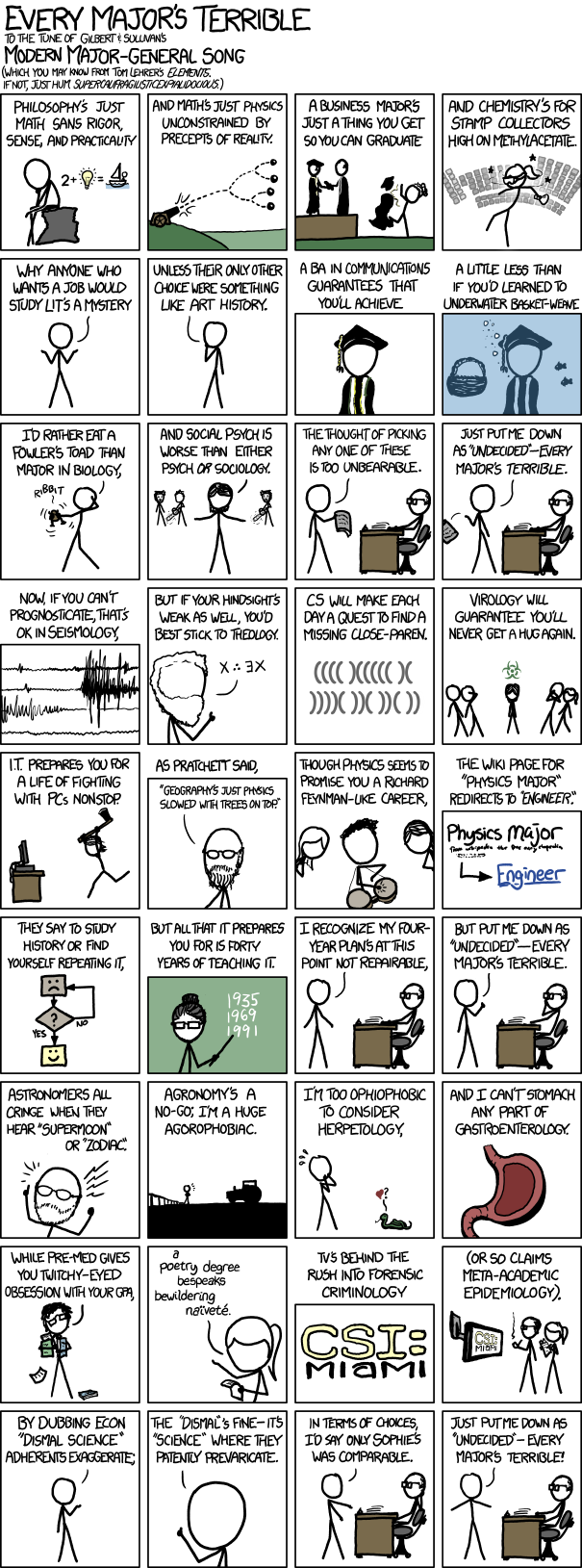
Did you sing it? All the way through?
I thought it was rather clever. There's one spot (that I noticed, at least) that didn't quite scan, but it's still a really impressive filk!
Also, I was reminded of the song "What Do You Do With a B.A. in English?" from Avenue Q.
Did you sing it? All the way through?
I thought it was rather clever. There's one spot (that I noticed, at least) that didn't quite scan, but it's still a really impressive filk!
Also, I was reminded of the song "What Do You Do With a B.A. in English?" from Avenue Q.
Friday, May 13, 2011
The Stanford Daily: Shakespeare (Kind of) in the Park
An article I wrote (I think it's my first lead story!) that runs today:
http://www.stanforddaily.com/2011/05/13/shakespeare-kind-of-in-the-park
As You Like It is really funny (though I'll admit that I often find Shakespearean humor more amusing than I do contemporary humor), and the Stanford Shakespeare Company does it quite well. You can see the review for details, but suffice to say that I'd gladly see it again. If you're on campus, go see it! Tickets: http://shakespeare.stanford.edu.
(I also realize that there's a bit of a skewed representation of my journalism on the blog. I'm predominately a book critic, but it seems like everything I plug here is about drama. I'll try to remember to post more of my book reviews!)
Edit: If you're interested in books, or just journalist-y things that I write, there's now a new button in the sidebar. Someone told me it would be a good idea, but I forget who it was, so thanks!
http://www.stanforddaily.com/2011/05/13/shakespeare-kind-of-in-the-park
As You Like It is really funny (though I'll admit that I often find Shakespearean humor more amusing than I do contemporary humor), and the Stanford Shakespeare Company does it quite well. You can see the review for details, but suffice to say that I'd gladly see it again. If you're on campus, go see it! Tickets: http://shakespeare.stanford.edu.
(I also realize that there's a bit of a skewed representation of my journalism on the blog. I'm predominately a book critic, but it seems like everything I plug here is about drama. I'll try to remember to post more of my book reviews!)
Edit: If you're interested in books, or just journalist-y things that I write, there's now a new button in the sidebar. Someone told me it would be a good idea, but I forget who it was, so thanks!
Wednesday, March 2, 2011
The Stanford Daily: StanShakes Triumphs with "Julius Caesar"
An article I wrote last week:
http://www.stanforddaily.com/2011/02/25/stanshakes-triumphs-with-julius-caesar/
Julius Caesar is amazing -- I went through several phases of "favorite Shakespeare play" and it's my most recent favorite. I loved A Midsummer Night's Dream in elementary and early middle school -- I thought it was absolutely hysterical. It was also the time, at least in elementary, when kids were obsessed with the notion that the other gender had "cooties". Go figure. Then, in middle school, I really liked Hamlet. I think it might have been the brooding, misunderstood, woe-is-me element of it; most teenagers angst and have persecution complexes and think their parental figures don't understand them (I wasn't so far removed from that myself; I merely had... different ways of expressing it). And then, in early high school, I started taking Latin again, and rediscovered a love of Roman history and political structures. Hence the especial fondness for Julius Caesar. Somewhere in there, I briefly liked Macbeth (oops, sorry, I mean "that Scottish play"), but my tenth grade English teacher sort of ruined it for me. I was, apparently, reading it too much in historical context, rather than as pure literature. But that's another story.
http://www.stanforddaily.com/2011/02/25/stanshakes-triumphs-with-julius-caesar/
Julius Caesar is amazing -- I went through several phases of "favorite Shakespeare play" and it's my most recent favorite. I loved A Midsummer Night's Dream in elementary and early middle school -- I thought it was absolutely hysterical. It was also the time, at least in elementary, when kids were obsessed with the notion that the other gender had "cooties". Go figure. Then, in middle school, I really liked Hamlet. I think it might have been the brooding, misunderstood, woe-is-me element of it; most teenagers angst and have persecution complexes and think their parental figures don't understand them (I wasn't so far removed from that myself; I merely had... different ways of expressing it). And then, in early high school, I started taking Latin again, and rediscovered a love of Roman history and political structures. Hence the especial fondness for Julius Caesar. Somewhere in there, I briefly liked Macbeth (oops, sorry, I mean "that Scottish play"), but my tenth grade English teacher sort of ruined it for me. I was, apparently, reading it too much in historical context, rather than as pure literature. But that's another story.
Tuesday, June 15, 2010
NYTimes: Summer Shakespeare, Outside and Urban
One of the many things I love about summers in New York:
http://www.nytimes.com/2010/06/04/theater/04shakespeare.html?ref=nyregion
I intend to catch at least one play this summer. Anyone want to come?
http://www.nytimes.com/2010/06/04/theater/04shakespeare.html?ref=nyregion
I intend to catch at least one play this summer. Anyone want to come?
Sunday, June 13, 2010
NYTimes: The Scoop (iPhone app and website)
Just in time for the summer:
http://nytimes.com/thescoop
It appears to be quite comprehensive. I'm looking forward to trying it out. I intend to explore the City a little in the next few months, and this might be just the thing. If you're a New Yorker, or are here for any duration, do get the app, and let me know what you think of it (and whether you want to go adventuring!).
http://nytimes.com/thescoop
It appears to be quite comprehensive. I'm looking forward to trying it out. I intend to explore the City a little in the next few months, and this might be just the thing. If you're a New Yorker, or are here for any duration, do get the app, and let me know what you think of it (and whether you want to go adventuring!).
Wednesday, June 2, 2010
NYTimes: In Broadway Lights, No Vacancy
I'm a huge fan of Broadway theater, and it's good to know that even in this economic climate, Broadway theaters aren't languishing empty; shows still appear to be doing quite well for themselves:
http://www.nytimes.com/2010/05/02/theater/02stages.html?hp
I'm glad to see directors sticking to their guns regarding artistic vision; rather than going for any available theater, many new shows are holding out for certain specific theaters that fit their particular needs. Too much of show business has been tainted by money.
I'm also terribly excited to be home this summer; the arts (performing and visual) are one of the things I miss most about New York.
http://www.nytimes.com/2010/05/02/theater/02stages.html?hp
I'm glad to see directors sticking to their guns regarding artistic vision; rather than going for any available theater, many new shows are holding out for certain specific theaters that fit their particular needs. Too much of show business has been tainted by money.
I'm also terribly excited to be home this summer; the arts (performing and visual) are one of the things I miss most about New York.
Saturday, May 29, 2010
NYTimes: Tips on Scoring Discounted Tickets to Musicals, Plays, Museum Tours, &c. in New York this Summer
A handy article for anyone in New York for the summer:
http://travel.nytimes.com/2010/05/28/travel/28linestrategy.html?hpw
Entertainment in the City isn't cheap; Broadway shows, operas, concerts, &c. are mostly beyond your average college students' budgets. The ones that don't cost as much, like museum tours, Shakespeare in the Park, that sort of thing, all sell out ridiculously quickly; I know people who have waited in line, in ungodly hours of night and early morning, to try to get tickets to Shakespeare in the Park. (Yes, the part of me that laments the decline of literacy of the masses is greatly heartened to hear it, even though it means that I didn't get to see Othello last summer.)
Chances are, though, that after this article, people will flock to these once-secret box offices, and these tips will grow obsolete within the summer. Ah, well.
http://travel.nytimes.com/2010/05/28/travel/28linestrategy.html?hpw
Entertainment in the City isn't cheap; Broadway shows, operas, concerts, &c. are mostly beyond your average college students' budgets. The ones that don't cost as much, like museum tours, Shakespeare in the Park, that sort of thing, all sell out ridiculously quickly; I know people who have waited in line, in ungodly hours of night and early morning, to try to get tickets to Shakespeare in the Park. (Yes, the part of me that laments the decline of literacy of the masses is greatly heartened to hear it, even though it means that I didn't get to see Othello last summer.)
Chances are, though, that after this article, people will flock to these once-secret box offices, and these tips will grow obsolete within the summer. Ah, well.
Saturday, May 15, 2010
NYTimes: The Resurrected Phantom Proves that Zombies Can't Sing
Horror of horrors! Andrew Lloyd Webber wrote a sequel to The Phantom of the Opera. Behold:
http://www.nytimes.com/2010/03/10/theater/10love.html
I'm not quite sure how to respond. The obvious conclusion is that, well, Webber sold out. The idea of a sequel is simply mind-boggling. How the hell do you add anything to the Phantom story?
***SPOILER ALERT***
It's implied in the original musical that the Phantom dies... but no, apparently, he moves to Coney Island and builds an amusement park! (I wish I were kidding.)
Really, I kind of hope it flops. Some people just won't leave well enough alone.
(The title was my idea of a joke. My apologies for inflicting my particularly peculiar brand of humor on you all -- though I suppose it comes with the territory.)
http://www.nytimes.com/2010/03/10/theater/10love.html
I'm not quite sure how to respond. The obvious conclusion is that, well, Webber sold out. The idea of a sequel is simply mind-boggling. How the hell do you add anything to the Phantom story?
***SPOILER ALERT***
It's implied in the original musical that the Phantom dies... but no, apparently, he moves to Coney Island and builds an amusement park! (I wish I were kidding.)
Really, I kind of hope it flops. Some people just won't leave well enough alone.
(The title was my idea of a joke. My apologies for inflicting my particularly peculiar brand of humor on you all -- though I suppose it comes with the territory.)
Subscribe to:
Posts (Atom)