This is what Frank, Wendy, and I stayed up until 4:00am doing... (It probably won't make much sense unless you attend Stanford/are familiar with our campus.)
Friday, April 29, 2011


Thursday, April 28, 2011
BBC: Royal Roses Planted at Windsor Great Park
It seems like everyone is terribly excited about the upcoming nuptials of Prince William and Catherine Middleton. (I can see how it's exciting, even though the British monarchy has no real power anymore.) Related to the hoopla, I found an article on an interesting botanical tradition behind royal weddings:
http://www.bbc.co.uk/news/uk-england-berkshire-13152315
The Catherine rose is quite pretty, though I think the breed name really isn't quite distinctive enough. There have been so many British princesses and queens named Catherine (Henry VIII alone had two wives of that name) that I don't think, in a few decades, anyone will remember that this rose was named for this particular Catherine. (The Royal William rose, methinks, is only slightly less drably named.)
Nonetheless, it seems like a particularly beautiful thing to have a rose named after you. In this case, it's within the dictates of royal tradition, but I imagine that, for a botanist, to name a rose after someone she loved would be much like writing him a love letter or buying him a ring, only orders of magnitude greater -- like an astronomer naming a star for someone.
http://www.bbc.co.uk/news/uk-england-berkshire-13152315
The Catherine rose is quite pretty, though I think the breed name really isn't quite distinctive enough. There have been so many British princesses and queens named Catherine (Henry VIII alone had two wives of that name) that I don't think, in a few decades, anyone will remember that this rose was named for this particular Catherine. (The Royal William rose, methinks, is only slightly less drably named.)
Nonetheless, it seems like a particularly beautiful thing to have a rose named after you. In this case, it's within the dictates of royal tradition, but I imagine that, for a botanist, to name a rose after someone she loved would be much like writing him a love letter or buying him a ring, only orders of magnitude greater -- like an astronomer naming a star for someone.
Monday, April 25, 2011
Crazy Diamonds Optical Illusion
A very interesting illusion for you to ponder:
It took me a few replays of the video, but I eventually figured it out. It's clever -- tricksy, even, but not hugely mind-blowing.
It took me a few replays of the video, but I eventually figured it out. It's clever -- tricksy, even, but not hugely mind-blowing.
Sunday, April 24, 2011
NYTimes: Instant Ramen Saves Lives
In college (and in bachelor pads everywhere), cup noodles often become a dietary staple. Any sort of instant food, but especially instant ramen, is generally not good for the body, as it is usually full of preservatives, artificial flavoring, and the like. Make no mistake -- I have a box of ramen sitting in my closet right now. It's not a completely terrible thing; it's actually pretty decent as far as junk food goes. It's just not something one should consume too often.
This article, however, vindicates instant noodles for a completely different cause (certainly a much better one than college students pulling all-nighters):
http://www.nytimes.com/2011/03/20/weekinreview/20noodles.html?ref=asia
Cup noodles for tsunami relief! (I wouldn't mind sending my box of ramen to Japan and buying something more like carrot sticks. Also, Japanese cup noodles are probably a sight healthier than what we have here.)
This article, however, vindicates instant noodles for a completely different cause (certainly a much better one than college students pulling all-nighters):
http://www.nytimes.com/2011/03/20/weekinreview/20noodles.html?ref=asia
Cup noodles for tsunami relief! (I wouldn't mind sending my box of ramen to Japan and buying something more like carrot sticks. Also, Japanese cup noodles are probably a sight healthier than what we have here.)
Friday, April 22, 2011
Happy Earth Day! or, Nature (by Henry Wadsworth Longfellow)
Today is Earth Day. Given my various posts on the subject in the past, it's self-evident that the earth, and therefore this holiday, is something I care a lot about.
In honor of the occasion, here is an appropriate poem I quite like:
Nature
by Henry Wadsworth Longfellow (1900)
As a fond mother, when the day is o'er,
Leads by the hand her little child to bed,
Half willing, half reluctant to be led,
And leave his broken playthings on the floor,
Still gazing at them through the open door,
Nor wholly reassured and comforted
By promises of others in their stead,
Which though more splendid, may not please him more;
So Nature deals with us, and takes away
Our playthings one by one, and by the hand
Leads us to rest so gently, that we go
Scarce knowing if we wish to go or stay,
Being too full of sleep to understand
How far the unknown transcends the what we know.
A beautiful poetic interpretation of the expression "Mother Earth," which many of us take for granted. But not today.
In honor of the occasion, here is an appropriate poem I quite like:
Nature
by Henry Wadsworth Longfellow (1900)
As a fond mother, when the day is o'er,
Leads by the hand her little child to bed,
Half willing, half reluctant to be led,
And leave his broken playthings on the floor,
Still gazing at them through the open door,
Nor wholly reassured and comforted
By promises of others in their stead,
Which though more splendid, may not please him more;
So Nature deals with us, and takes away
Our playthings one by one, and by the hand
Leads us to rest so gently, that we go
Scarce knowing if we wish to go or stay,
Being too full of sleep to understand
How far the unknown transcends the what we know.
A beautiful poetic interpretation of the expression "Mother Earth," which many of us take for granted. But not today.
Thursday, April 21, 2011
Scientific Attempt To Create Most Annoying Song Ever
This came up at another meal (I think it was Josh who showed this to us, but I could be mistaken):
http://www.wired.com/listening_post/2008/04/a-scientific-at
The opera rap portion is... interesting. Ear-blisteringly so. Give it a listen; it's a bit slow in the beginning, but it becomes hilarious at around a minute and a half.
There has been a lot of scholarly debate over whether our ideas of euphony and cacophony are innate or learned. Music in minor keys, for instance, evokes sadness in western music, but lacks that connotation in some other cultures. I wonder if opera rap might be considered normal, or at least non-comical, to listeners from other parts of the world.
http://www.wired.com/listening_post/2008/04/a-scientific-at
The opera rap portion is... interesting. Ear-blisteringly so. Give it a listen; it's a bit slow in the beginning, but it becomes hilarious at around a minute and a half.
There has been a lot of scholarly debate over whether our ideas of euphony and cacophony are innate or learned. Music in minor keys, for instance, evokes sadness in western music, but lacks that connotation in some other cultures. I wonder if opera rap might be considered normal, or at least non-comical, to listeners from other parts of the world.
Tuesday, April 19, 2011
Tron Slug
Alex (Q) was talking about this in the dining hall the other day, and I knew I had to see it for myself:
http://en.wikipedia.org/wiki/Chelidonura_varians
Does that explain the post title? (It's a reference to this film.)
(Any relation to the previous post is completely unintentional, I promise. But it is cute.)
http://en.wikipedia.org/wiki/Chelidonura_varians
Does that explain the post title? (It's a reference to this film.)
(Any relation to the previous post is completely unintentional, I promise. But it is cute.)
Monday, April 18, 2011
Beauty
Believe it or not, I was a techie once upon a time. Well, more techie than fuzzy, at least. (It's Stanford terminology; techie means science-oriented, and fuzzy means humanities-oriented.) That was before college; I was a mathlete, and built airplanes and trebuchets for Science Olympiad, and memorized the periodic table, and dressed as a nucleotide for Hallowe'en one year... the works. (I was an... interesting child.)
Anyhow, even though I've gone over to the dark side, as it were, I can definitely relate to this (once, for an art assignment wherein I had to draw two creatures interacting, I rendered two one-celled organisms floating around under a microscope):
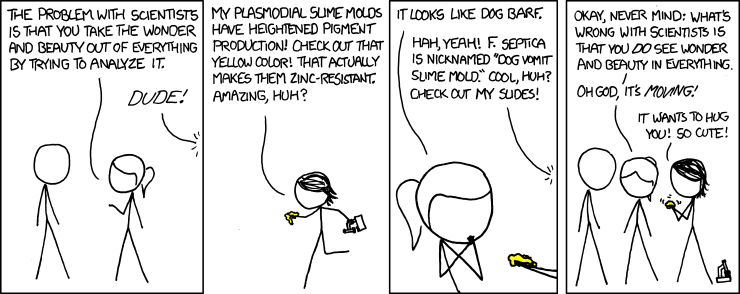
http://xkcd.com/877
Anyhow, even though I've gone over to the dark side, as it were, I can definitely relate to this (once, for an art assignment wherein I had to draw two creatures interacting, I rendered two one-celled organisms floating around under a microscope):
http://xkcd.com/877
Sunday, April 17, 2011
The Breaking Light (Vienna Teng)
Vienna Teng/Alex Wong have a new single out! (It's been out for a while, but I only just realized that I neglected to mention it.) It can be found on Alex's website:
http://alexwong.bandcamp.com/track/the-breaking-light-live-at-yoshis
All proceeds go to disaster relief in Japan, so go get yourself some awesome music and help out the Japanese!
Another cool tidbit: it was recorded live (with a bit of audience participation), and I, along with a number of Stanford friends, were at the show at which they recorded it. *grins*
http://alexwong.bandcamp.com/track/the-breaking-light-live-at-yoshis
All proceeds go to disaster relief in Japan, so go get yourself some awesome music and help out the Japanese!
Another cool tidbit: it was recorded live (with a bit of audience participation), and I, along with a number of Stanford friends, were at the show at which they recorded it. *grins*
Wednesday, April 13, 2011
NYTimes: The City
An ode to my hometown, or rather, an analysis of its continued prominence in the collective consciousness:
http://www.nytimes.com/2010/11/08/opinion/08judt.html?src=me&ref=general
I've always known that I wanted to come back to New York -- that wherever I went, for school or work or pleasure, I would never find a place that quite compared. Where else would you find world-class museums, a fantastic theatre scene, an equally fantastic classical music scene, Broadway, and just about every major culture and language on earth (and some not-so-major ones too) -- not to mention that it's the hub of so many different industries, one of which is the publishing industry. It's a bittersweet fate, I must admit -- I have made some fast friends here at Stanford, and I'm not looking forward to the day I graduate and leave them all. (Most of them are computer scientists, and likely to remain in Silicon Valley.) And yet, it's a homecoming.
The magic of the City, methinks, is that it's secure in its brilliant, often-conflicting identity. New York has never sought to prove anything, never tried to claim any dubious superlatives, never really defined itself, or attempted to. The best analogy I can think of would be classical Rome -- the center of the world in its day, comfortable subsuming other cultures, or coexisting with them, or ignoring them, as was expedient. It required assimilation, but only to a point. So long as Roman subjects accepted its legal and political jurisdiction, so long as they also adopted aspects of Roman identity, they were allowed to retain their own languages, customs, and beliefs. They were, within a generation or two, accorded the rights of a citizen of Rome. Rome did not fear its immigrants, did not shun the unusual or the foreign, but kept them all until they became no longer quite so strange. And this is how Rome endured for centuries as the foremost city in the (known) world. And so, too, does New York.
http://www.nytimes.com/2010/11/08/opinion/08judt.html?src=me&ref=general
I've always known that I wanted to come back to New York -- that wherever I went, for school or work or pleasure, I would never find a place that quite compared. Where else would you find world-class museums, a fantastic theatre scene, an equally fantastic classical music scene, Broadway, and just about every major culture and language on earth (and some not-so-major ones too) -- not to mention that it's the hub of so many different industries, one of which is the publishing industry. It's a bittersweet fate, I must admit -- I have made some fast friends here at Stanford, and I'm not looking forward to the day I graduate and leave them all. (Most of them are computer scientists, and likely to remain in Silicon Valley.) And yet, it's a homecoming.
The magic of the City, methinks, is that it's secure in its brilliant, often-conflicting identity. New York has never sought to prove anything, never tried to claim any dubious superlatives, never really defined itself, or attempted to. The best analogy I can think of would be classical Rome -- the center of the world in its day, comfortable subsuming other cultures, or coexisting with them, or ignoring them, as was expedient. It required assimilation, but only to a point. So long as Roman subjects accepted its legal and political jurisdiction, so long as they also adopted aspects of Roman identity, they were allowed to retain their own languages, customs, and beliefs. They were, within a generation or two, accorded the rights of a citizen of Rome. Rome did not fear its immigrants, did not shun the unusual or the foreign, but kept them all until they became no longer quite so strange. And this is how Rome endured for centuries as the foremost city in the (known) world. And so, too, does New York.
Tuesday, April 12, 2011
MSNBC: Two Suns Spotted in China Defy Explanation
A very interesting optical phenomenon spotted about a month ago:
http://www.msnbc.msn.com/id/41927089/ns/technology_and_science-space/GT1=43001
I'm inclined to believe that it's an issue of atmospheric refraction, as the article says. I don't think a faulty lens could produce an image of such clarity.
http://www.msnbc.msn.com/id/41927089/ns/technology_and_science-space/GT1=43001
I'm inclined to believe that it's an issue of atmospheric refraction, as the article says. I don't think a faulty lens could produce an image of such clarity.
Friday, April 8, 2011
Human Pac-Man
This is awesome:
After seeing the final result, I can understand how they might have persuaded that many people to spend hours playing musical chairs in an empty movie theater.
After seeing the final result, I can understand how they might have persuaded that many people to spend hours playing musical chairs in an empty movie theater.
Thursday, April 7, 2011
One Art (by Elizabeth Bishop)
I haven't posted any poetry in much too long. Here's a villanelle (a famous and much admired one) for your consideration:
One Art
by Elizabeth Bishop (1979)
The art of losing isn't hard to master;
so many things seem filled with the intent
to be lost that their loss is no disaster.
Lose something every day. Accept the fluster
of lost door keys, the hour badly spent.
The art of losing isn't hard to master.
Then practice losing farther, losing faster:
places, and names, and where it was you meant
to travel. None of these will bring disaster.
I lost my mother's watch. And look! my last, or
next-to-last, of three loved houses went.
The art of losing isn't hard to master.
I lost two cities, lovely ones. And, vaster,
some realms I owned, two rivers, a continent.
I miss them, but it wasn't a disaster.
--Even losing you (the joking voice, a gesture
I love) I shan't have lied. It's evident
the art of losing's not too hard to master
though it may look like (Write it!) like disaster.
The beauty of this poem lies not only in its masterful use of a difficult form (the villanelle is really hard to do well; I've tried), but also the interplay of its text and subtext. I'll leave that for you to admire and figure out. ;-)
One Art
by Elizabeth Bishop (1979)
The art of losing isn't hard to master;
so many things seem filled with the intent
to be lost that their loss is no disaster.
Lose something every day. Accept the fluster
of lost door keys, the hour badly spent.
The art of losing isn't hard to master.
Then practice losing farther, losing faster:
places, and names, and where it was you meant
to travel. None of these will bring disaster.
I lost my mother's watch. And look! my last, or
next-to-last, of three loved houses went.
The art of losing isn't hard to master.
I lost two cities, lovely ones. And, vaster,
some realms I owned, two rivers, a continent.
I miss them, but it wasn't a disaster.
--Even losing you (the joking voice, a gesture
I love) I shan't have lied. It's evident
the art of losing's not too hard to master
though it may look like (Write it!) like disaster.
The beauty of this poem lies not only in its masterful use of a difficult form (the villanelle is really hard to do well; I've tried), but also the interplay of its text and subtext. I'll leave that for you to admire and figure out. ;-)
NYTimes: Morality and Human Nature
I found this really interesting article a long while back, on the origins and development of the sense of morality in humans:
http://www.nytimes.com/2010/05/09/magazine/09babies-t.html?hpw
It's really validating for an optimist; I've always believed that people are fundamentally good. We are, methinks, born with a sense of natural law, of right and wrong -- and this is only a small exaggeration. It is usually those with innate psychological imbalances, or those exposed to corrupting social influences, or those who have been driven by circumstances to desperation and folly, &c., who do evil. Humans tend not to be evil by choice; evil is often motivated by lesser vices, such as laziness, pride, and so forth.
Anyhow, you should read the article for yourself; they talk about a lot of interesting case studies and experiments therein.
http://www.nytimes.com/2010/05/09/magazine/09babies-t.html?hpw
It's really validating for an optimist; I've always believed that people are fundamentally good. We are, methinks, born with a sense of natural law, of right and wrong -- and this is only a small exaggeration. It is usually those with innate psychological imbalances, or those exposed to corrupting social influences, or those who have been driven by circumstances to desperation and folly, &c., who do evil. Humans tend not to be evil by choice; evil is often motivated by lesser vices, such as laziness, pride, and so forth.
Anyhow, you should read the article for yourself; they talk about a lot of interesting case studies and experiments therein.
Friday, April 1, 2011
Happy Edible Book Day!
Today may be April Fools' Day, but it is also Edible Book Day.
Yes, such a holiday actually exists. It is wonderful, and if I could bake, I would definitely be baking a cake right now. Maybe an Antigone-shaped cake, or a Silmarillion-shaped one. Any bakers out there want to give it a try?
Have fun! Go eat a book!
Yes, such a holiday actually exists. It is wonderful, and if I could bake, I would definitely be baking a cake right now. Maybe an Antigone-shaped cake, or a Silmarillion-shaped one. Any bakers out there want to give it a try?
Have fun! Go eat a book!
Subscribe to:
Posts (Atom)