I found this story, wherein a professor experiments on his children, hilarious and a bit inspiring (such dedication to the scientific method!), which probably means that I shouldn't reproduce anytime soon...
http://io9.com/questionable-parenting-science-the-tickler-1558053188
Unsurprisingly, this happened two or three generations ago, when it was more socially acceptable for a psychologist to perform experiments on his young and unsuspecting kids in the name of science. (Then again, my father likes to recount the behavioral "experiments" he performed on us when my sister and I were small -- though they were neither as rigorous nor as scientific as Clarence Leuba's.) I'm surprised, though, that his wife was willing to go along with it! Usually, the more responsible parent has veto power over harebrained ideas involving the shared children.
This makes me wonder how many other scientists' children have had rather unorthodox upbringings that have contributed to scientific research. (I read recently in a biography of Alfred Loomis that quite a few members of his extended family, and even occasional house guests, were drafted as test subjects in his experiments.) I hope that in most of those cases, parental instinct would have tempered any potential for lasting damage...
Showing posts with label io9. Show all posts
Showing posts with label io9. Show all posts
Saturday, May 10, 2014


Saturday, December 21, 2013
io9: Clever Cosplayers Sued for Carpet Costumes
This seems like a hilarious take on camouflage/your usual Con cosplay:
http://io9.com/cosplayers-threatened-with-legal-action-for-hotel-carpe-1366152096
I can't say I'm terribly surprised that the cosplayers were hit with a cease-and-desist... I imagine that the hotel was, copyright infringement aside, probably afraid that the next DragonCon would see an entire regiment of cosplayers crawling about on the floor like that! (A shame it won't happen, though -- it would have been fun to see!)
http://io9.com/cosplayers-threatened-with-legal-action-for-hotel-carpe-1366152096
I can't say I'm terribly surprised that the cosplayers were hit with a cease-and-desist... I imagine that the hotel was, copyright infringement aside, probably afraid that the next DragonCon would see an entire regiment of cosplayers crawling about on the floor like that! (A shame it won't happen, though -- it would have been fun to see!)
Friday, September 27, 2013
io9: The Downs-Thomson Paradox is the Bane of Commuters Everywhere
This io9 article reminded me quite a bit of public transit in California (one of the things I definitely don't miss about university). It's also interesting to consider given the recent spate of service disruptions on MetroNorth (I have a few coworkers who commute from suburbs north of Manhattan).
http://io9.com/how-the-downs-thomson-paradox-will-ruin-your-commute-1152573927
Vehicular traffic, especially of the diesel variety, a huge environmental and economic impact on urban centers. There's debilitating smog (Beijing) that contributes to global warming and respiratory problems, and hours-long traffic jams (Los Angeles) that seriously decreases productivity and happiness, among other problems. Most urban planners, I would imagine, give serious thought to methods of reducing the number of cars on the road.
The optimization of the weekday commute in urban centers is one of those challenges that is more important than it seems at first blush, and is extremely difficult to implement. It's largely due to massive user inertia, and the difficulties of transition. One of the major issues with any major urban infrastructure project is that the construction required to overhaul the system affects the millions of people who need to use said system every day. In order to avoid such disruption, most updates simply involve adding to, rather than substantively changing, the existing system. That's how we get, for example, redundancies in subway lines, or routes and hubs that are sub-optimal because population densities and distribution change with time. Over the years, problems in transit systems tend to be compounded precisely because our networks are augmented rather than remade anew. And, as the article points out, these inefficiencies drive people (no pun intended) to use cars instead of public transit. Who knew there was a formal theory to describe it?
http://io9.com/how-the-downs-thomson-paradox-will-ruin-your-commute-1152573927
Vehicular traffic, especially of the diesel variety, a huge environmental and economic impact on urban centers. There's debilitating smog (Beijing) that contributes to global warming and respiratory problems, and hours-long traffic jams (Los Angeles) that seriously decreases productivity and happiness, among other problems. Most urban planners, I would imagine, give serious thought to methods of reducing the number of cars on the road.
The optimization of the weekday commute in urban centers is one of those challenges that is more important than it seems at first blush, and is extremely difficult to implement. It's largely due to massive user inertia, and the difficulties of transition. One of the major issues with any major urban infrastructure project is that the construction required to overhaul the system affects the millions of people who need to use said system every day. In order to avoid such disruption, most updates simply involve adding to, rather than substantively changing, the existing system. That's how we get, for example, redundancies in subway lines, or routes and hubs that are sub-optimal because population densities and distribution change with time. Over the years, problems in transit systems tend to be compounded precisely because our networks are augmented rather than remade anew. And, as the article points out, these inefficiencies drive people (no pun intended) to use cars instead of public transit. Who knew there was a formal theory to describe it?
Sunday, September 15, 2013
Reality, Relativity, and Light
I read José Saramago's The History of the Siege of Lisbon last week -- in translation, of course, since I don't read Portuguese. It's excellent, and somewhat stylistically and structurally unusual. But I was struck, in particular, by this line, spoken to the protagonist by his lover (the relationship is rather more complicated than that, of course):
This is especially relevant to the subject matter because the 1147 Siege of Lisbon, about which the protagonist writes, was a manifestation of a centuries-old clash of cultures and religions, a battle between two peoples who understood the same God through different scriptures and different prophets. Elizabeth I once said, in another century about another religious conflict, "I would not open windows into men's souls." Such windows can only be approximated, even in the best of circumstances.
I'm also taken by the Saramago's use of light in this scene -- something one normally associates with visual art rather than with prose. It's ripe with symbolism; the notion of shedding light on something intangible, that our eyes can tell us about reality between two people, &c. I'm reminded of two things:
The second thing is Plato's Allegory of the Cave. Our understanding of what goes on inside another person's mind is rather like to the prisoners' understanding of the shadows on the wall. Another person's reality undergoes several layers of translation before it becomes comprehensible to us; the "truth" is distorted by their perception, interpreted by their mind, conveyed by their words, filtered by our ears, and only then is it analyzed by our minds. Plato's prisoners are eventually unchained, but there is no way for any of us to overcome this process of interpretation. The amount that must get lost in translation is mind-boggling. It makes me wonder what a society of perfect communication (of telepathy, essentially) would look like.
Edit: Soon after writing this post, I chanced upon an io9 article about philosophical thought experiments: http://io9.com/9-philosophical-thought-experiments-that-will-keep-you-1340952809@AnnaleeNewitz. The third entry therein, "The Beetle in the Box" (aka the Private Language Argument), is very much like what I discuss above. The second entry, "Mary the Colorblind Neuroscientist" (aka the Inverted Spectrum Problem), is also quite similar to the Allegory of the Cave. It's well worth reading.
Switch on the light, she said, I want to know if this is real. (p264)The relationship between any two people -- even within family, even between people who might have known each other their whole lives -- is a fragile thing. Within that relationship, there are layers of reality, of perception. It's a sort of relativity, even -- one that isn't governed by any laws of physics. His reality and hers could be completely different, and each moment's reality different from the next. It's odd to think that we can never know what another person's reality looks like; the closest we can come is to achieve an understanding of how our reality compares to what we perceive to be their reality, with full awareness that our vantage point colours our reading.
This is especially relevant to the subject matter because the 1147 Siege of Lisbon, about which the protagonist writes, was a manifestation of a centuries-old clash of cultures and religions, a battle between two peoples who understood the same God through different scriptures and different prophets. Elizabeth I once said, in another century about another religious conflict, "I would not open windows into men's souls." Such windows can only be approximated, even in the best of circumstances.
I'm also taken by the Saramago's use of light in this scene -- something one normally associates with visual art rather than with prose. It's ripe with symbolism; the notion of shedding light on something intangible, that our eyes can tell us about reality between two people, &c. I'm reminded of two things:
Perhaps we may frighten away the ghost of so many years ago with a little illumination...So many years after the events of "The Phantom of the Opera," the very chandelier that was associated with the disaster perpetrated by the Phantom is now a source of illumination -- both as a refurbished light fixture, and as a window into the murky past, the audience's introduction to the story. Because it is an inanimate object with a lofty vantage point, it is, in a fashion, the impartial observer of the story. And yet, it is also a crucial "participant" in the story. Its impartiality is not so much due to its placement, a lamp hanging high above the human characters, but rather because it has no free will, no desires or motivations of its own.
~ "The Phantom of the Opera," Act I, Scene 1
The second thing is Plato's Allegory of the Cave. Our understanding of what goes on inside another person's mind is rather like to the prisoners' understanding of the shadows on the wall. Another person's reality undergoes several layers of translation before it becomes comprehensible to us; the "truth" is distorted by their perception, interpreted by their mind, conveyed by their words, filtered by our ears, and only then is it analyzed by our minds. Plato's prisoners are eventually unchained, but there is no way for any of us to overcome this process of interpretation. The amount that must get lost in translation is mind-boggling. It makes me wonder what a society of perfect communication (of telepathy, essentially) would look like.
Edit: Soon after writing this post, I chanced upon an io9 article about philosophical thought experiments: http://io9.com/9-philosophical-thought-experiments-that-will-keep-you-1340952809@AnnaleeNewitz. The third entry therein, "The Beetle in the Box" (aka the Private Language Argument), is very much like what I discuss above. The second entry, "Mary the Colorblind Neuroscientist" (aka the Inverted Spectrum Problem), is also quite similar to the Allegory of the Cave. It's well worth reading.
Saturday, September 7, 2013
io9: Why Eugenics is a Bad Idea (aside from all the obvious moral reasons)
I recently read Paolo Bacigalupi's short story collection Pump Six and Other Stories, which is deliciously creepy and dystopian. That anthology, and this io9 article (which I read at around the same time), got me thinking about human genetic engineering on a macroscopic scale:
http://io9.com/5925024/why-eugenics-will-always-fail
Our notions of eugenics can be roughly sorted into two categories: ways to optimize our species (for some agreed-upon and likely artificial optimal characteristics), and ways to eliminate genetic weaknesses (an extremely aggressive, sentient form of Darwinism). The former option represents selecting for a hypothetical upper bound, and the latter would be selecting against a lower bound.
When we talk about eugenics, most of us imagine the first option. The cultural connotation of the term "eugenics" includes the Holocaust, the book Brave New World, and the film "Gattaca" -- all of which involve human rights violations. In selecting for a certain ideal, a society makes mincemeat of the rights of those who fall below the arbitrary cut-off. Because eugenics usually comes with gross restrictions of free will -- and in many cases, murder -- we tend to see it as a purely moral evil. This usually brings about international intervention (the timeliness and effectiveness of said interventions being a different matter entirely), or at least the common recognition that such atrocities ought to be prevented.
The above io9 article lays out a few intuitive arguments against eugenics from a practical perspective, contending that -- morality aside -- it simply wouldn't be effective. They boil down to: imprecision, biodiversity, and the limitations of human foresight. (In essence, the short-term microscopic, the middle-term macroscopic, and the long-term in both. The article explains in further detail.) We don't know enough (and likely will never know enough) to get away with attempting to fashion our species in the image of some ideal -- not to mention that it would be impossible to get all seven billion of us to agree on said ideal in the first place. These are all, however, problems that arise when selecting for an upper bound, a hypothetical ideal specimen of humanity.
A (very) soft version of a scenario where we select against a lower bound is already in place, given amniocentesis and women's right to abort. Many women choose to abort after they receive an abnormal genetic diagnosis -- when the fetus has a genetic or congenital defect that would severely diminish the hypothetical child's lifespan or quality of life. The logic is that never existing -- which, for the record, is distinct from ceasing to exist after a period of existence -- is preferable to a life of pain and suffering with little ability to self-actualize. Self-actualization is incredibly important -- it's what makes us human and distinguishes us from other animals. This form of selection, which can be considered a mild and diffuse form of eugenics, increases the average human being's ability to self-actualize, thereby increasing (in a thought experiment where sentience is quantifiable on a scale) our species's average sentience through conscious choice by prospective parents -- a rough extension of natural sexual selection, in the way that most technologies exacerbate existing dilemmas and play upon existing quirks of human nature, rather than creating new ones where they didn't exist before. (To be clear, I recognize that I just exploded a can of worms -- that humans aren't generally more or less sentient than other humans, and that legally, ethically, metaphysically, &c. we all ought to be considered equally sentient, except in cases of limited ability to consent (i.e. children, mentally disabled persons), in which case laws are made to protect said people.)
The danger, then, is where the upper and lower bound options meet in the middle. (I'm resisting the obvious temptation to make some horrible joke about quantum mechanics and relativity here.) It's significant, therefore, that the former option is mandated by an external force and doesn't allow parents to meaningfully consent; the latter option is voluntarily initiated by the potential parents. The lower bound scenario never turns into the problematic upper bound scenario precisely because of this element of free will. The moment it moves from a bottom-up to a top-down approach -- when it veers too close to selection for an ideal, thereby impinging upon the rights of the sentient but non-ideal population -- it becomes the morally degenerate form of eugenics of genocide and dystopian science fiction. There lies the bright-line we should be aware of.
And that's all for now. I'd love to hear your thoughts!
http://io9.com/5925024/why-eugenics-will-always-fail
Our notions of eugenics can be roughly sorted into two categories: ways to optimize our species (for some agreed-upon and likely artificial optimal characteristics), and ways to eliminate genetic weaknesses (an extremely aggressive, sentient form of Darwinism). The former option represents selecting for a hypothetical upper bound, and the latter would be selecting against a lower bound.
When we talk about eugenics, most of us imagine the first option. The cultural connotation of the term "eugenics" includes the Holocaust, the book Brave New World, and the film "Gattaca" -- all of which involve human rights violations. In selecting for a certain ideal, a society makes mincemeat of the rights of those who fall below the arbitrary cut-off. Because eugenics usually comes with gross restrictions of free will -- and in many cases, murder -- we tend to see it as a purely moral evil. This usually brings about international intervention (the timeliness and effectiveness of said interventions being a different matter entirely), or at least the common recognition that such atrocities ought to be prevented.
The above io9 article lays out a few intuitive arguments against eugenics from a practical perspective, contending that -- morality aside -- it simply wouldn't be effective. They boil down to: imprecision, biodiversity, and the limitations of human foresight. (In essence, the short-term microscopic, the middle-term macroscopic, and the long-term in both. The article explains in further detail.) We don't know enough (and likely will never know enough) to get away with attempting to fashion our species in the image of some ideal -- not to mention that it would be impossible to get all seven billion of us to agree on said ideal in the first place. These are all, however, problems that arise when selecting for an upper bound, a hypothetical ideal specimen of humanity.
A (very) soft version of a scenario where we select against a lower bound is already in place, given amniocentesis and women's right to abort. Many women choose to abort after they receive an abnormal genetic diagnosis -- when the fetus has a genetic or congenital defect that would severely diminish the hypothetical child's lifespan or quality of life. The logic is that never existing -- which, for the record, is distinct from ceasing to exist after a period of existence -- is preferable to a life of pain and suffering with little ability to self-actualize. Self-actualization is incredibly important -- it's what makes us human and distinguishes us from other animals. This form of selection, which can be considered a mild and diffuse form of eugenics, increases the average human being's ability to self-actualize, thereby increasing (in a thought experiment where sentience is quantifiable on a scale) our species's average sentience through conscious choice by prospective parents -- a rough extension of natural sexual selection, in the way that most technologies exacerbate existing dilemmas and play upon existing quirks of human nature, rather than creating new ones where they didn't exist before. (To be clear, I recognize that I just exploded a can of worms -- that humans aren't generally more or less sentient than other humans, and that legally, ethically, metaphysically, &c. we all ought to be considered equally sentient, except in cases of limited ability to consent (i.e. children, mentally disabled persons), in which case laws are made to protect said people.)
The danger, then, is where the upper and lower bound options meet in the middle. (I'm resisting the obvious temptation to make some horrible joke about quantum mechanics and relativity here.) It's significant, therefore, that the former option is mandated by an external force and doesn't allow parents to meaningfully consent; the latter option is voluntarily initiated by the potential parents. The lower bound scenario never turns into the problematic upper bound scenario precisely because of this element of free will. The moment it moves from a bottom-up to a top-down approach -- when it veers too close to selection for an ideal, thereby impinging upon the rights of the sentient but non-ideal population -- it becomes the morally degenerate form of eugenics of genocide and dystopian science fiction. There lies the bright-line we should be aware of.
And that's all for now. I'd love to hear your thoughts!
Tuesday, May 7, 2013
io9: Galileo's Ship Was One of the Oldest Relativity Though Experiments
It has always irked me, a little, when people claim that Einstein "invented" relativity. The man was a genius, to be sure, and contributed greatly to our understanding of general and special relativity in modern physics -- but the idea of relativity existed well before him. The term itself is quite broad, encompassing everything from temporal and spatial relativity to more nebulous perspective- and human interaction-based concepts; it hardly seems possible that despite hundreds of years of innovation in math and physics, relativity only arose within the past century. Certainly, there have been a number of similar (if more rudimentary) observations throughout history, such as Zeno's paradox(es). One of the oldest examples dates from the Renaissance:
http://io9.com/galileos-ship-was-one-of-the-oldest-relativity-thought-486468038
It sounds like a very low-tech version of Einstein's lasers-on-a-train thought experiment, doesn't it?
This brings to mind a blog post from about a year ago... Straying away from the sciences for a moment, relativity as an abstract concept -- even models of relative perspective uncannily like the sort of thought experiments Einstein proposed -- seems to have existed in the literary and cultural milieu for quite a while. It's reasonable to conjecture that there was some cross-pollination. (Eliot, for example, even drops an allusion or two to relativity in "The Waste Land.") The idea of relativity is marvelously intuitive (albeit in a slightly mind-bendy way) and quite useful in describing life alongside other sentient beings.
http://io9.com/galileos-ship-was-one-of-the-oldest-relativity-thought-486468038
It sounds like a very low-tech version of Einstein's lasers-on-a-train thought experiment, doesn't it?
This brings to mind a blog post from about a year ago... Straying away from the sciences for a moment, relativity as an abstract concept -- even models of relative perspective uncannily like the sort of thought experiments Einstein proposed -- seems to have existed in the literary and cultural milieu for quite a while. It's reasonable to conjecture that there was some cross-pollination. (Eliot, for example, even drops an allusion or two to relativity in "The Waste Land.") The idea of relativity is marvelously intuitive (albeit in a slightly mind-bendy way) and quite useful in describing life alongside other sentient beings.
Sunday, February 3, 2013
io9: Race Relations in the Space Age
An adorable, moving video about breaking all sorts of glass ceilings in pursuit of one's dreams (also, Star Trek pioneering integration FTW):
http://io9.com/5981089/a-sweet-animated-tale-of-challenger-astronaut-ronald-mcnairs-early-experience-standing-up-to-racism
Ronald McNair. I didn't know who he was until I saw this, but I'm glad I found it. I'll admit to tearing up a little at the end. (Challenger, why?) He's one of the many unsung heroes of science -- much as the Catholic Church has a body of saints, I propose that science establish its own roster of martyrs for the cause. McNair would be up there with Galileo and Marie Curie.
http://io9.com/5981089/a-sweet-animated-tale-of-challenger-astronaut-ronald-mcnairs-early-experience-standing-up-to-racism
Ronald McNair. I didn't know who he was until I saw this, but I'm glad I found it. I'll admit to tearing up a little at the end. (Challenger, why?) He's one of the many unsung heroes of science -- much as the Catholic Church has a body of saints, I propose that science establish its own roster of martyrs for the cause. McNair would be up there with Galileo and Marie Curie.
Sunday, January 13, 2013
io9: Let's Bring Back the Greek Gods!
Because they were so much more interesting than the all-powerful monotheist deities people worship now!
http://io9.com/5974126/can-we-bring-the-greek-gods-back-please
Granted, religion isn't meant to be entertaining so much as to provide followers with a roadmap to a pleasant afterlife and an explanation for all questions not yet answered by science. But the Greeks had both those (well, perhaps not always the nicest afterlife) as well as extremely colourful and often interactive mythology. I don't fancy getting abducted by a Greek god, but going to an oracle sounds like quite the experience. (Then again, the oracle of Delphi was supposed to be on psychotropic fumes emitted by the volcanic vents in the area.)
In any case, it sure beats Calvinism!
http://io9.com/5974126/can-we-bring-the-greek-gods-back-please
Granted, religion isn't meant to be entertaining so much as to provide followers with a roadmap to a pleasant afterlife and an explanation for all questions not yet answered by science. But the Greeks had both those (well, perhaps not always the nicest afterlife) as well as extremely colourful and often interactive mythology. I don't fancy getting abducted by a Greek god, but going to an oracle sounds like quite the experience. (Then again, the oracle of Delphi was supposed to be on psychotropic fumes emitted by the volcanic vents in the area.)
In any case, it sure beats Calvinism!
Thursday, December 20, 2012
NASA's Take on Gangnam Style
I found this on io9, and it's too good not to share:
One of the more amusing things in this video (there are many) is the varying levels of enthusiasm and embarrassment among the NASA employees. Some people are extremely excited to be part of it, some are rather embarrassed to be dancing on YouTube for the world to see (and having fun while they're at it), some are Not Amused, some are gritting their teeth and dancing in the name of science, and some (mostly the ones at the end) are probably secretly shaking their heads and thinking, "kids these days." I can only imagine what it must have taken to persuade a bunch of scientists to put this thing together -- which is probably not all that much, come to think of it. This is a pretty geeky idea of a good time! (Also, a fun form of science outreach, which we need more of these days.)
One of the more amusing things in this video (there are many) is the varying levels of enthusiasm and embarrassment among the NASA employees. Some people are extremely excited to be part of it, some are rather embarrassed to be dancing on YouTube for the world to see (and having fun while they're at it), some are Not Amused, some are gritting their teeth and dancing in the name of science, and some (mostly the ones at the end) are probably secretly shaking their heads and thinking, "kids these days." I can only imagine what it must have taken to persuade a bunch of scientists to put this thing together -- which is probably not all that much, come to think of it. This is a pretty geeky idea of a good time! (Also, a fun form of science outreach, which we need more of these days.)
Thursday, May 31, 2012
io9: Blowfish-Man Film
This is somewhat disturbing, and so quintessentially Japanese:
http://io9.com/5914061/watch-a-man-turn-into-a-blowfish-in-one-horrifying-short?tag=trailer-frenzy
I'll admit, I watched that trailer about five times, with what I'm sure was an expression of horrified fascination on my face. The CGI is really something; it's in that zone between extremely realistic and "you know it's impossible even though your eyes tell you otherwise." It evokes the sort of feeling that Neil Gaiman's or China Miéville's writing does; the milieu is rather Lovecraftian.
http://io9.com/5914061/watch-a-man-turn-into-a-blowfish-in-one-horrifying-short?tag=trailer-frenzy
I'll admit, I watched that trailer about five times, with what I'm sure was an expression of horrified fascination on my face. The CGI is really something; it's in that zone between extremely realistic and "you know it's impossible even though your eyes tell you otherwise." It evokes the sort of feeling that Neil Gaiman's or China Miéville's writing does; the milieu is rather Lovecraftian.
Thursday, January 26, 2012
io9: Why Are Monkeys' Faces All So Bizarrely Different?
Just a fun science-y piece I found:
http://io9.com/5875354/why-are-monkeys-faces-all-so-bizarrely-different?tag=biology
It makes me wonder about people who are ostentatious with regard to personal ornamentation (especially facial ornamentation). Are heavily bearded men less expressive? For that matter, is it possible that women's supposedly superior communication skills have something to do with our lack of facial hair? (Is this why Santa Claus's interpersonal communication is largely relegated to the iconic "Ho ho ho"?)
Also, that monkey's face is priceless. :)
http://io9.com/5875354/why-are-monkeys-faces-all-so-bizarrely-different?tag=biology
It makes me wonder about people who are ostentatious with regard to personal ornamentation (especially facial ornamentation). Are heavily bearded men less expressive? For that matter, is it possible that women's supposedly superior communication skills have something to do with our lack of facial hair? (Is this why Santa Claus's interpersonal communication is largely relegated to the iconic "Ho ho ho"?)
Also, that monkey's face is priceless. :)
Wednesday, October 26, 2011
io9: Vegetable Orchestra
A strange, wonderful idea:
http://io9.com/5817756/vegetable-orchestra-grow-your-own-guitar
It takes some imagination to come up with such a thing -- it sounds like something out of a children's book, or a Greek myth. It reminds me of those Giuseppe Arcimboldo paintings of vegetable men, like this one, which I believe is one of his most famous:
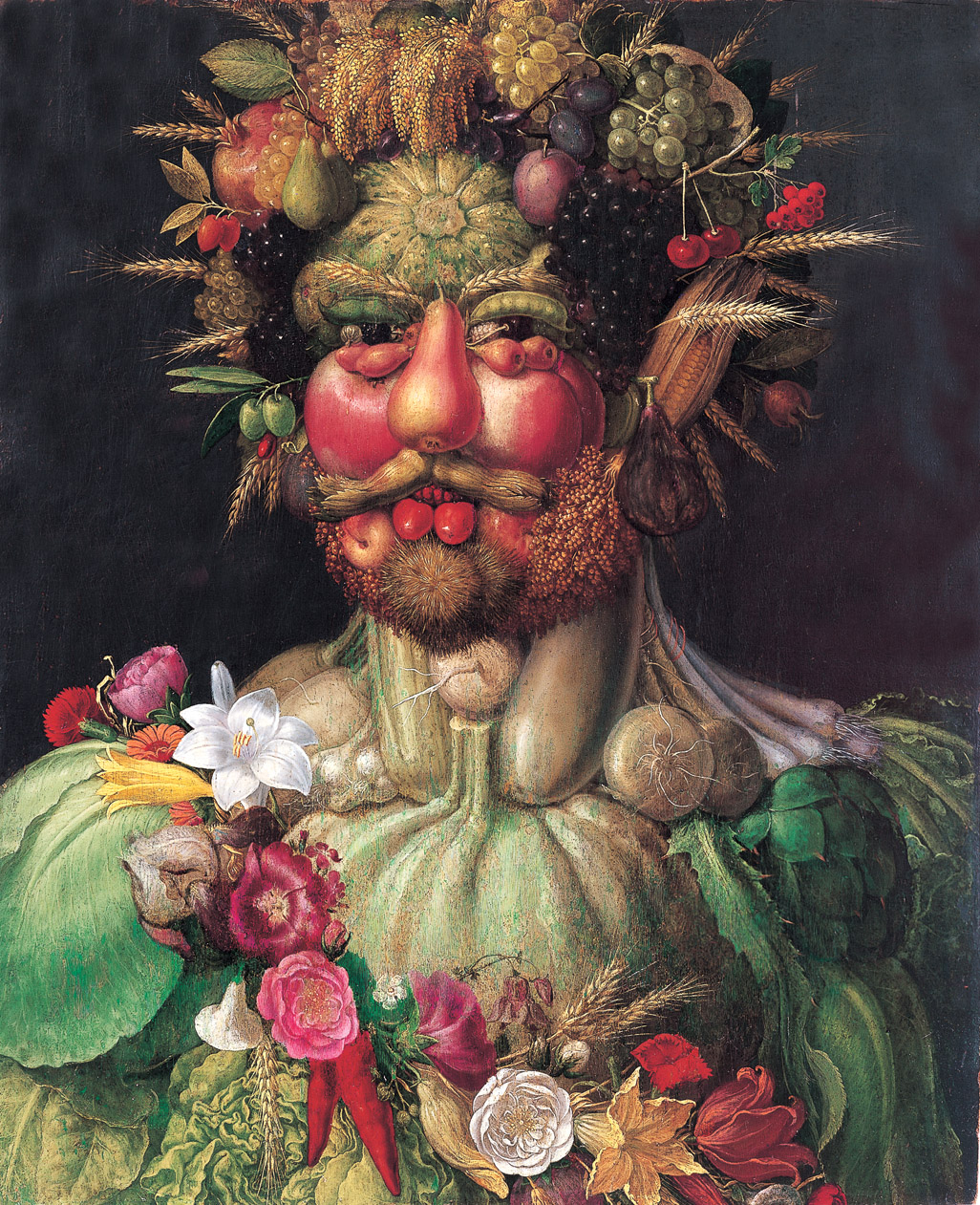
I kind of want to make a vegetable instrument (though I imagine it's much harder than it looks). Another experiment to try in our kitchen, perhaps?
http://io9.com/5817756/vegetable-orchestra-grow-your-own-guitar
It takes some imagination to come up with such a thing -- it sounds like something out of a children's book, or a Greek myth. It reminds me of those Giuseppe Arcimboldo paintings of vegetable men, like this one, which I believe is one of his most famous:
I kind of want to make a vegetable instrument (though I imagine it's much harder than it looks). Another experiment to try in our kitchen, perhaps?
Friday, September 16, 2011
io9: Pigeon-Guided Missile Could Have Changed the Course of WWII
Well, in theory, it could have worked:
http://io9.com/5828298/pigeon+guided-missile-could-have-changed-the-course-of-world-war-ii
Carrier pigeons have actually been used in war, of course, but using them as missiles takes it to a whole new level.
For another, more humorous use of homing pigeons, check out the last section of the Wikipedia article.
http://io9.com/5828298/pigeon+guided-missile-could-have-changed-the-course-of-world-war-ii
Carrier pigeons have actually been used in war, of course, but using them as missiles takes it to a whole new level.
For another, more humorous use of homing pigeons, check out the last section of the Wikipedia article.
Wednesday, July 27, 2011
io9: Death by Fan in South Korea
As someone with an Asian mother, I'm no stranger to odd superstitions and health advice, especially quoted from "reputable" Chinese newspapers. This one's pretty good:
http://io9.com/5818197/in-south-korea-falling-asleep-in-front-of-a-fan-is-the-kiss-of-death
Reminds me a bit of my mum's "X causes cancer" line, where X is whatever I happen to be eating at the moment.
http://io9.com/5818197/in-south-korea-falling-asleep-in-front-of-a-fan-is-the-kiss-of-death
Reminds me a bit of my mum's "X causes cancer" line, where X is whatever I happen to be eating at the moment.
Subscribe to:
Posts (Atom)