is the 55th anniversary of the death of Rosalind Franklin, an unsung heroine of biophysics (Watson and Crick got all the credit, including the Nobel Prize that she should have been jointly awarded). Women like Franklin -- like Marie Curie, like Ada Lovelace -- were among my childhood idols.
I am reminded of a blog post I wrote a few months ago, wherein I discuss feminism and dead people. Perhaps mine is not the generation in which we achieve true gender equality, but it is inevitable -- I have faith that the inexorable progress of our species is headed in such a direction -- and I hope to see it within my lifetime. Someday, female scientists, artists, leaders, and thinkers will be extraordinary for their accomplishments alone; someday, no one will even think to mention that a Nobel Prize winner was female -- that she won will be accomplishment enough.
And here are some pictures of very colorful (very pretty) corn in honor of Franklin's work on the structure of DNA:
http://milkwood.net/2012/05/12/glass-gem-corn-and-other-heirloom-jewels-of-the-corn-cabinet/
Showing posts with label botany. Show all posts
Showing posts with label botany. Show all posts
Tuesday, April 16, 2013


Tuesday, June 5, 2012
BBC: The Japanese Quest for the Perfect Fruit
Asian gifting (and general social niceties) taken to a horticultural extreme:
http://www.bbc.co.uk/news/world-radio-and-tv-17352173
It's an interesting social phenomenon, but seriously, that technology and effort could be put to so much better use! If horticulturalists in Japan had only chosen to attempt, say, breeding better crop plants and alleviating hunger in the developing world, imagine all the good they could be doing. It reminds me a little of the way the Japanese electronics industry developed; for a long time, they were among the most reliable manufacturers of electronics in the world, and yet, they stuck to making things like televisions, and kitchen appliances, and little toy robot things. They innovated, of course, but it was mostly on a small scale -- how to make a better circuit board and the like -- rather than dreaming big, as big as they could have. And now, given the way the Japanese economy's looking, it might be just a little too late.
Anyhow, I don't know how that turned from "look at this interesting, slightly ridiculous cultural quirk" to "let's solve all the world's problems." But -- just look at all those melons in a row!
http://www.bbc.co.uk/news/world-radio-and-tv-17352173
It's an interesting social phenomenon, but seriously, that technology and effort could be put to so much better use! If horticulturalists in Japan had only chosen to attempt, say, breeding better crop plants and alleviating hunger in the developing world, imagine all the good they could be doing. It reminds me a little of the way the Japanese electronics industry developed; for a long time, they were among the most reliable manufacturers of electronics in the world, and yet, they stuck to making things like televisions, and kitchen appliances, and little toy robot things. They innovated, of course, but it was mostly on a small scale -- how to make a better circuit board and the like -- rather than dreaming big, as big as they could have. And now, given the way the Japanese economy's looking, it might be just a little too late.
Anyhow, I don't know how that turned from "look at this interesting, slightly ridiculous cultural quirk" to "let's solve all the world's problems." But -- just look at all those melons in a row!
Sunday, November 13, 2011
BBC: Human-Induced Fires Sow Seeds of the Future
"Natural" selection at work:
http://www.bbc.co.uk/news/science-environment-15674495
It's an interesting, if not surprising, case of observable evolution, much like the moths adapting to soot-stained England a century or two ago.
http://www.bbc.co.uk/news/science-environment-15674495
It's an interesting, if not surprising, case of observable evolution, much like the moths adapting to soot-stained England a century or two ago.
Wednesday, October 26, 2011
io9: Vegetable Orchestra
A strange, wonderful idea:
http://io9.com/5817756/vegetable-orchestra-grow-your-own-guitar
It takes some imagination to come up with such a thing -- it sounds like something out of a children's book, or a Greek myth. It reminds me of those Giuseppe Arcimboldo paintings of vegetable men, like this one, which I believe is one of his most famous:
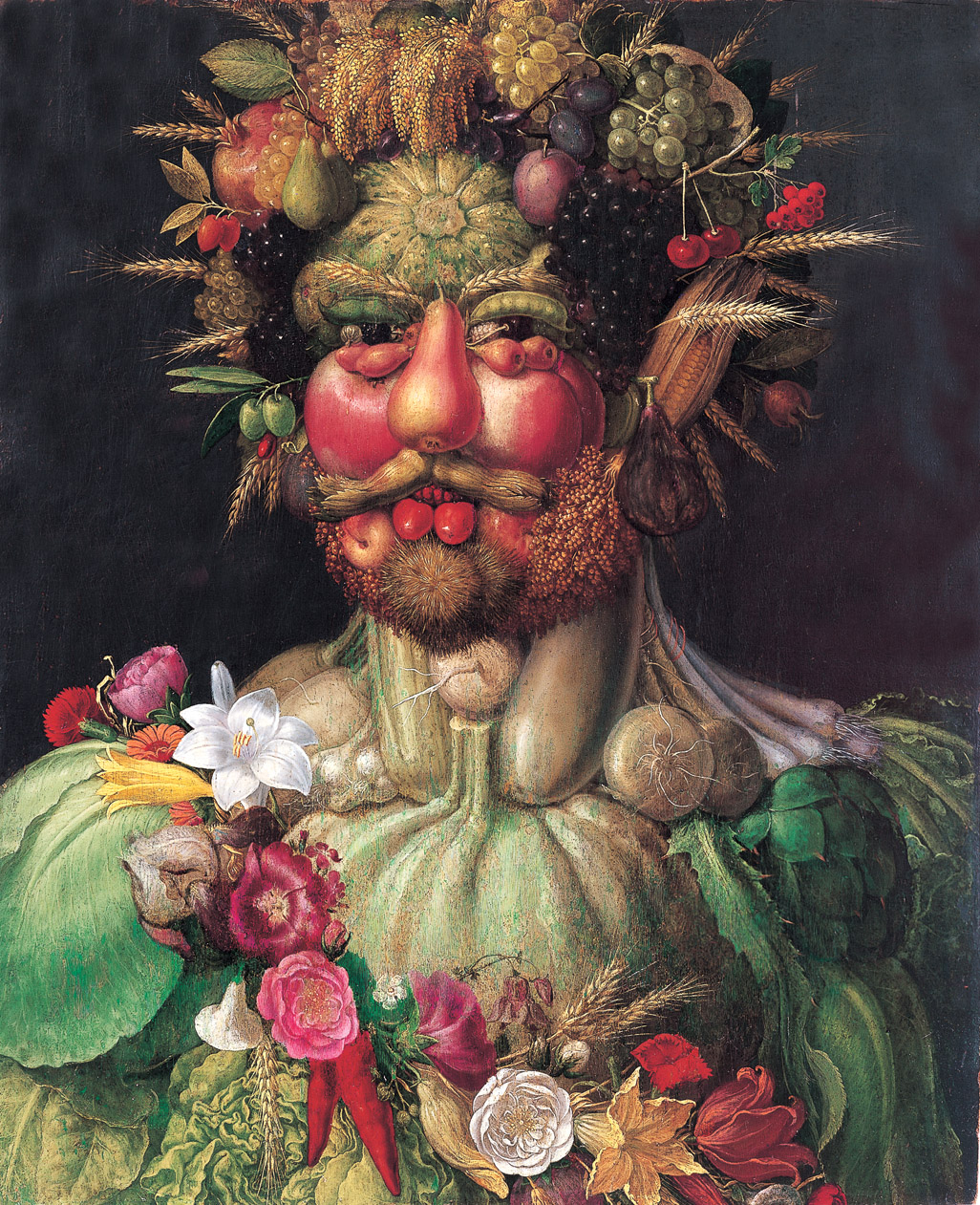
I kind of want to make a vegetable instrument (though I imagine it's much harder than it looks). Another experiment to try in our kitchen, perhaps?
http://io9.com/5817756/vegetable-orchestra-grow-your-own-guitar
It takes some imagination to come up with such a thing -- it sounds like something out of a children's book, or a Greek myth. It reminds me of those Giuseppe Arcimboldo paintings of vegetable men, like this one, which I believe is one of his most famous:
I kind of want to make a vegetable instrument (though I imagine it's much harder than it looks). Another experiment to try in our kitchen, perhaps?
Tuesday, May 24, 2011
NYTimes: Dragon Fruit has a Knack for Getting Noticed
The New York Times has discovered the dragon fruit:
http://www.nytimes.com/2011/05/11/dining/dragon-fruit-has-a-knack-for-getting-noticed.html
I'm passably familiar with this odd-looking fruit; it's rather common in Chinese supermarkets when it's in season, and especially in China. It's interesting how America/Western Europe picks up products and practices from elsewhere in the world, and then all of a sudden, with a bit of marketing, they become the next big thing. Then again, that's been happening for hundreds of years (tea, anyone?).
I think it dates back to the Classical Roman idea of the exotic (it applies to most empires in human history -- Rome just happened to be one of the better-documented ones). The Romans often conquered because they were interested in the goods produced by far-flung lands -- silk from Asia, cotton from Egypt, horses from the Arabian Peninsula, &c. Trade quickly resulted in a demand for more specialized luxury products, such as spices and exotic pets, which were valuable for their scarcity, difficulty of transport, unfamiliarity, and distant origins -- sometimes more so for these incidental factors than for their inherent trade value.
Nowadays, there are all these health-, beauty-, and palate-related fads that claim to provide some benefit intrinsic to their provenances. Stripped down, they're much the same thing.
http://www.nytimes.com/2011/05/11/dining/dragon-fruit-has-a-knack-for-getting-noticed.html
I'm passably familiar with this odd-looking fruit; it's rather common in Chinese supermarkets when it's in season, and especially in China. It's interesting how America/Western Europe picks up products and practices from elsewhere in the world, and then all of a sudden, with a bit of marketing, they become the next big thing. Then again, that's been happening for hundreds of years (tea, anyone?).
I think it dates back to the Classical Roman idea of the exotic (it applies to most empires in human history -- Rome just happened to be one of the better-documented ones). The Romans often conquered because they were interested in the goods produced by far-flung lands -- silk from Asia, cotton from Egypt, horses from the Arabian Peninsula, &c. Trade quickly resulted in a demand for more specialized luxury products, such as spices and exotic pets, which were valuable for their scarcity, difficulty of transport, unfamiliarity, and distant origins -- sometimes more so for these incidental factors than for their inherent trade value.
Nowadays, there are all these health-, beauty-, and palate-related fads that claim to provide some benefit intrinsic to their provenances. Stripped down, they're much the same thing.
Thursday, April 28, 2011
BBC: Royal Roses Planted at Windsor Great Park
It seems like everyone is terribly excited about the upcoming nuptials of Prince William and Catherine Middleton. (I can see how it's exciting, even though the British monarchy has no real power anymore.) Related to the hoopla, I found an article on an interesting botanical tradition behind royal weddings:
http://www.bbc.co.uk/news/uk-england-berkshire-13152315
The Catherine rose is quite pretty, though I think the breed name really isn't quite distinctive enough. There have been so many British princesses and queens named Catherine (Henry VIII alone had two wives of that name) that I don't think, in a few decades, anyone will remember that this rose was named for this particular Catherine. (The Royal William rose, methinks, is only slightly less drably named.)
Nonetheless, it seems like a particularly beautiful thing to have a rose named after you. In this case, it's within the dictates of royal tradition, but I imagine that, for a botanist, to name a rose after someone she loved would be much like writing him a love letter or buying him a ring, only orders of magnitude greater -- like an astronomer naming a star for someone.
http://www.bbc.co.uk/news/uk-england-berkshire-13152315
The Catherine rose is quite pretty, though I think the breed name really isn't quite distinctive enough. There have been so many British princesses and queens named Catherine (Henry VIII alone had two wives of that name) that I don't think, in a few decades, anyone will remember that this rose was named for this particular Catherine. (The Royal William rose, methinks, is only slightly less drably named.)
Nonetheless, it seems like a particularly beautiful thing to have a rose named after you. In this case, it's within the dictates of royal tradition, but I imagine that, for a botanist, to name a rose after someone she loved would be much like writing him a love letter or buying him a ring, only orders of magnitude greater -- like an astronomer naming a star for someone.
Saturday, October 9, 2010
MSNBC: New Species from New Guinea
And this is why conservation matters:
http://cosmiclog.msnbc.msn.com/_news/2010/10/05/5235675-new-species-from-new-guinea?GT1=43001
I especially like the "bug with bugged-out pink eyes". It's actually kind of pretty, in a bright, insectoid sort of way.
http://cosmiclog.msnbc.msn.com/_news/2010/10/05/5235675-new-species-from-new-guinea?GT1=43001
I especially like the "bug with bugged-out pink eyes". It's actually kind of pretty, in a bright, insectoid sort of way.
Wednesday, August 18, 2010
The Most Efficient Way to Mow a Lawn (article)
A whimsical, fun article on how to mow one's lawn in the most geometrically efficient way possible:
http://realestate.msn.com/listarticle.aspx?cp-documentid=25152485>1=35000
As was mentioned, we don't take particular care of our lawn (especially in the back), but my parents engage the local troupe of mowing-people (if there is a technical term for such, I don't know it) once a year in the spring. I wish they wouldn't; the mowing-people are rather careless with flowers, and have chopped the blooms off our daffodils every year since I've been in high school. I wouldn't mind if the yard were overgrown with weeds and wildflowers and sprawling hedges taller than I am -- I would rather enjoy the Secret Garden-esque feel of it, methinks. It's a pity my mother likes things neat, and that both my parents are afflicted with varying degrees of hayfever.
http://realestate.msn.com/listarticle.aspx?cp-documentid=25152485>1=35000
As was mentioned, we don't take particular care of our lawn (especially in the back), but my parents engage the local troupe of mowing-people (if there is a technical term for such, I don't know it) once a year in the spring. I wish they wouldn't; the mowing-people are rather careless with flowers, and have chopped the blooms off our daffodils every year since I've been in high school. I wouldn't mind if the yard were overgrown with weeds and wildflowers and sprawling hedges taller than I am -- I would rather enjoy the Secret Garden-esque feel of it, methinks. It's a pity my mother likes things neat, and that both my parents are afflicted with varying degrees of hayfever.
Thursday, August 5, 2010
Having an O'Keefe Moment...
I have wonderful friends (Amy and Cindy) who decided that the perfect joint (with Weily) early birthday celebration would be a picnic in Central Park, and the perfect gifts would include adorable cards and this stunning rose:

It is even more beautiful in real life; the orange-ish bits are actually a jewel-shade of magenta.
You guys are the best! Thank you!

It is even more beautiful in real life; the orange-ish bits are actually a jewel-shade of magenta.
You guys are the best! Thank you!
Wednesday, August 4, 2010
BBC: The Case for Genetically Modified Food
This is a very interesting, very well-written take on the GM food debate:
http://news.bbc.co.uk/2/hi/science/nature/8789279.stm
It is indisputable that there exists a global food problem. There are many ways towards solving it, many of which can be implemented alongside others. Genetically modified produce is one such solution. While it has its problems, it is, as the article suggests, one of the best solutions available. There is no magical cure-all -- GM foods may be the best we can do with the technology we have.
To the people who are concerned about personal health: it's not perfect. It's far from perfect. That's what the FDA is for. If you're going to let doctors play with things like human stem cell regeneration, which is an accepted scientific practice nowadays, have a little faith in GM foods, too. It's progress. The risk factor is the price we've paid for technology and advancement of civilization ever since we first became Homo sapiens.
I'd eat some GM foods. Not all of them -- I'm not stupid (I don't think) -- but certainly the more widely available and well-regulated ones.
http://news.bbc.co.uk/2/hi/science/nature/8789279.stm
It is indisputable that there exists a global food problem. There are many ways towards solving it, many of which can be implemented alongside others. Genetically modified produce is one such solution. While it has its problems, it is, as the article suggests, one of the best solutions available. There is no magical cure-all -- GM foods may be the best we can do with the technology we have.
To the people who are concerned about personal health: it's not perfect. It's far from perfect. That's what the FDA is for. If you're going to let doctors play with things like human stem cell regeneration, which is an accepted scientific practice nowadays, have a little faith in GM foods, too. It's progress. The risk factor is the price we've paid for technology and advancement of civilization ever since we first became Homo sapiens.
I'd eat some GM foods. Not all of them -- I'm not stupid (I don't think) -- but certainly the more widely available and well-regulated ones.
Saturday, June 26, 2010
Romantic Gardens Exhibit at the Morgan Museum
I do believe I've mentioned the Morgan Museum before. It was the private estate of the millionaire banker J. P. Morgan before he bequeathed it, in his will, unto the people of New York as a museum. It always has interesting exhibits, even though it's much smaller than, say, the Met. There's one in particular that's showing this summer, that I especially want to see. It's on the landscaping and outdoor architecture of manor estates during the Romantic period:
http://www.themorgan.org/exhibitions/exhibition.asp?id=27
http://www.themorgan.org/exhibitions/exhibition.asp?id=27
Tuesday, June 15, 2010
NYTimes: Planting the Strip Between Sidewalk and Street
I've always thought that the little strips of grass by the curb are rather lonely and neglected. The trees planted there sometimes create cracks in the sidewalk, and the grass is always rather thin and the soil rather loose. I'm glad people are reclaiming it, like so:
http://www.nytimes.com/2010/05/27/garden/27garden.html?hpw
Maybe that can be another new project this summer. We have a good few yards of grass strip in front of our house.
A list of erosion-controlling plants: http://www.theodorepayne.org/plants/plants_for_erosion_control.htm. The monkey flower is very pretty, but requires a lot of water.
http://www.nytimes.com/2010/05/27/garden/27garden.html?hpw
Maybe that can be another new project this summer. We have a good few yards of grass strip in front of our house.
A list of erosion-controlling plants: http://www.theodorepayne.org/plants/plants_for_erosion_control.htm. The monkey flower is very pretty, but requires a lot of water.
Friday, June 4, 2010
NYTimes: A Resurgence of Terrariums
Self-sufficient gardens in little glass jars; like snowglobes, but better:
http://www.nytimes.com/2010/06/03/garden/03terrarium.html
I want one. Hmm... maybe I'll make one over the summer? Trial and error? Hope that the plants don't die on me?
http://www.nytimes.com/2010/06/03/garden/03terrarium.html
I want one. Hmm... maybe I'll make one over the summer? Trial and error? Hope that the plants don't die on me?
Monday, May 24, 2010
BBC: French Farmers turn Champs-Elysees into Huge Farm Fair
I've been to the Champs-Elysees, and the idea of it turning into a giant farm for two days is a little mindboggling.
http://news.bbc.co.uk/2/hi/europe/10143393.stm
I want to go see it, but it's only around for a few days.
There's also a video on Al Jazeera.
http://news.bbc.co.uk/2/hi/europe/10143393.stm
I want to go see it, but it's only around for a few days.
There's also a video on Al Jazeera.
BBC: Waterlily Saved from Extinction
And the world's smallest waterlily, too, so it's extra special (though every species brought back from the brink of extinction is a miracle in and of itself):
http://news.bbc.co.uk/2/hi/science_and_environment/10124250.stm
I care quite a lot, if you haven't noticed, about the environment and the other species with whom we share this green Earth. Stories like this one make me very, very happy.
http://news.bbc.co.uk/2/hi/science_and_environment/10124250.stm
I care quite a lot, if you haven't noticed, about the environment and the other species with whom we share this green Earth. Stories like this one make me very, very happy.
Saturday, May 22, 2010
NYTimes: Upside-Down Gardening
One of the many things I want to try at some point (probably not in college, in this case):
http://www.nytimes.com/2010/05/20/garden/20tomato.html?src=me&ref=homepage
Plants growing out from the bottoms of hanging buckets: probably the ultimate garden for the big city apartment balcony. It also just sounds like a lot of fun.
http://www.nytimes.com/2010/05/20/garden/20tomato.html?src=me&ref=homepage
Plants growing out from the bottoms of hanging buckets: probably the ultimate garden for the big city apartment balcony. It also just sounds like a lot of fun.
Sunday, May 16, 2010
The Daffodils (by William Wordsworth)
Another nature poem:
The Daffodils
by William Wordsworth (1875)
I wander'd lonely as a cloud
That floats on high o'er vales and hills,
When all at once I saw a crowd,
A host of golden daffodils,
Beside the lake, beneath the trees,
Fluttering and dancing in the breeze.
Continuous as the stars that shine
And twinkle on the Milky Way,
They stretch'd in never-ending line
Along the margin of a bay:
Ten thousand saw I at a glance,
Tossing their heads in sprightly dance.
The waves beside them danced, but they
Outdid the sparkling waves in glee:—
A poet could not but be gay
In such a jocund company!
I gazed, and gazed, but little thought
What wealth the show to me had brought:
For oft, when on my couch I lie
In vacant or in pensive mood,
They flash upon that inward eye
Which is the bliss of solitude;
And then my heart with pleasure fills,
And dances with the daffodils.
I first read this poem in the fifth grade (gosh, that was nearly a decade ago, wasn't it?), and something about it resonated with me even then. I was too young to really appreciate much of the poetry that I came to love later, seeing as I was still rather too immature for love poetry (I read "Shall I Compare Thee to a Summer's Day" around then, as well, and thought it rather too mushy for my tastes), but I thought "The Daffodils" singularly inspired.
We had daffodils growing on our front lawn, then, and the lawn-mowing people would mistake the early shoots for particularly obstinate weeds, and cut them down before they bloomed. I cried -- I remember it distinctly. I would come home from school and kneel in the freshly cut grass, running my fingers over the ragged ends of those yellow-green shoots and wishing for daffodils. Then my mum would shout through the screen door that I was getting grass stains on the knees of my jean -- didn't I know that they were so hard to get out, even with a stiff-bristled brush? -- and I would go back inside the house, lock the bathroom door as I ran my hands under the tap, and cry for the daffodils that wouldn't be blooming this year, again.
The Daffodils
by William Wordsworth (1875)
I wander'd lonely as a cloud
That floats on high o'er vales and hills,
When all at once I saw a crowd,
A host of golden daffodils,
Beside the lake, beneath the trees,
Fluttering and dancing in the breeze.
Continuous as the stars that shine
And twinkle on the Milky Way,
They stretch'd in never-ending line
Along the margin of a bay:
Ten thousand saw I at a glance,
Tossing their heads in sprightly dance.
The waves beside them danced, but they
Outdid the sparkling waves in glee:—
A poet could not but be gay
In such a jocund company!
I gazed, and gazed, but little thought
What wealth the show to me had brought:
For oft, when on my couch I lie
In vacant or in pensive mood,
They flash upon that inward eye
Which is the bliss of solitude;
And then my heart with pleasure fills,
And dances with the daffodils.
I first read this poem in the fifth grade (gosh, that was nearly a decade ago, wasn't it?), and something about it resonated with me even then. I was too young to really appreciate much of the poetry that I came to love later, seeing as I was still rather too immature for love poetry (I read "Shall I Compare Thee to a Summer's Day" around then, as well, and thought it rather too mushy for my tastes), but I thought "The Daffodils" singularly inspired.
We had daffodils growing on our front lawn, then, and the lawn-mowing people would mistake the early shoots for particularly obstinate weeds, and cut them down before they bloomed. I cried -- I remember it distinctly. I would come home from school and kneel in the freshly cut grass, running my fingers over the ragged ends of those yellow-green shoots and wishing for daffodils. Then my mum would shout through the screen door that I was getting grass stains on the knees of my jean -- didn't I know that they were so hard to get out, even with a stiff-bristled brush? -- and I would go back inside the house, lock the bathroom door as I ran my hands under the tap, and cry for the daffodils that wouldn't be blooming this year, again.
Saturday, May 1, 2010
Floriography
is, for the uninitiated, the Victorian practice of assigning meanings to species of flowers and plants. Friends, relatives, and lovers would send each other bouquets with which they communicated their sentiments and wishes. It was a way of saying what could not be said aloud, within the bounds of tact and social norms (more the latter, given that Victorian -- I use the term loosely -- sensibilities, especially among the elites and the educated, were circumscribed by strict propriety and etiquette).
A table: http://www.thegardener.btinternet.co.uk/flowerlanguage.html
I've always been enamored of the concept of such a cipher -- a quaint and fascinating practice, to be sure.
Wikipedia supplies another such glossary (included herein for cross-referencing purposes): http://en.wikipedia.org/wiki/Floriography
A table: http://www.thegardener.btinternet.co.uk/flowerlanguage.html
I've always been enamored of the concept of such a cipher -- a quaint and fascinating practice, to be sure.
Wikipedia supplies another such glossary (included herein for cross-referencing purposes): http://en.wikipedia.org/wiki/Floriography
Subscribe to:
Posts (Atom)