Showing posts with label fiction. Show all posts

Saturday, January 24, 2015

BBC: Death... Not Quite Permanent?

I've been pondering life and death again (you know, as you do). We humans tend to think of the two as definite, opposing states of being. The vast majority of the time, we have no problem identifying someone as "alive" or "dead." But, as science fiction has predicted, we've arrived at an age when these concepts are no longer quite binary -- when it's possible to restore to life someone who's been, albeit briefly, declared dead. See this article from last year:

http://www.bbc.com/future/story/20140704-i-bring-the-dead-back-to-life

Cryonics and cryogenics has been a well-trodden trope in popular fiction for decades, from the works of Robert Heinlein and Arthur C. Clarke (of the "Golden Age of Science Fiction") to Captain America's decades of being frozen in a block of ice. Science is nowhere near such capabilities, of course, and it's important for the general public to understand what is and is not possible, to be able to distinguish between fact and fiction (and fiction that might well become fact in the future). Most of the scientists cited in the above BBC article, for example, are careful to qualify their work. But the mere possibility -- the mere notion that we might be capable of blurring the boundary between life and death -- calls into question some of humanity's most deep-seated beliefs.

One of the most memorable moments in genomics research (which could be considered the other end of the debate) came from Dr. Craig Venter, the geneticist and entrepreneur best known for his work in mapping the human genome and in artificially synthesizing life. When he was asked how he felt about "playing God," Venter famously replied, "I don't play."

Clever quip aside, the creation of life and the reversal of death are traditionally the provinces of myth. Much of human fascination with divinity and the supernatural stems from our desire to understand -- and in some small way, influence -- these opaque, immutable bookends to our time on earth. We, like all other living creatures, are by nature afraid of death, and seek to stave it off as long as we can. If given the option to return from the other side, I'd venture that most people would do so without hesitation. And who wouldn't want to bring back a newly-deceased loved one, if they could?

What, then, might it mean to live, if we could choose not to die? Issues of reproduction and overpopulation aside (though those, too, would become important challenges), would near-immortality change the nature of humanity? How and why would one decide to die? Tolkien's elves, incidentally, would be a close approximation of that dilemma.

I'm reminded of something a wise man once said, about that final journey:
"After all, to the well-organized mind, death is but the next great adventure."
~Albus Dumbledore, Harry Potter and the Sorcerer's Stone

Thursday, January 8, 2015

Advice on Life, Creativity, and Making Meaning, from the Creator of Calvin and Hobbes

I'll be the first to admit that I'm not as well-versed in the iconic comic Calvin and Hobbes as I should be. What little I've seen of it has moved me, and I mean to read more, truly. Bill Watterson is a rare talent. And he gives some pretty inspiring advice, too, both for creatives and for everyone else:

http://www.fastcodesign.com/3027095/4-tips-on-creativity-from-the-creator-of-calvin-hobbes

The four maxims Watterson presents are by no means comprehensive, but they do form a solid foundation for a creative life. And, even though it's clear from context that he uses "creative" to mean "artistic," I believe his advice holds true for any field involving passion and productivity, which is most of them.

Essentially, it boils down to: "Do something you love (no field is too small or esoteric), stay true to your vision, and give it 110%." Sensible for anyone, but especially for creatives who face a long, risky, uphill battle with no surety of success and with little but their own belief to light their way. It's true of artists, entrepreneurs, and innovators of all stripes -- one hopes to have the cultural impact Watterson did.

And then there's this, which was illustrated by Gavin Aung Than of Zen Pencils:

http://www.slate.com/blogs/browbeat/2013/08/27/bill_watterson_s_cartoonist_s_advice_in_comic_form_by_zen_pencils_aka_gavin.html

In its narrowest reading, this graphic interpretation of Watterson's words vindicates stay-at-home parenting -- for either gender. While challenging normative views of masculinity and patriarchy is daring and important, it isn't quite innovative today. Rather, the broader readings of this comic are more interesting: in a society where status -- as defined by a widely accepted slate of value judgments -- is in part determined by income and prestige of employment, Watterson and Than assert that one can viably choose not to take part in that hierarchy (or at least, choose to ignore it). If your idea of meaning and fulfillment cannot be met within the traditional system, it's legitimate to create your own. You shouldn't let society influence or shame you into pursuing a traditional path towards conventional markers of success.

It's an almost Thoreauvian way of living -- not necessarily the most practical or accessible, but a worthy goal nonetheless.

Monday, February 3, 2014

"Borges and I" by Jorge Luis Borges

I was just rereading one of my favorite short stories, and I wanted to share it with all of you. It's a very short piece called "Borges and I" by Jorges Luis Borges, and may be found here:
http://www.sccs.swarthmore.edu/users/00/pwillen1/lit/borg&i.htm

It's not precisely a story, and it's so short that it might qualify more as flash fiction or microfiction -- or perhaps not any sort of fiction at all. I first encountered it, that I can remember, in a philosophy of literature course at university. Even then, I was awed by the way the piece conveys all the meaning of an essay in just a few paragraphs. It's stayed with me, the idea of the human being as a vessel for the creative spirit, much like Athena in the skull of Zeus.

In particular, there's the line "I live, let myself go on living, so that Borges may contrive his literature, and this literature justifies me." I find that over the past few years, I've appropriated that term, "justify," for my own use when thinking about creative output, human identity, and self-worth. It's a particularly powerful word in that it demands an answer. A person spends a lifetime striving for that answer -- especially artists, philosophers, creators, and others who feel the need to pursue goals greater than themselves.

It also introduces, in just a few turns of phrase, the dichotomy of solitary creation and human experience. Art is usually a form of commentary and a crystallization of ideas -- even if the artwork and the artist espouse no agenda nor any overt message. Good art requires some understanding of the themes and cadences of human existence, of living our lives on this planet. And yet so often, when an artist in the act is not experiencing anything new of the outside world; rather, he experiences himself in the act of creation. So, in one flesh and one mind, there must be some rub between the human being who lives and learns, and the artist who creates. Is it, then, the artist's fate to oscillate forever?

Just some food for thought, going into the new year. (The lunar New Year was this weekend.)

Wednesday, February 15, 2012

BBC: V (for Vendetta) as a Cultural Symbol

In light of the Occupy movement's and Anonymous's adoption of the Guy Fawkes mask as a rallying image, Alan Moore, the creator of the original comic V for Vendetta writes for the BBC on the cultural cachet that the vigilante V holds in the collective consciousness:

http://www.bbc.co.uk/news/technology-16968689

The tagline should be V's quotation about how he's not a man, but an idea -- and ideas never die. One of the problems that the Occupy movement, at least, will have to confront, is precisely that it's an idea, an exercise of populist sentiment. Its lack of leadership and a practical agenda might well deflate the movement. The advantage that V had is that his idea was embodied in a single person, with his own goals and vision, his own coherent plan of action. He was the figurehead, if not the de facto leader of his own revolution. Occupy doesn't have that single person, than coherency. It has the mask -- many such masks -- but not the single visionary behind it.

Monday, October 17, 2011

Map of Top 100 SciFi & Fantasy Books

Something that Brett sent me a few weeks ago that every scifi/fantasy nerd should appreciate: 


(You'll have to click on it to see everything.)

I'm glad that there's such diversity in this map, including quite a few books that wouldn't conventionally be found in the scifi/fantasy section of the bookstore. It's also wonderful that it doesn't portray The Lord of the Rings as the founding bedrock of the genre (not to understate Tolkien's genius); there were plenty of classic novels that should be recognized as scifi/fantasy (like Frankenstein and Cat's Cradle, by Mary Shelley and Kurt Vonnegut, respectively).

Friday, August 27, 2010

Looking for McGonagall, Perhaps?

The average LOLcat is pretty inane, but occasionally, they come up with really clever ones. I thought this one was quite good:


The surprised expression on the cat's face is just perfect. And it's a black cat! You know what they say about black cats!

Tuesday, August 24, 2010

The Uncommon Reader (by Alan Bennett)

I recently read, and feel obliged to recommend, this novella:

http://www.indiebound.org/book/9780312427641

http://www.indiebound.org/book/9780312427641

It's a really whimsical little work about the Queen of England, who develops bibliophilic tendencies late in life, and the havoc her reading habits wreak upon the government of Great Britain. (As a fellow literature enthusiast, I can definitely relate!) It reads like a faerie story for grown-ups. It was cute, but not sickeningly so, and literary (for certain definitions thereof) without being inaccessible. It's meta, self-consciously so (a book about reading!), but in a quirky, endearing way. It's a very quick read -- perfect for a subway ride.

Thursday, July 22, 2010

The Problem with World-Hopping Fantasy Novels

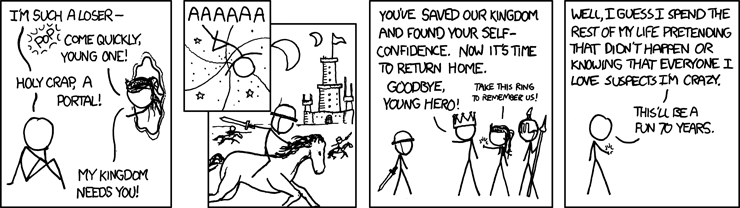
I've always wondered about this, actually, in the back of my mind:


http://xkcd.com/693

(Click on the image; it's a little small to read.)

Neil Gaiman's story "The Problem of Susan" addressed this in the Narnia-verse (Lewis himself touches upon the problem in the later books), but few of the subsequent Narnia-inspired world-hopping fantasy novels really deal with the problem of post-return adjustment, especially since the protagonists often spend years of their lives in these otherworlds, only to come back the same age as when they left. One would think that there would be some period of time immediately afterwards where the protagonists couldn't help acting oddly, out of habit, and were shipped off to a psychiatrist or something. (That would make an interesting story, come to think of it.)

This is a problem often found in the work of inexperienced fantasy writers; I see this sort of thing every day in the slush pile (which is, for the uninitiated, the flood of unsolicited submissions we get in the submissions inbox). Advice/food for thought for aspiring fantasy writers, from someone who reads (and judges) your submissions:

(a) What the deuce would a magical world need from some kid (it's invariably a teenager) from Earth that a native couldn't do better (and don't give me any of that "prophecy" drivel)?

(b) Why would you ever leave your admittedly ordinary life on Earth on the request of some elf-guy who randomly appears in your bedroom? How do you know they won't just bash you over the head and eat you? I've been told I'm entirely too trusting, but even I know better than to trust strangers who break into my house.

(c) What makes you think that someone didn't just slip something into your drink? If someone tells me I'm the savior of the world and makes some pretty sparkling lights, I'd assume I ate something funny, not that I needed to travel to another dimension and face the legions of the Dark Lord, or something equally preposterous.

I'd caveat that all of this can be done well. But generally, most of the people who think they can do it well really, really can't (and the ones who can and know they can are generally pretty modest about such things).

Thursday, June 10, 2010

Ten Rules for Writing Fiction

Writers share their personal sets of ten(ish) rules for writing fiction:

http://www.guardian.co.uk/books/2010/feb/20/ten-rules-for-writing-fiction-part-one


It is rather interesting that the rules are so different for each author. This is a pretty hard-hitting list (Neil Gaiman, Margaret Atwood, Geoff Dyer, &c.). Goes to show that it doesn't really matter how you write, as long as you do it well.

Thursday, June 3, 2010

I, Cthulhu, or, What’s A Tentacle-Faced Thing Like Me Doing In A Sunken City Like This (Latitude 47° 9' S, Longitude 126° 43' W)?

Neil Gaiman's romp in the Lovecraft universe:

http://www.tor.com/index.php?option=com_content&view=blog&id=58523

Gaiman's a brilliant fanfiction writer. (He's also a brilliant writer, period, but then you already knew that.) This isn't his first foray into fanfiction (he wrote "The Problem of Susan" in response to The Chronicles of Narnia) nor into the Cthulhu mythos (his well-known story "A Study in Emerald" is a Sherlock Holmes and Cthulu crossover). It makes sense, given the nature of his work. Since American Gods, and the Sandman comics before that, he's worked in a rich literary and cultural tradition. With all the clever and nuanced allusions he makes, one would think he was raised in a library.

Anyhow, this was first brought to my attention many months ago by a good friend and teacher, Lisa. Good things are meant to be shared.

Friday, May 21, 2010

Bartleby

Bartleby is an online database of poetry, prose (fictional and otherwise), reference works, quotations, &c. It's tremendously useful, and I thought others might benefit from knowing about it.

http://bartleby.com

Monday, May 17, 2010

NYTimes: Twilight Babies -- Like Oedipus's Spawn, Minus the Literary Merit

If you know me, you probably know how much I dislike the disturbingly popular Twilight series. You can imagine, then, that I was quite horrified to read this:

http://www.nytimes.com/2010/05/08/us/08names.html?ref=books

I fear for the future of American children. Seriously, I'd have such self-esteem issues (and/or hate my parents) if I learned that I was named after a sparkly manic-depressive vampire, or an emotionally dependent, teenaged mother (whose child subsequently falls for a man old enough to be her father (who actually almost was her father)). I'm not making this up -- it's like the descent lines in Oedipus, only the author doesn't actually realize how messed up the situation really is. When Aeschylus and Sophocles did it, it was meant to be horrible and crazy and actually tragic, rather than an obliviously abusive relationship between Bella "I have no life outside of my boyfriend" Swan and Edward "I'm a thousand years old but still angst like a high school emo kid" Cullen, masquerading as true love. You want true love? Read Tolkien.

(It's labeled "humor" because it's kind of an acute case of schadenfreude.)

Thursday, May 13, 2010

Limyaael's Fantasy Rants

http://coyotecult.com/communities/sfandf_critters/references/limyaael.php

This should be required reading for any scifi/fantasy writer. It's some of the most cogent writing and worldbuilding advice I've found in my years of writing fantasy fiction and trawling the tubes. Limyaael, as the author calls herself, addresses many of the problems endemic to the genre and to amateur writing in general, everything from overused and misused tropes to plot holes (which are just as dangerous as, but not identical to, pot holes), all in the form of informal, snarky essays she calls "rants."

I know that this archive has been an education for me, and I hope it's been, and will continue to be, widely read and shared. The science fiction and fantasy community is better for it.

Tuesday, May 11, 2010

Neil Gaiman

I am constantly surprised by people who don't know who he is. Neil Gaiman is a rock star of the literary world (no, seriously, there was some newspaper or something that used those exact words). He's the author of such works as American Gods, Stardust, Coraline, Good Omens (co-authored with Terry Pratchett, another literary titan), and of course, the Sandman graphic novels. He's a genius, and I only hope that someday, I might have a tenth of his talent. Anyhow, he keeps a blog, which is smart and funny and full of interesting tidbits, here: http://journal.neilgaiman.com.

(The rest of his website, http://www.neilgaiman.com, is also chock full of cool material, including some fiction, but the blog does tend to have the latest news.)

Monday, May 10, 2010

NYTimes: Steampunk!

http://www.nytimes.com/2008/05/08/fashion/08PUNK.html?_r=1&em&ex=1210392000&en=38483d5ad02044a4&ei=5087%0A

I'm so glad a credible, mainstream news source has finally picked up on it! I'm a fan of steampunk, mostly because it incorporates many elements of Regency and Victorian culture for which I have a sort of sentimental fondness. I grew up reading Sherlock Holmes, for one (Doyle was my action-adventure fix; no comics or television for me!). Elements of steampunk I think are cool, to list a few:
- dirigibles
- clockwork
- waistcoats
- gunpowder
- horse-drawn carriages
- calling cards
(I have a bunch of Victoriana links on the blog, for more interesting tidbits.)

Friday, May 7, 2010

Garth Nix Parodies Bad Fantasy

http://www.garthnix.com/garbeliad.html

Garth Nix is an amazing writer (the Old Kingdom books are old favorites). Who knew he also has such a great sense of humor? It's almost The Eye of Argon (which was not a parody, but rather just hilariously bad), but a good deal cleverer.

Monday, May 3, 2010

The New Yorker: A Tiny Feast

http://www.newyorker.com/fiction/features/2009/04/20/090420fi_fiction_adrian

It's a really excellent short story. I love A Midsummer Night's Dream, and Chris Adrian captures the Fey Folk perfectly. And the Beastie is just a wonderful touch.