Showing posts with label words. Show all posts

Wednesday, June 19, 2013

If I Used Twitter

tonight's post would be:
2nd place at YPG spelling bee: winner got "quixotic;" my word not found in OED. Still, pretty cool consolation prize: tinyurl.com/oac7w92.
It's a very graphically interesting cover design:


That is all.

Monday, February 27, 2012

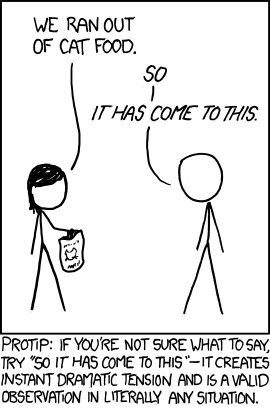
xkcd: So, It Has Come to This

Today's xkcd, which I thought was wonderfully funny:


http://xkcd.com/1022


Appending "of epic proportions" to nouns at the end of sentences achieves a similar effect, as several friends and I have discovered over the years.

Thursday, February 9, 2012

What Computer Problems Would Look Like if They Were Literally Real

Something funny that Russell sent out:


The stories about the etymologies of some tech terms are quite interesting. A "bug" used to mean, literally, that an insect had gotten stuck in the huge, room-sized computer machinery, back in the 80s or so. Even though the enactments are rather over-the-top, you can still see where a lot of the idioms arose.

Thursday, November 24, 2011

NYTimes: What's in a Name?

Seeing as it's Thanksgiving -- a celebration of family and loved ones -- I thought that this would be an appropriate article to post; it's an observation on an inevitable quandary in naming trends, given recent (within the past several decades) developments in gender equality and increasingly diverse modern familial structures:

http://www.nytimes.com/2011/11/24/fashion/babies-surnames-to-hyphenate-or-not.html?_r=1&ref=fashion?src=dayp

I've given this a fair bit of thought. As a heterosexual female, Western social customs would have me relinquish my surname in favor of my hypothetical husband's, if I were to marry at some point in my life. I'm not so keen on that, myself; I'm rather attached to my last name. It has a history behind it, a connection to generations of family and culture.

Ergo, one of my goals in life is to achieve a level of "success" (definition variable) such that if the time comes, it would appear to be logical (rather than vain or self-serving) to keep my surname. It's rather sad that society is still at a stage where a woman needs a reason to keep her maiden name, while a man may do so merely by virtue of his Y chromosome. I hope that someday, English-speaking society will have progressed such that women keep their own names as a matter of course, and some equitable system exists whereby children's surnames are evenly distributed between their sire and dam.

I'm not sure about hypothetical children (haven't given them much thought -- I'm many years too young for that!) but I imagine it would depend a lot on the ethnic origins of their father. Surnames in some languages lend themselves more readily to hyphenation than those in others. I'd want them to have a Chinese name, too. If the father were non-Chinese, I'd like to give them my own Chinese family name to use in contexts that would require it; phonetically deriving one from the father's surname seems a little cheap, next to a name with history and family.

Interestingly, in Chinese society, women retain the use of their maiden names throughout life; it's only when referring to them specifically as "wife of so-and-so" that they go by the equivalent of "Mrs." Gender equality is, in some respects (this is a pretty significant caveat), more apparent in modern Chinese society (i.e. beginning with my generation). I think it has a lot to do with the One Child Policy, in that if parents have only one child, they will give it the best they can in the way of opportunity and attention. There is much less opportunity for parents to favor sons over daughters (after the birth of the child; female infanticide is still a problem in some areas), because they typically only have one child to dote upon. The surname given to the child is still the father's, so it's not a perfect system, by any means, but in this specific practice, it's a bit closer to gender equality than in English-speaking countries.

Wednesday, August 17, 2011

Hipster Ipsum

A funny, ironic (of course) article I found on Boing Boing:

http://boingboing.net/2011/08/15/hipster-ipsum-filler-text-for-your-next-design-project.html

Lorem ipsum is itself derived from Cicero (and I use "derived from" very loosely in this context, considering how mangled it actually is), so I suppose further adulteration isn't too far from the spirit of the thing.

Oh, and see the illustration, of course. :-)

Tuesday, August 9, 2011

Microsoft Printing Dress: Wear What You Tweet

This is a really amazing bit of textile wizardry:
http://news.cnet.com/8301-17938_105-20089642-1/microsoft-printing-dress-wear-what-you-tweet/

It certainly looks much too impractical for everyday use (not to mention, I can't imagine that a lot of people would want to wear that on a day-to-day basis), but the concept is quite fascinating nonetheless. I can see it having niche appeal, mostly among technorati, and perhaps some specialized applications. Imagine being paid to wear scrolling advertisements, much like people nowadays are paid to advertise products on their websites, or their cars (like those VW beetle skins that show up now and again), or their storefronts. Maybe it'll be a futuristic version of the branding that is now ubiquitous on clothing and personal accessories. It reminds me a bit of Gibson's Pattern Recognition, actually, only in a less depressing way.

Tuesday, July 5, 2011

Adverbs, and the Killing Thereof

A humorous take on the not-so-funny problems with the way writing is taught in American grade schools:

http://www.therejectionist.com/2011/02/dear-superior-person_25.html

I remember, vaguely (it was a decade ago), the extremes to which grade school instructors went in instilling "show, don't tell" into the repertoires of their unsuspecting charges. It is, as with most rules, best applied in moderation. Fancy verbs and superfluous adverbs are annoying and frilly, and often make the text that much less readable. Beginner mistakes, to be sure, but ones that are utterly preventable -- and indeed, wouldn't crop up in the first place, if it weren't for these notions about grade school writing.

Mark Twain said it best: "If you see an adverb, kill it!"

Saturday, May 28, 2011

All Roads Lead to Philosophy

 According to Wednesday's xkcd, if you click through the first non-italicized, non-parenthetical link on any Wikipedia page, and keep clicking through every subsequent page, you will eventually reach the article "Philosophy". Naturally, I had to try this:

Friday, April 29, 2011

Stanford Themedical Dorms

This is what Frank, Wendy, and I stayed up until 4:00am doing... (It probably won't make much sense unless you attend Stanford/are familiar with our campus.)

Thursday, April 28, 2011

BBC: Royal Roses Planted at Windsor Great Park

It seems like everyone is terribly excited about the upcoming nuptials of Prince William and Catherine Middleton. (I can see how it's exciting, even though the British monarchy has no real power anymore.) Related to the hoopla, I found an article on an interesting botanical tradition behind royal weddings:

http://www.bbc.co.uk/news/uk-england-berkshire-13152315

The Catherine rose is quite pretty, though I think the breed name really isn't quite distinctive enough. There have been so many British princesses and queens named Catherine (Henry VIII alone had two wives of that name) that I don't think, in a few decades, anyone will remember that this rose was named for this particular Catherine. (The Royal William rose, methinks, is only slightly less drably named.)

Nonetheless, it seems like a particularly beautiful thing to have a rose named after you. In this case, it's within the dictates of royal tradition, but I imagine that, for a botanist, to name a rose after someone she loved would be much like writing him a love letter or buying him a ring, only orders of magnitude greater -- like an astronomer naming a star for someone.

Tuesday, January 18, 2011

NYTimes: Crafting the Perfect Crossword

I have a certain fondness for crosswords; I enjoy doing them, and I wrote a few (by hand, yes) for my high school paper (they were quite amateur, and I'm sure I would be embarrassed to see them again). A friend (John) and I would sometimes do New York Times crosswords together between classes; we wouldn't often finish, but it was fun nonetheless. And I've encountered crosswords in events like College Puzzle Challenge and Google Games; being the only fuzzy in a passel of techies does occasionally have its rewards.

Anyhow, a piece on crossword construction as a hobby and an art:

http://www.nytimes.com/2010/12/07/science/07construct.html?hpw

Monday, November 22, 2010

Bulbous Bouffant

One of my NaNoWriMo classmates showed this to us a week or two ago -- maybe it's because we were so burned out after typing away for hours, but we found it very entertaining in a spacey, surreal way:


I often find that if I say a word many times, it starts to sound strange and somehow incorrect to my ears. And some words are just irrationally funny-sounding if you really think about them. Or maybe I've been writing for way too long.

Friday, October 15, 2010

Pax Vobiscum

My roommate, Wendy, and I were discussing valedictions to formal letters, and I mentioned that I'm in the habit of signing off with "Pax vobiscum", or simply "Pax" (meaning "Peace be with you" and "Peace", respectively, in Latin). I thought that perhaps I should vary it a bit. With minimal Googling, I found the following site, which lists the translations for "peace" in practically every (written) language out there:

http://www.columbia.edu/~fdc/pace/

I'm aware that "Pax vobiscum" is most often encountered within the Catholic Church, where it has the connotation of wishing God's grace and protection upon the recipient, a benediction, of sorts. It need not be imbued with any religious meaning, as the words themselves are purely secular. Latin in itself was not originally a religious language -- unlike, say, Hebrew.

Monday, October 4, 2010

NYTimes: A Bible Reference, Hidden in a Computer Virus, Provides Clues to Origins

This sounds like something out of a Dan Brown novel:

http://www.nytimes.com/2010/09/30/world/middleeast/30worm.html?_r=1&src=me&ref=homepage

The concept of calling cards (in this case, the sort left by a criminal, rather those of a Victorian houseguest) has always both irked and fascinated me.  It's a terribly foolhardy move on the part of the hacker -- which is, I suppose the point of hacker bravado -- but also very interesting in that it's a much more sophisticated form of terrorism, specifically the claiming of a criminal act by a certain cause. It's a message and an act of war (well, pseudo-war), all in one.

So long as they don't start with Bible codes and whatnot.

Tuesday, June 29, 2010

A Word a Day

I get this in my inbox everyday:

http://wordsmith.org/awad/index.html

It's a treasure trove for logophiles, dispensed in tiny, tantalizing, tidbits every morning. Strange words, rare words, words that have fallen out of common usage, but are wonderfully interesting.

Join the mailing list -- do it.

Monday, June 28, 2010

The Minute But Very Important Differences between Nerds, Geeks, Dorks, and Dweebs

I've heard this debate countless times as I've been shunted from one such category to another for most of my life. I don't know about its accuracy, but this is probably the simplest explanation I've seen thus far:


http://www.swiss-miss.com/2010/06/what-are-you.html

According to this diagram, I'm a nerd. I guess that settles it...? (Which of these, then, are you?)

Finder's credit goes to Weily.

Friday, June 18, 2010

NYTimes: Oxford's One Word Exam, Abandoned

This sounds really interesting, like something I might have enjoyed, but I suppose it never would have affected me anyhow...

http://www.nytimes.com/2010/05/28/world/europe/28oxford.html?hp

I agree that it's not necessarily the best way to test intelligence, in that some of the most brilliant people probably did really terribly on it, but on the other hand, I think that a truly inspired essay would definitely have helped reveal some hidden talent in people who might otherwise have appeared intelligent, but not extraordinary, on their applications. Anyhow, it's an interesting exercise, and perhaps they could have offered it as a prize essay, rather than for admissions, if they really didn't see its value.

A sample exam: http://documents.nytimes.com/the-fellowship-exam-oxford-universitys-all-souls-college

Wednesday, June 9, 2010

NYTimes: Schott's Vocab

A wonderful New York Times blog about interesting words!

http://schott.blogs.nytimes.com

This is the same Ben Schott who did the various Schott's Miscellan[ies]. He is awesome. Seriously, I want to be him when I grow up.

Saturday, May 29, 2010

The Two Towers, with Engrish Subtitles

The Lord of the Rings films were international bestsellers ("Bestseller"is the book term; I'm not sure what the film equivalent might be.), with all the perils that international, multilingual showing brings. Here are a series of screenshots of a Chinese-dubbed version, which somebody attempted to subtitle in English. It's a hoot.

http://www.angelfire.com/rings/ttt-subtitles/index.html

Wednesday, May 26, 2010

FreeRice.com: Alleviate World Hunger While Expanding Your Vocabulary

It's a great concept. Basically, you complete multiple choice vocabulary questions, and for each one you get right, ten grains of rice are donated. It doesn't seem like much, but if there are enough people playing, it adds up. It takes about 7000 grains of rice to fill a cup: get twenty people to complete a piddling 35 questions a day, and you've fed somebody in the world, and improved the usage of the English language -- everyone wins!

http://www.freerice.com