So. I just became the desk editor of the arts section (known as "Intermission") of my school paper -- I start next week! -- and because it's online, I thought some of you might be interested in seeing what I'm going to be editing. To wit:
The Stanford Daily: http://www.stanforddaily.com
Intermission: http://www.stanforddaily.com/category/intermission
I've been writing for Intermission these past few years, and a few of you have expressed an interest, at some point or other, in reading what I write. A selection of my articles may be found on my author page (they're mostly about books; no surprise there): http://www.stanforddaily.com/author/sarahguan
Anyhow. Just thought my readers might like to take a gander.
Saturday, January 29, 2011


Wednesday, January 26, 2011
NYTimes: Computer System Calculates the Rarity of a Fingerprint
This is really interesting -- a small, simple idea turned into a technology that will make a difference in the world of forensics:
http://www.nytimes.com/2010/12/14/science/14obfingerprint.html?hpw
Cool, no?
http://www.nytimes.com/2010/12/14/science/14obfingerprint.html?hpw
Cool, no?
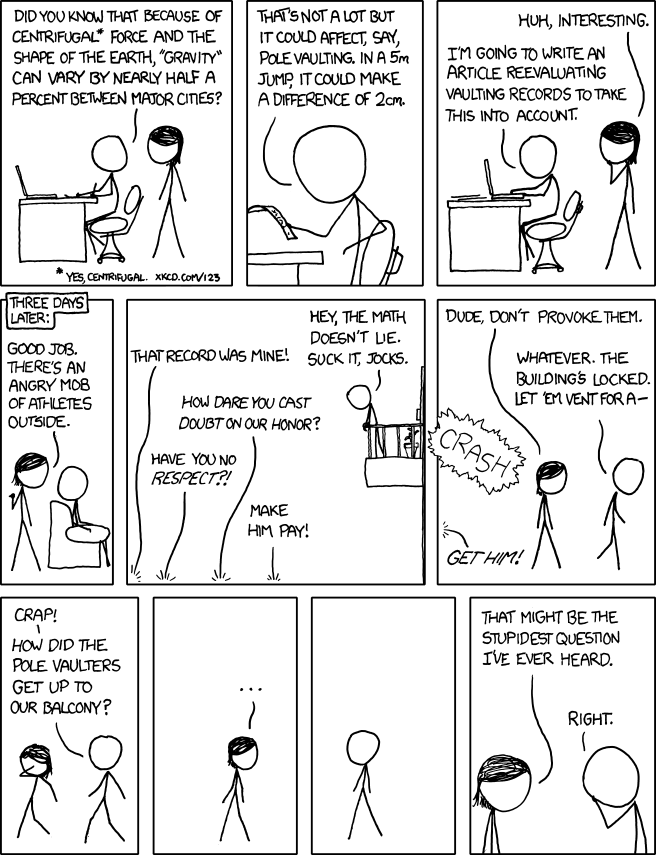
xkcd: Scientist vs. Pole Vaulters
Today's xkcd, which I thought was especially funny:
 http://xkcd.com/852/
Though, come to think of it, 2cm makes a big difference in certain sports.
Though, come to think of it, 2cm makes a big difference in certain sports.
Monday, January 24, 2011
Today
is the 1970th anniversary of the assassination of the Roman emperor Caligula, and the ascension of his uncle Claudius to his throne.
Caligula was insane. Actually, brutally insane. He made his horse consul (his motives are unfathomable, but presumably it was just because he could). He was fond of drunken orgies and senseless executions. He ruled ineffectively, squandering his treasury, and was indifferent to the starvation that resulted. It was a terrible time to be Roman.
Claudius (the one that features in Robert Graves's I, Claudius), succeeded him. He was physically infirm (this was probably how he survived Caligula's bloody reign -- he was consistently underestimated), but he was a capable and engaged administrator, well-versed in law and a prolific builder of public works. He was never completely secure on the throne (in comparison with other emperors), probably because of his manifest weakness, but was nonetheless successful in his reign.
Caligula was insane. Actually, brutally insane. He made his horse consul (his motives are unfathomable, but presumably it was just because he could). He was fond of drunken orgies and senseless executions. He ruled ineffectively, squandering his treasury, and was indifferent to the starvation that resulted. It was a terrible time to be Roman.
Claudius (the one that features in Robert Graves's I, Claudius), succeeded him. He was physically infirm (this was probably how he survived Caligula's bloody reign -- he was consistently underestimated), but he was a capable and engaged administrator, well-versed in law and a prolific builder of public works. He was never completely secure on the throne (in comparison with other emperors), probably because of his manifest weakness, but was nonetheless successful in his reign.
Thursday, January 20, 2011

Wednesday, January 19, 2011
R.I.P. R. Sargent Shriver
The obituary article:
http://www.nytimes.com/2011/01/19/us/politics/19shriver.html?hp
He is best known as the founder of the Peace Corps. My interest in him and the organization he built is that I've considered, and still am considering, applying to the Peace Corps. My parents, as one may imagine, would not be best pleased.
Rest you now in peace, Mr. Shriver, knowing that you have done a great thing, a greater and more wonderful thing than most mortal men can claim for their legacy.
http://www.nytimes.com/2011/01/19/us/politics/19shriver.html?hp
He is best known as the founder of the Peace Corps. My interest in him and the organization he built is that I've considered, and still am considering, applying to the Peace Corps. My parents, as one may imagine, would not be best pleased.
Rest you now in peace, Mr. Shriver, knowing that you have done a great thing, a greater and more wonderful thing than most mortal men can claim for their legacy.
Tuesday, January 18, 2011
NYTimes: Crafting the Perfect Crossword
I have a certain fondness for crosswords; I enjoy doing them, and I wrote a few (by hand, yes) for my high school paper (they were quite amateur, and I'm sure I would be embarrassed to see them again). A friend (John) and I would sometimes do New York Times crosswords together between classes; we wouldn't often finish, but it was fun nonetheless. And I've encountered crosswords in events like College Puzzle Challenge and Google Games; being the only fuzzy in a passel of techies does occasionally have its rewards.
Anyhow, a piece on crossword construction as a hobby and an art:
http://www.nytimes.com/2010/12/07/science/07construct.html?hpw
Anyhow, a piece on crossword construction as a hobby and an art:
http://www.nytimes.com/2010/12/07/science/07construct.html?hpw
Saturday, January 15, 2011
The Original Snuggies
This is, of course, Raphael's "The School of Athens". I have a photograph of the original in its entirety in an earlier post. The speakers depicted are Plato and Aristotle, which makes it even better.
Thursday, January 13, 2011
Boomerangs
Just something I found recently:
The game of life is the game of boomerangs. Our thoughts, deeds and words return to us sooner or later with astounding accuracy.
~ Florence Scovel ShinnIt's not a very complex thought; it's basically an eloquent explanation of karma, or causation. The line is most striking, methinks, in its use of language. There is a certain profoundness, a certain timelessness, to it, that is manifest in the use of that particular analogy.
Monday, January 10, 2011
NYTimes: The U.S.S Prius
A very interesting, ingenious mash-up of the sometimes-antagonistic causes of environmentalism and the Iraq war:
http://www.nytimes.com/2010/12/19/opinion/19friedman.html
It's brilliant, isn't it? It's a perfect argument for reducing our dependence on Middle Eastern oil that appeals to not only the "bleeding-heart, granola-crunching" segment of the American populace (which is often analogous to preaching to the choir), but also to the more conservative, more militarily-minded constituency. Military initiative has historically been one of the greatest catalysts for technological innovation (look at the internet, for example). If the military sticks with this, really pushes it and invests in it, imagine what our carbon footprints might look like in ten years.
It's going to happen, it really is. Yes we can.
http://www.nytimes.com/2010/12/19/opinion/19friedman.html
It's brilliant, isn't it? It's a perfect argument for reducing our dependence on Middle Eastern oil that appeals to not only the "bleeding-heart, granola-crunching" segment of the American populace (which is often analogous to preaching to the choir), but also to the more conservative, more militarily-minded constituency. Military initiative has historically been one of the greatest catalysts for technological innovation (look at the internet, for example). If the military sticks with this, really pushes it and invests in it, imagine what our carbon footprints might look like in ten years.
It's going to happen, it really is. Yes we can.
Thursday, January 6, 2011
MSNBC: Holiday Bauble Made by Supernova
A belatedly festive astronomical phenomenon:
http://cosmiclog.msnbc.msn.com/_news/2010/12/14/5648858-holiday-bauble-made-by-supernova?gt1=43001
It's marvellous and shiny -- what can I say?
http://cosmiclog.msnbc.msn.com/_news/2010/12/14/5648858-holiday-bauble-made-by-supernova?gt1=43001
It's marvellous and shiny -- what can I say?
Monday, January 3, 2011
Cats Playing Patty-Cake, with Dubbing
Something my sister showed me over break. It's... really really odd.
I'm not quite sure what to make of it. Somebody (two somebodies) clearly had way too much time on their hands, and also quite an active imagination. But really, how did this even happen?
I'm not quite sure what to make of it. Somebody (two somebodies) clearly had way too much time on their hands, and also quite an active imagination. But really, how did this even happen?
Subscribe to:
Posts (Atom)