I've been thinking, lately, about free will -- and I recalled this article that I read last year. It's a good, concise analysis of causality (particularly the bits about levels of complexity), and addresses some of the fallacies of breaking down human behavior into ever-smaller constituent components:
http://www.slate.com/articles/health_and_science/science/2013/09/free_will_debate_what_does_free_will_mean_and_how_did_it_evolve.html
The question is a version of "are we more than the sum of our parts?" Many people attempt to derive an answer from religion, espousing a concept of "soul," a metaphysical quantity that science is -- by definition -- unable to prove or disprove. But in the absence of such a belief, are we not just collections of atoms? Isn't each of our thought processes a mere chemical reaction in our neurons? It's a chilling way to think about ourselves; the idea that there is only one possible course of events because our actions are governed by a set immutable physical laws, that each circumstance leads logically into a specific next circumstance, is essentially a secular version of the idea of fate or predestination.
But there's a scientific argument against fate: the multiverse. If there is an infinite number of possible universes, infinitely many points at which one universe becomes multiple, then there isn't one logical state for the universe at any given point in time. The possibility of parallel universes implies, if not conscious choice at all times, then at least many possible outcomes, none of which are certain to happen. Quantum physics likewise deals with uncertainty -- with thought experiments such as Schroedinger's Cat, in which a situation manifests both possible outcomes simultaneously. Science, it appears, disproves fate.
Then, there are situations like this one, in which one person's choice, a split-second decision in a situation of incomplete information, may have prevented all-out nuclear destruction:
http://www.bbc.co.uk/news/world-europe-24280831
Given a circumstance like this, it's hard not to believe in free will. I'm sure that there's a parallel universe out there in which the world ended on September 26, 1983.
Showing posts with label physics. Show all posts
Showing posts with label physics. Show all posts
Wednesday, January 15, 2014


Wednesday, December 11, 2013
The Economist: The Dream of Interstellar Starships, or, the Hows and Whys of Technology
I'm in California, hanging out with a lot of techie folks whom I met at university. We've talked about things like Amazon drones and Elon Musk's proposed hyperloop... and naturally I was reminded of this article, which I saw in The Economist a month or two ago:
http://www.economist.com/news/science-and-technology/21588349-if-starships-are-ever-built-it-will-be-far-future-does-not-deter
Scientists have been contemplating interstellar travel for as long as science fiction authors have been writing about it (indeed, these two groups have a significant overlap). The above article catalogues some of the problems facing any space-adventuring hopefuls, most notably that of propulsion. It also asks the important question of why.
I was just discussing with a college friend the differences between the humanities and the sciences. It's engineers like them -- like the people I know who work at tech companies up and down the Bay -- who give us the means to achieve what could scarcely be imagined a few generations ago. The sciences answer the question of how. But for what purpose? To what end? Those are the questions the humanities hope to answer -- but we have too few people asking, and too few caring to ask.
There's always hype about the next great "disruptor" in the marketplace, the technology that no one ever imagines he needs, but which he soon finds indispensable (see Henry Ford and Steve Jobs, for example). But I can't help wondering: what kind of society do these visionaries hope to create with their revolutionary ideas? (There's Google's "Don't be evil," but that's hardly descriptive. It's not proscriptions, but rather prescriptions that build a new future.) Beyond the often nebulous concept of improving quality of life, how do inventors imagine their products shaping our society? (Interstellar travel, a la Star Trek, would irrevocably change the way we live and our understanding of our place in the universe.) As the article points out, "Because we can" is not a sufficient reason--it doesn't tell us why.
Some food for thought. I'll likely revisit this topic after my trip.
http://www.economist.com/news/science-and-technology/21588349-if-starships-are-ever-built-it-will-be-far-future-does-not-deter
Scientists have been contemplating interstellar travel for as long as science fiction authors have been writing about it (indeed, these two groups have a significant overlap). The above article catalogues some of the problems facing any space-adventuring hopefuls, most notably that of propulsion. It also asks the important question of why.
I was just discussing with a college friend the differences between the humanities and the sciences. It's engineers like them -- like the people I know who work at tech companies up and down the Bay -- who give us the means to achieve what could scarcely be imagined a few generations ago. The sciences answer the question of how. But for what purpose? To what end? Those are the questions the humanities hope to answer -- but we have too few people asking, and too few caring to ask.
There's always hype about the next great "disruptor" in the marketplace, the technology that no one ever imagines he needs, but which he soon finds indispensable (see Henry Ford and Steve Jobs, for example). But I can't help wondering: what kind of society do these visionaries hope to create with their revolutionary ideas? (There's Google's "Don't be evil," but that's hardly descriptive. It's not proscriptions, but rather prescriptions that build a new future.) Beyond the often nebulous concept of improving quality of life, how do inventors imagine their products shaping our society? (Interstellar travel, a la Star Trek, would irrevocably change the way we live and our understanding of our place in the universe.) As the article points out, "Because we can" is not a sufficient reason--it doesn't tell us why.
Some food for thought. I'll likely revisit this topic after my trip.
Saturday, November 9, 2013
Carl Sagan Day
Happy Carl Sagan Day!
Carl Sagan was one of the first and most well-known American populist scientists. That is, he championed the worthy cause of bringing science (especially astronomy) to the non-scientist public. (For comparison's sake, he was a contemporary of Freeman Dyson, another such luminary, and the forefather of scientists like Brian Greene and Neil deGrasse Tyson.) Sagan is perhaps best known for his novel Contact, subsequently made into an eponymous film, and for the television series Cosmos. It's fitting that he should have his own day of celebration (he would have been 79 today), wherein people contemplate the great beyond.
In addition to popularizing science, Sagan was also one of the great advocates for SETI in his day, as well as a proponent of nuclear disarmament. He was, as were many great scientists, a profound humanist. He was the originator of the saying "We are all stardust," one of my all-time favorites. (If I were ever to get a quotation tattooed somewhere on my body, this would be a top contender. It helps that it's short.) In another life, I might have gone into astrophysics -- largely because I grew up reading books by people like him.
Addendum: the Library of Congress recently acquired Carl Sagan's papers, which include his reading lists. This is facinating stuff!
Carl Sagan was one of the first and most well-known American populist scientists. That is, he championed the worthy cause of bringing science (especially astronomy) to the non-scientist public. (For comparison's sake, he was a contemporary of Freeman Dyson, another such luminary, and the forefather of scientists like Brian Greene and Neil deGrasse Tyson.) Sagan is perhaps best known for his novel Contact, subsequently made into an eponymous film, and for the television series Cosmos. It's fitting that he should have his own day of celebration (he would have been 79 today), wherein people contemplate the great beyond.
In addition to popularizing science, Sagan was also one of the great advocates for SETI in his day, as well as a proponent of nuclear disarmament. He was, as were many great scientists, a profound humanist. He was the originator of the saying "We are all stardust," one of my all-time favorites. (If I were ever to get a quotation tattooed somewhere on my body, this would be a top contender. It helps that it's short.) In another life, I might have gone into astrophysics -- largely because I grew up reading books by people like him.
Addendum: the Library of Congress recently acquired Carl Sagan's papers, which include his reading lists. This is facinating stuff!
Sunday, September 15, 2013
Reality, Relativity, and Light
I read José Saramago's The History of the Siege of Lisbon last week -- in translation, of course, since I don't read Portuguese. It's excellent, and somewhat stylistically and structurally unusual. But I was struck, in particular, by this line, spoken to the protagonist by his lover (the relationship is rather more complicated than that, of course):
This is especially relevant to the subject matter because the 1147 Siege of Lisbon, about which the protagonist writes, was a manifestation of a centuries-old clash of cultures and religions, a battle between two peoples who understood the same God through different scriptures and different prophets. Elizabeth I once said, in another century about another religious conflict, "I would not open windows into men's souls." Such windows can only be approximated, even in the best of circumstances.
I'm also taken by the Saramago's use of light in this scene -- something one normally associates with visual art rather than with prose. It's ripe with symbolism; the notion of shedding light on something intangible, that our eyes can tell us about reality between two people, &c. I'm reminded of two things:
The second thing is Plato's Allegory of the Cave. Our understanding of what goes on inside another person's mind is rather like to the prisoners' understanding of the shadows on the wall. Another person's reality undergoes several layers of translation before it becomes comprehensible to us; the "truth" is distorted by their perception, interpreted by their mind, conveyed by their words, filtered by our ears, and only then is it analyzed by our minds. Plato's prisoners are eventually unchained, but there is no way for any of us to overcome this process of interpretation. The amount that must get lost in translation is mind-boggling. It makes me wonder what a society of perfect communication (of telepathy, essentially) would look like.
Edit: Soon after writing this post, I chanced upon an io9 article about philosophical thought experiments: http://io9.com/9-philosophical-thought-experiments-that-will-keep-you-1340952809@AnnaleeNewitz. The third entry therein, "The Beetle in the Box" (aka the Private Language Argument), is very much like what I discuss above. The second entry, "Mary the Colorblind Neuroscientist" (aka the Inverted Spectrum Problem), is also quite similar to the Allegory of the Cave. It's well worth reading.
Switch on the light, she said, I want to know if this is real. (p264)The relationship between any two people -- even within family, even between people who might have known each other their whole lives -- is a fragile thing. Within that relationship, there are layers of reality, of perception. It's a sort of relativity, even -- one that isn't governed by any laws of physics. His reality and hers could be completely different, and each moment's reality different from the next. It's odd to think that we can never know what another person's reality looks like; the closest we can come is to achieve an understanding of how our reality compares to what we perceive to be their reality, with full awareness that our vantage point colours our reading.
This is especially relevant to the subject matter because the 1147 Siege of Lisbon, about which the protagonist writes, was a manifestation of a centuries-old clash of cultures and religions, a battle between two peoples who understood the same God through different scriptures and different prophets. Elizabeth I once said, in another century about another religious conflict, "I would not open windows into men's souls." Such windows can only be approximated, even in the best of circumstances.
I'm also taken by the Saramago's use of light in this scene -- something one normally associates with visual art rather than with prose. It's ripe with symbolism; the notion of shedding light on something intangible, that our eyes can tell us about reality between two people, &c. I'm reminded of two things:
Perhaps we may frighten away the ghost of so many years ago with a little illumination...So many years after the events of "The Phantom of the Opera," the very chandelier that was associated with the disaster perpetrated by the Phantom is now a source of illumination -- both as a refurbished light fixture, and as a window into the murky past, the audience's introduction to the story. Because it is an inanimate object with a lofty vantage point, it is, in a fashion, the impartial observer of the story. And yet, it is also a crucial "participant" in the story. Its impartiality is not so much due to its placement, a lamp hanging high above the human characters, but rather because it has no free will, no desires or motivations of its own.
~ "The Phantom of the Opera," Act I, Scene 1
The second thing is Plato's Allegory of the Cave. Our understanding of what goes on inside another person's mind is rather like to the prisoners' understanding of the shadows on the wall. Another person's reality undergoes several layers of translation before it becomes comprehensible to us; the "truth" is distorted by their perception, interpreted by their mind, conveyed by their words, filtered by our ears, and only then is it analyzed by our minds. Plato's prisoners are eventually unchained, but there is no way for any of us to overcome this process of interpretation. The amount that must get lost in translation is mind-boggling. It makes me wonder what a society of perfect communication (of telepathy, essentially) would look like.
Edit: Soon after writing this post, I chanced upon an io9 article about philosophical thought experiments: http://io9.com/9-philosophical-thought-experiments-that-will-keep-you-1340952809@AnnaleeNewitz. The third entry therein, "The Beetle in the Box" (aka the Private Language Argument), is very much like what I discuss above. The second entry, "Mary the Colorblind Neuroscientist" (aka the Inverted Spectrum Problem), is also quite similar to the Allegory of the Cave. It's well worth reading.
Monday, September 9, 2013
BuzzFeed: Schrodinger and Heisenberg Walk into a Bar...
Because we need more quantum mechanics jokes in the world, even if they're really corny:

http://www.buzzfeed.com/billypeltzer/20-jokes-only-a-physics-nerd-will-appreciate-ecuv
That is all. (I am such a magpie, I know!)
Tuesday, May 7, 2013
io9: Galileo's Ship Was One of the Oldest Relativity Though Experiments
It has always irked me, a little, when people claim that Einstein "invented" relativity. The man was a genius, to be sure, and contributed greatly to our understanding of general and special relativity in modern physics -- but the idea of relativity existed well before him. The term itself is quite broad, encompassing everything from temporal and spatial relativity to more nebulous perspective- and human interaction-based concepts; it hardly seems possible that despite hundreds of years of innovation in math and physics, relativity only arose within the past century. Certainly, there have been a number of similar (if more rudimentary) observations throughout history, such as Zeno's paradox(es). One of the oldest examples dates from the Renaissance:
http://io9.com/galileos-ship-was-one-of-the-oldest-relativity-thought-486468038
It sounds like a very low-tech version of Einstein's lasers-on-a-train thought experiment, doesn't it?
This brings to mind a blog post from about a year ago... Straying away from the sciences for a moment, relativity as an abstract concept -- even models of relative perspective uncannily like the sort of thought experiments Einstein proposed -- seems to have existed in the literary and cultural milieu for quite a while. It's reasonable to conjecture that there was some cross-pollination. (Eliot, for example, even drops an allusion or two to relativity in "The Waste Land.") The idea of relativity is marvelously intuitive (albeit in a slightly mind-bendy way) and quite useful in describing life alongside other sentient beings.
http://io9.com/galileos-ship-was-one-of-the-oldest-relativity-thought-486468038
It sounds like a very low-tech version of Einstein's lasers-on-a-train thought experiment, doesn't it?
This brings to mind a blog post from about a year ago... Straying away from the sciences for a moment, relativity as an abstract concept -- even models of relative perspective uncannily like the sort of thought experiments Einstein proposed -- seems to have existed in the literary and cultural milieu for quite a while. It's reasonable to conjecture that there was some cross-pollination. (Eliot, for example, even drops an allusion or two to relativity in "The Waste Land.") The idea of relativity is marvelously intuitive (albeit in a slightly mind-bendy way) and quite useful in describing life alongside other sentient beings.
Tuesday, April 16, 2013
Today
is the 55th anniversary of the death of Rosalind Franklin, an unsung heroine of biophysics (Watson and Crick got all the credit, including the Nobel Prize that she should have been jointly awarded). Women like Franklin -- like Marie Curie, like Ada Lovelace -- were among my childhood idols.
I am reminded of a blog post I wrote a few months ago, wherein I discuss feminism and dead people. Perhaps mine is not the generation in which we achieve true gender equality, but it is inevitable -- I have faith that the inexorable progress of our species is headed in such a direction -- and I hope to see it within my lifetime. Someday, female scientists, artists, leaders, and thinkers will be extraordinary for their accomplishments alone; someday, no one will even think to mention that a Nobel Prize winner was female -- that she won will be accomplishment enough.
And here are some pictures of very colorful (very pretty) corn in honor of Franklin's work on the structure of DNA:
http://milkwood.net/2012/05/12/glass-gem-corn-and-other-heirloom-jewels-of-the-corn-cabinet/
I am reminded of a blog post I wrote a few months ago, wherein I discuss feminism and dead people. Perhaps mine is not the generation in which we achieve true gender equality, but it is inevitable -- I have faith that the inexorable progress of our species is headed in such a direction -- and I hope to see it within my lifetime. Someday, female scientists, artists, leaders, and thinkers will be extraordinary for their accomplishments alone; someday, no one will even think to mention that a Nobel Prize winner was female -- that she won will be accomplishment enough.
And here are some pictures of very colorful (very pretty) corn in honor of Franklin's work on the structure of DNA:
http://milkwood.net/2012/05/12/glass-gem-corn-and-other-heirloom-jewels-of-the-corn-cabinet/
Monday, February 18, 2013
Friday, January 4, 2013
Discover: How Would Time Travel Actually Work (or, something for all the Whovians)?
A good, cogent article on the physics of time travel:
http://discovermagazine.com/2010/mar/02-the-real-rules-for-time-travelers/
I first encountered this explanation of time travel in Harry Potter and the Prizoner of Azkaban, where Harry and Hermione use a Time-Turner to save Sirus and Buckbeak. (I trust that I didn't spoil the book for anyone -- and if I did, you're way behind the times!) The detail of the Time Turner chapter that I found most memorable was the thud of the executioner's axe: Harry and Hermione heard it fall in real time and assumed that Buckbeak had been beheaded; however, when they went back in time to rescue the hippogryff, they realized that the sound they'd thought was Buckbeak's decapitation was actually the executioner swinging the axe into a hunk of wood in frustration upon discovering that Buckbeak had escaped. Harry and Hermione, therefore, did not change the timeline using the Time Turner; rather, events incorporated all nonlinear parts and intersections of the timeline.
The concept of free will, as the above article notes, becomes problematic if this framework of time is true. Nature, it would seem, is more like a Greek tragedy than we Americans would like to believe. We are uncomfortable with the idea of external limits on our free will, and time is too nebulous to most of us to think its laws as insurmountable as, say, those of Newtonian physics. If we were told that our free will is limited by gravity (no matter how much we might wish to levitate through the air, we cannot), we do not find it unjust. Told that Oedipus had no choice but to kill his father and marry his mother, despite all of his attempts to escape his fate, we find his situation grossly unfair. The above description of time travel suggests that our universe operates more like Oedipus's than we'd imagined.
I believe in free will. I do. But I'd love to try time travelling -- it sounds fascinating.
http://discovermagazine.com/2010/mar/02-the-real-rules-for-time-travelers/
I first encountered this explanation of time travel in Harry Potter and the Prizoner of Azkaban, where Harry and Hermione use a Time-Turner to save Sirus and Buckbeak. (I trust that I didn't spoil the book for anyone -- and if I did, you're way behind the times!) The detail of the Time Turner chapter that I found most memorable was the thud of the executioner's axe: Harry and Hermione heard it fall in real time and assumed that Buckbeak had been beheaded; however, when they went back in time to rescue the hippogryff, they realized that the sound they'd thought was Buckbeak's decapitation was actually the executioner swinging the axe into a hunk of wood in frustration upon discovering that Buckbeak had escaped. Harry and Hermione, therefore, did not change the timeline using the Time Turner; rather, events incorporated all nonlinear parts and intersections of the timeline.
The concept of free will, as the above article notes, becomes problematic if this framework of time is true. Nature, it would seem, is more like a Greek tragedy than we Americans would like to believe. We are uncomfortable with the idea of external limits on our free will, and time is too nebulous to most of us to think its laws as insurmountable as, say, those of Newtonian physics. If we were told that our free will is limited by gravity (no matter how much we might wish to levitate through the air, we cannot), we do not find it unjust. Told that Oedipus had no choice but to kill his father and marry his mother, despite all of his attempts to escape his fate, we find his situation grossly unfair. The above description of time travel suggests that our universe operates more like Oedipus's than we'd imagined.
I believe in free will. I do. But I'd love to try time travelling -- it sounds fascinating.
Friday, April 27, 2012
NYTimes: A Quantum Theory of Mitt Romney
I spotted this article a few weeks ago. The little part of me that loves theoretical physics (I list Dyson and Feynman among my favorite authors, yes) thinks this is the wittiest political commentary of the election cycle:
http://www.nytimes.com/2012/04/01/opinion/sunday/a-quantum-theory-of-mitt-romney.html
Something (okay, quite a few things) about Romney just doesn't sit right with me. Probably all the hot air.
http://www.nytimes.com/2012/04/01/opinion/sunday/a-quantum-theory-of-mitt-romney.html
Something (okay, quite a few things) about Romney just doesn't sit right with me. Probably all the hot air.
Friday, March 9, 2012
Neil deGrasse Tyson, Book Critiqua, and the Universe at Large
My latest column is up! You can find it at: http://www.stanforddaily.com/2012/03/09/book-critiqua-space-chronicles/
I'd never read anything of Tyson's before this one, but Space Chronicles makes me want to check out some of his other works. His writing reminds me a little of Freeman J. Dyson's books -- an old favorite when it comes to theoretical physics.
On a related note, here's a video that Lucas sent me. It's Tyson talking about the beauty of the universe, the "we are all stardust" sentiment. (He says it more poetically than I do.) People who don't think that atheists can find meaning in life should watch this.
I'd never read anything of Tyson's before this one, but Space Chronicles makes me want to check out some of his other works. His writing reminds me a little of Freeman J. Dyson's books -- an old favorite when it comes to theoretical physics.
On a related note, here's a video that Lucas sent me. It's Tyson talking about the beauty of the universe, the "we are all stardust" sentiment. (He says it more poetically than I do.) People who don't think that atheists can find meaning in life should watch this.
Friday, February 24, 2012
Fire and Ice (by Robert Frost)
I presented this very famous poem today in a history class about Einstein and his work. It's a beautiful little piece, and it's interesting to consider in the context of relativity and nuclear technology.
Fire and Ice
by Robert Frost (1920)
Some say the world will end in fire,
Some say in ice.
From what I’ve tasted of desire
I hold with those who favor fire.
But if it had to perish twice,
I think I know enough of hate
To know that for destruction ice
Is also great
And would suffice.
I'm doing my paper on the cultural conversation between 20th century literature and Einsteinian physics. Relevant authors (of which I'll be discussing some subset in the paper) are people like Virginia Woolf, William Faulkner, T. S. Eliot, Kurt Vonnegut, and of course, Robert Frost.
Fire and Ice
by Robert Frost (1920)
Some say the world will end in fire,
Some say in ice.
From what I’ve tasted of desire
I hold with those who favor fire.
But if it had to perish twice,
I think I know enough of hate
To know that for destruction ice
Is also great
And would suffice.
I'm doing my paper on the cultural conversation between 20th century literature and Einsteinian physics. Relevant authors (of which I'll be discussing some subset in the paper) are people like Virginia Woolf, William Faulkner, T. S. Eliot, Kurt Vonnegut, and of course, Robert Frost.
Tuesday, November 29, 2011
Beauty and Madness
I've been reading some William Morris for a literature class on medievalism (both medieval literature and Victorian medievalism). This line, in particular, struck me:
Madness itself can be beautiful, in its own way (hence the Gothic novel). There's a certain purity to madness, in that everything that affects a lunatic ultimately comes from within her own head (much of it is exhibited as response to stimuli, but the response is atypical -- i.e. not socially dictated). The greater part of the significance that literature assigns to madness is the uniqueness of its perspective.
Western culture idealizes individualism to an extent unmatched in other societies -- and that applies to Western intellectual culture as well. I think of it, sometimes, as the "genius in a box" phenomenon. People are attracted to the image of great ideas springing fully formed from the aether, like Athena from Zeus's head. They like thinking that geniuses are born, not made, and that they achieve their success purely through their own inscrutable methods. Of course, this construct doesn't quite reflect reality; as Newton once said, "If I have seen a little further it is by standing on the shoulders of giants." (His expression of the sentiment is the most famous, but not the first; the earliest known attribution is to Bernard of Chartres.) I actually just read, for a history of science class, an interesting book by Peter Galison entitled Einstein's Clocks, Poincaré's Maps, which argues (perhaps a tad overzealously) that Einstein, the quintessential representation of genius in modern Western culture, was inspired in the formation of his theories of relativity by the mathematician Henri Poincaré. One can't be a pioneer in one's field without having a good grasp of the work that preceded one's own. Genius is hardly ever as isolated as the romantic ideal would have it.
The thing is, genius is isolating only insofar as society renders it so. There were plenty of intellectuals throughout history who, in addition to being brilliant, were also scintillating conversationalists, consummate socialites and courtiers, and infamous Lotharios -- Renaissance men, as it were. It's terribly unfortunate that in the modern day, intelligence is seen as a social liability (that's probably a reflection on the state of American society, but we'll not go there tonight). But it's that isolation that makes it seem mysterious, unattainable -- and therefore beautiful.
A bit of a digression, I suppose. Perhaps not quite what Morris was going for, but that's how I read it.
I was half mad with beauty on that day...
~ William Morris, "The Defence of Guenevere"I've noticed that beautiful people, and people who create beautiful things, are often a little mad. (By "beautiful people," I mean people who have beautiful souls or minds, not attractive exteriors.) There's a sort of fragile beauty, the sort where you can hear the madness vibrating under the surface, like an impossibly light glass orb that might shatter if you touch it. It's the wildness of it, the thrill of unpredictability. It's the beauty of the endangered predator, the tiger that doesn't know it's one of the last of its kind, that can still kill you where you stand.
Madness itself can be beautiful, in its own way (hence the Gothic novel). There's a certain purity to madness, in that everything that affects a lunatic ultimately comes from within her own head (much of it is exhibited as response to stimuli, but the response is atypical -- i.e. not socially dictated). The greater part of the significance that literature assigns to madness is the uniqueness of its perspective.
Western culture idealizes individualism to an extent unmatched in other societies -- and that applies to Western intellectual culture as well. I think of it, sometimes, as the "genius in a box" phenomenon. People are attracted to the image of great ideas springing fully formed from the aether, like Athena from Zeus's head. They like thinking that geniuses are born, not made, and that they achieve their success purely through their own inscrutable methods. Of course, this construct doesn't quite reflect reality; as Newton once said, "If I have seen a little further it is by standing on the shoulders of giants." (His expression of the sentiment is the most famous, but not the first; the earliest known attribution is to Bernard of Chartres.) I actually just read, for a history of science class, an interesting book by Peter Galison entitled Einstein's Clocks, Poincaré's Maps, which argues (perhaps a tad overzealously) that Einstein, the quintessential representation of genius in modern Western culture, was inspired in the formation of his theories of relativity by the mathematician Henri Poincaré. One can't be a pioneer in one's field without having a good grasp of the work that preceded one's own. Genius is hardly ever as isolated as the romantic ideal would have it.
The thing is, genius is isolating only insofar as society renders it so. There were plenty of intellectuals throughout history who, in addition to being brilliant, were also scintillating conversationalists, consummate socialites and courtiers, and infamous Lotharios -- Renaissance men, as it were. It's terribly unfortunate that in the modern day, intelligence is seen as a social liability (that's probably a reflection on the state of American society, but we'll not go there tonight). But it's that isolation that makes it seem mysterious, unattainable -- and therefore beautiful.
A bit of a digression, I suppose. Perhaps not quite what Morris was going for, but that's how I read it.
Friday, November 18, 2011
Physics from Hell
Speaking of Galileo:
It's quite fascinating how this entire body of mythology developed as a way of rationalizing a historical document in light of scientific advances over the course of centuries. It led to some pretty interesting literalist interpretations, as shown above. (Obviously, Biblical literalism yielded some rather significant results, mostly through its loss of scientific credibility. Ironic, but not surprising.)
It's quite fascinating how this entire body of mythology developed as a way of rationalizing a historical document in light of scientific advances over the course of centuries. It led to some pretty interesting literalist interpretations, as shown above. (Obviously, Biblical literalism yielded some rather significant results, mostly through its loss of scientific credibility. Ironic, but not surprising.)
Tuesday, November 15, 2011
Poetry vs. the Inquisition
A thought on the power of poetry, or perhaps just the abstruseness of some of the stuff:
Hardy was himself a great poet, so he knows whereof he speaks.
If Galileo had said in verse that the world moved, the inquisition might have let him alone.
~ Thomas HardyOf course, if Galileo had written the Dialogue in the style of Vergil, he might never have achieved the posthumous scientific success that he did. (Then again, there were Renaissance men in his day, scientist-poet-philosophers. I wish our modern education system allowed for that -- but that's for a different post all together.)
Hardy was himself a great poet, so he knows whereof he speaks.
Friday, November 11, 2011
Wednesday, October 26, 2011
io9: Vegetable Orchestra
A strange, wonderful idea:
http://io9.com/5817756/vegetable-orchestra-grow-your-own-guitar
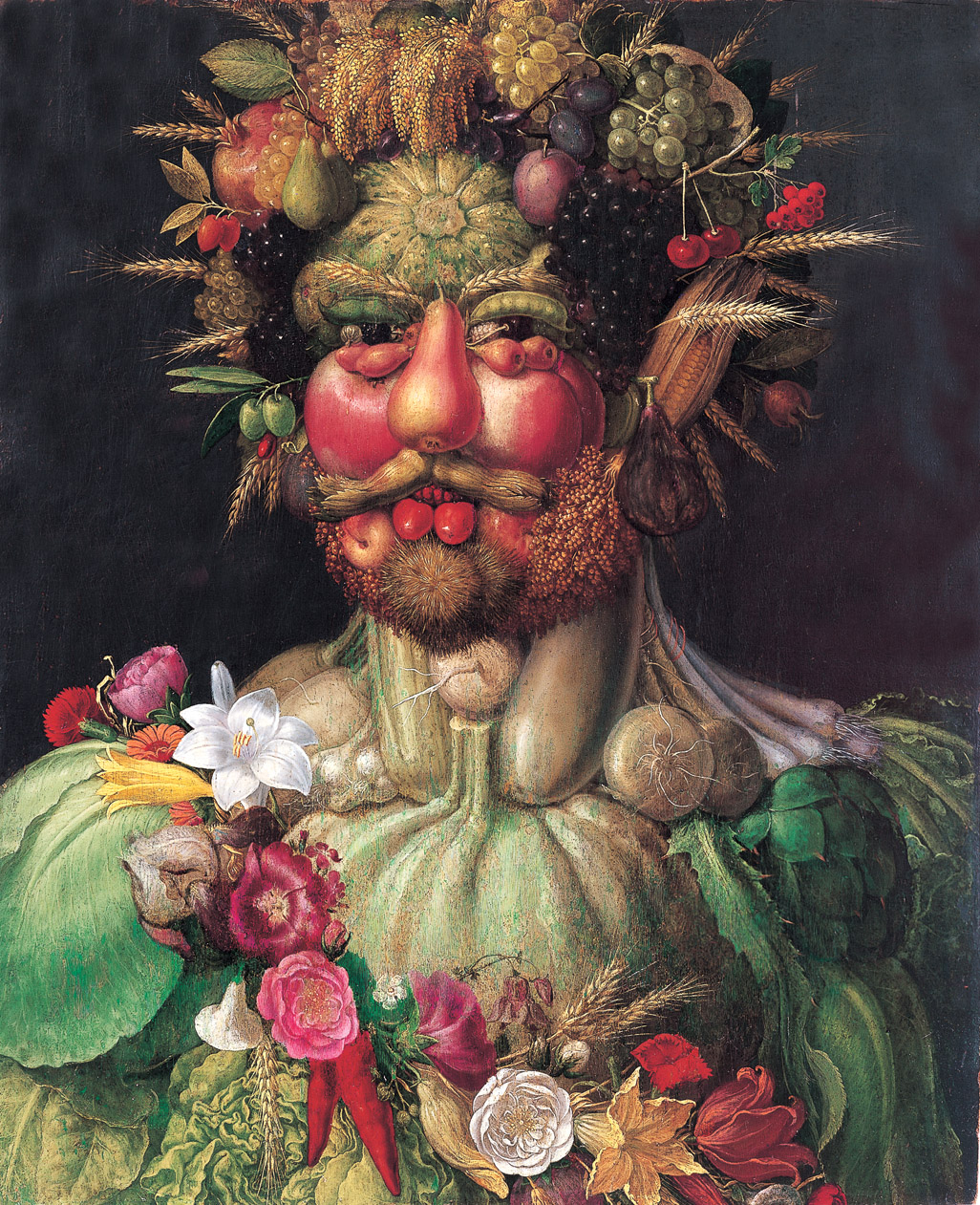
It takes some imagination to come up with such a thing -- it sounds like something out of a children's book, or a Greek myth. It reminds me of those Giuseppe Arcimboldo paintings of vegetable men, like this one, which I believe is one of his most famous:
I kind of want to make a vegetable instrument (though I imagine it's much harder than it looks). Another experiment to try in our kitchen, perhaps?
http://io9.com/5817756/vegetable-orchestra-grow-your-own-guitar
It takes some imagination to come up with such a thing -- it sounds like something out of a children's book, or a Greek myth. It reminds me of those Giuseppe Arcimboldo paintings of vegetable men, like this one, which I believe is one of his most famous:
I kind of want to make a vegetable instrument (though I imagine it's much harder than it looks). Another experiment to try in our kitchen, perhaps?
Tuesday, May 24, 2011
Pendula Madness
Watch this when very tired and/or over-caffeinated:
And this, creative use of pool balls and all:
So hypnotic...
And this, creative use of pool balls and all:
So hypnotic...
Tuesday, April 12, 2011
MSNBC: Two Suns Spotted in China Defy Explanation
A very interesting optical phenomenon spotted about a month ago:
http://www.msnbc.msn.com/id/41927089/ns/technology_and_science-space/GT1=43001
I'm inclined to believe that it's an issue of atmospheric refraction, as the article says. I don't think a faulty lens could produce an image of such clarity.
http://www.msnbc.msn.com/id/41927089/ns/technology_and_science-space/GT1=43001
I'm inclined to believe that it's an issue of atmospheric refraction, as the article says. I don't think a faulty lens could produce an image of such clarity.
Monday, March 14, 2011
Music Video for Vienna Teng's "Gravity", and the Making Thereof
Despite it being the weekend before finals, I spontaneously went to a concert yesterday. I think I was justified; I had just finished two papers, my first final isn't until Wednesday, and it was Vienna Teng. I've mentioned her here before. One of my all-time favorite musicians, and one of the few "modern" musicians whom I really love.
Anyhow, she has one music video (that I know of, at least, but I checked), for her song "Gravity", and it's beautiful -- too beautiful not to share, so here it is:
And then, I found this (the making of the "Gravity" video):
Enjoy!
Anyhow, she has one music video (that I know of, at least, but I checked), for her song "Gravity", and it's beautiful -- too beautiful not to share, so here it is:
And then, I found this (the making of the "Gravity" video):
Enjoy!
Subscribe to:
Posts (Atom)