I've been watching the Winter Olympics this weekend (mostly for the figure skating, which is wonderful). I've also been keeping abreast of Putin's crackdown on LGBT rights and the subsequent displays of pride and solidarity from other countries. Here's an excellent little video by The Guardian, wherein a number of British celebrities learn how to say "Where can I buy a rainbow flag?" in Russian:
http://www.theguardian.com/lifeandstyle/video/2014/feb/07/learn-russian-protest-anti-gay-laws-sochi-winter-olympics-video
Neil Gaiman! Stephen Fry!
Because damn it, Putin, you're not going to bring Russia into the twenty-first century without some twenty-first century values -- among which are equal rights for all citizens, including gay ones. (Yes, we have a ways to go on this issue in the US as well.)
Showing posts with label Neil Gaiman. Show all posts
Showing posts with label Neil Gaiman. Show all posts
Sunday, February 9, 2014


Thursday, October 31, 2013
Cover-a-Week #33: "Creepy Doll" by Jonathan Coulton
It's Hallowe'en! Ergo, today's the day for a spooky song:
http://youtu.be/f1hddcJiGZ8
This was such a fun piece to cover! (Jonathan Coulton is an evil genius.)
I was tempted to make Coraline-style button eyes out of construction paper to really get in the spirit of "Creepy Doll," but I realized that I couldn't see very well out of the tiny buttonholes...
http://youtu.be/f1hddcJiGZ8
This was such a fun piece to cover! (Jonathan Coulton is an evil genius.)
I was tempted to make Coraline-style button eyes out of construction paper to really get in the spirit of "Creepy Doll," but I realized that I couldn't see very well out of the tiny buttonholes...
Saturday, June 9, 2012
R.I.P. Ray Bradbury
He died this week (on the 5th). The New York Times obituary:
http://www.nytimes.com/2012/06/07/books/ray-bradbury-popularizer-of-science-fiction-dies-at-91.html?_r=1&ref=arts&gwh=DAB304701677810DA93A673A1510F1D2
I first learned of it from Neil Gaiman's blog, actually. He was tapped to write a tribute piece in The Guardian, and he paints a beautiful portrait of this science fiction maestro:
http://www.guardian.co.uk/books/2012/jun/06/ray-bradbury-neil-gaiman-appreciation
We all knew that Bradbury was a pioneer of the genre. We all admired his skill, his imagination, his understanding of human nature. This reveals a side of him that, sadly, many of us never encountered -- the genuine, kind human being. People like that are precious.
Here's another:
http://www.bbc.com/future/story/20120608-meeting-the-master-ray-bradbury
I love his devotion to the book as an object (something I'm more than a little afraid that e-readers will kill off), especially seeing as he was a science fiction writer. (I have an e-reader, but I feel the same way about books, which increasingly makes me appear a troglodyte among my peers.) I love his enthusiasm. And of course, as Gaiman so eloquently depicted it, his kindness.
Rest in peace, Mr. Bradbury.
http://www.nytimes.com/2012/06/07/books/ray-bradbury-popularizer-of-science-fiction-dies-at-91.html?_r=1&ref=arts&gwh=DAB304701677810DA93A673A1510F1D2
I first learned of it from Neil Gaiman's blog, actually. He was tapped to write a tribute piece in The Guardian, and he paints a beautiful portrait of this science fiction maestro:
http://www.guardian.co.uk/books/2012/jun/06/ray-bradbury-neil-gaiman-appreciation
We all knew that Bradbury was a pioneer of the genre. We all admired his skill, his imagination, his understanding of human nature. This reveals a side of him that, sadly, many of us never encountered -- the genuine, kind human being. People like that are precious.
Here's another:
http://www.bbc.com/future/story/20120608-meeting-the-master-ray-bradbury
I love his devotion to the book as an object (something I'm more than a little afraid that e-readers will kill off), especially seeing as he was a science fiction writer. (I have an e-reader, but I feel the same way about books, which increasingly makes me appear a troglodyte among my peers.) I love his enthusiasm. And of course, as Gaiman so eloquently depicted it, his kindness.
Rest in peace, Mr. Bradbury.
Sunday, January 22, 2012
Artists on PIPA and SOPA
There's been a lot of buzz about PIPA and SOPA, especially here in Silicon Valley. The online protests, most notably the Wikipedia blackout, have gotten a lot of people interested, if not involved. A perspective that hasn't gotten as much attention as it should, methinks, is that of the artists themselves, whose intellectual property is what's ultimately at stake. This (found via Neil Gaiman's blog) is worth reading:
http://stopthewall.us/artists/
They say it better than I ever could -- internet freedom means free publicity. I'll just add that I've discovered some of my favorite songs and musicians (such as Heather Dale and Jonathan Coulton) via YouTube, and some excellent television online (such as the BBC's Sherlock). If it weren't for the internet, if not for YouTube, I would not have gone and bought a Heather Dale album on iTunes, or bought some tracks from Jonathan Coulton's website. That would have been a net loss for the music industry. (Yes, I acknowledge that YouTube, being more akin to a streaming service than a downloading site, isn't necessarily what people mean when they say "pirating music.")
The greater part of the illegal download problem in America, and in the Western world at large, is not piracy so much as accessibility. By and large, we in the developed world don't balk at paying $0.99 for a track on iTunes, or $9.99 for an e-book; compare those to a $12 CD with about a dozen songs on it or an $8 (mass-market) or $12 (trade) paperback. What is problematic, rather, is when music, books, or films are not readily available for purchase -- leading those who really want to obtain said materials to seek other means to get them. (This, as far as I'm aware, often becomes an issue where foreign rights and such are concerned.) By and large, if there is a convenient venue for purchase at a fair price, Americans will pay for the electronic media they consume.
A side-note to the above: one of the truly significant illegal download problems in the developed world, is that of children or teenagers who don't have their own source of income. In the past, they would have asked their parents for money, or saved up their allowances, or done a bit of babysitting in order to purchase the media they want. I'm sure many adults today have fond childhood memories of going to the record store, for example, and buying that album they wanted with their hard-earned cash. Nowadays, it's much easier to bypass the work required to get the money to buy books or music by illegally downloading. I agree that children who don't grow up with a certain moral framework in which content creators should be compensated for their work might one-day become income-earning adults who pirate all of their media despite having the funds to pay for it. But in that case, much as children who commit petty crimes (vandalism and disruption of the peace come to mind) are generally granted more legal leeway than adults who do the same, I don't think that PIPA and SOPA are the right tools to use to crack down on underage media pirates. That's in the realm of killing an ant with a sledgehammer. Also, I would argue that children and teenagers without income fall somewhere towards the middle of the spectrum of "consumers who can afford to pay for all the content they want" and "consumers who would not consume content if it cost money."
In other, mostly developing countries, the concept of copyright is still rather hazy in the public consciousness. Photocopying -- or pirating -- of textbooks, DVDs, &c. is the norm, rather than the exception. Citizens of many of these countries wouldn't buy these products even if they were impossible to pirate -- they're prohibitively expensive. If people in, say, China were prevented in any meaningful way from illegally accessing copyrighted American media, they would just turn to other shows, other books, other music -- non-American media. The income for artists and media companies wouldn't substantially increase as a result of the largely outwards-facing bills. In these markets, increasing profits would mean substantially lowering prices, perhaps to a point where there would be no point in producing said content for these consumers, because it would not be cost-effective.
While PIPA and SOPA are largely well-intentioned -- an attempt to secure for creative individuals the rewards of their work -- they're very problematically written. They were written by politicians -- not the artists they're supposed to protect, or the technologists who are supposed to enforce it. In their current incarnation, they cause more harm than good, especially where censorship and due process are concerned. Additionally, as most of my techie friends would tell you, meaningful enforcement would be basically impossible. As the internet has become an essential component of life in this country and around the world, the law needs to reflect an understanding of how to govern the web. Someone in Washington really ought to put the lawmakers, the technologists, the media companies, and the artists all in the same room to hammer out a solution that addresses everyone's needs and comes with a thorough understanding of current technology. That's the only way it'll work.
http://stopthewall.us/artists/
They say it better than I ever could -- internet freedom means free publicity. I'll just add that I've discovered some of my favorite songs and musicians (such as Heather Dale and Jonathan Coulton) via YouTube, and some excellent television online (such as the BBC's Sherlock). If it weren't for the internet, if not for YouTube, I would not have gone and bought a Heather Dale album on iTunes, or bought some tracks from Jonathan Coulton's website. That would have been a net loss for the music industry. (Yes, I acknowledge that YouTube, being more akin to a streaming service than a downloading site, isn't necessarily what people mean when they say "pirating music.")
The greater part of the illegal download problem in America, and in the Western world at large, is not piracy so much as accessibility. By and large, we in the developed world don't balk at paying $0.99 for a track on iTunes, or $9.99 for an e-book; compare those to a $12 CD with about a dozen songs on it or an $8 (mass-market) or $12 (trade) paperback. What is problematic, rather, is when music, books, or films are not readily available for purchase -- leading those who really want to obtain said materials to seek other means to get them. (This, as far as I'm aware, often becomes an issue where foreign rights and such are concerned.) By and large, if there is a convenient venue for purchase at a fair price, Americans will pay for the electronic media they consume.
A side-note to the above: one of the truly significant illegal download problems in the developed world, is that of children or teenagers who don't have their own source of income. In the past, they would have asked their parents for money, or saved up their allowances, or done a bit of babysitting in order to purchase the media they want. I'm sure many adults today have fond childhood memories of going to the record store, for example, and buying that album they wanted with their hard-earned cash. Nowadays, it's much easier to bypass the work required to get the money to buy books or music by illegally downloading. I agree that children who don't grow up with a certain moral framework in which content creators should be compensated for their work might one-day become income-earning adults who pirate all of their media despite having the funds to pay for it. But in that case, much as children who commit petty crimes (vandalism and disruption of the peace come to mind) are generally granted more legal leeway than adults who do the same, I don't think that PIPA and SOPA are the right tools to use to crack down on underage media pirates. That's in the realm of killing an ant with a sledgehammer. Also, I would argue that children and teenagers without income fall somewhere towards the middle of the spectrum of "consumers who can afford to pay for all the content they want" and "consumers who would not consume content if it cost money."
In other, mostly developing countries, the concept of copyright is still rather hazy in the public consciousness. Photocopying -- or pirating -- of textbooks, DVDs, &c. is the norm, rather than the exception. Citizens of many of these countries wouldn't buy these products even if they were impossible to pirate -- they're prohibitively expensive. If people in, say, China were prevented in any meaningful way from illegally accessing copyrighted American media, they would just turn to other shows, other books, other music -- non-American media. The income for artists and media companies wouldn't substantially increase as a result of the largely outwards-facing bills. In these markets, increasing profits would mean substantially lowering prices, perhaps to a point where there would be no point in producing said content for these consumers, because it would not be cost-effective.
While PIPA and SOPA are largely well-intentioned -- an attempt to secure for creative individuals the rewards of their work -- they're very problematically written. They were written by politicians -- not the artists they're supposed to protect, or the technologists who are supposed to enforce it. In their current incarnation, they cause more harm than good, especially where censorship and due process are concerned. Additionally, as most of my techie friends would tell you, meaningful enforcement would be basically impossible. As the internet has become an essential component of life in this country and around the world, the law needs to reflect an understanding of how to govern the web. Someone in Washington really ought to put the lawmakers, the technologists, the media companies, and the artists all in the same room to hammer out a solution that addresses everyone's needs and comes with a thorough understanding of current technology. That's the only way it'll work.
Thursday, December 29, 2011
Look What I Got for Christmas!
A ukulele!

It's a concert-sized Lanikai (LU-21C). I did my research (looking at online reviews, mostly), and it seems like this is a solid choice for a beginner (good quality for the price, decent sound, etc.).
There's a story behind it. Remember this post (about the Neil Gaiman and Amanda Palmer show that I attended last month)? If you don't want to read the whole article (it's short, though), the relevant bits are: she performed her song "Dear Old House," which became one of my favorite pieces on the spot (give it a listen below), and then her "Ukulele Anthem," one of the most memorable lines of which explains that it only takes an hour to learn to play the ukulele, which is comparable to the time required "to teach someone to build a standard pipe bomb." I was intrigued. I wanted a ukulele.
Then, my sister asked me what I wanted for Christmas. It appeared that my parents were a bit stumped as to what to get me. Ergo, I asked for a ukulele. They were a little confused as to what the instrument actually is (I don't imagine that "ukulele" is a word one would encounter in the standard Chinese-English dictionary), but I explained that it was a bit like a guitar, only smaller and Hawaiian. They were afraid it would be made of pineapples or coconuts or something [edit: there apparently actually exists a type of ukulele known as a pineapple ukulele], and I think they were secretly a bit relieved that it was a completely normal-looking, if slightly small, instrument. And so we went to the local Sam Ash when I got back to New York, and my father bought me one. I just learned to play "Hallelujah" by Leonard Cohen. I'm working on "Dear Old House," too, but the chords are harder.
And that is what I got for Christmas.

It's a concert-sized Lanikai (LU-21C). I did my research (looking at online reviews, mostly), and it seems like this is a solid choice for a beginner (good quality for the price, decent sound, etc.).
There's a story behind it. Remember this post (about the Neil Gaiman and Amanda Palmer show that I attended last month)? If you don't want to read the whole article (it's short, though), the relevant bits are: she performed her song "Dear Old House," which became one of my favorite pieces on the spot (give it a listen below), and then her "Ukulele Anthem," one of the most memorable lines of which explains that it only takes an hour to learn to play the ukulele, which is comparable to the time required "to teach someone to build a standard pipe bomb." I was intrigued. I wanted a ukulele.
Then, my sister asked me what I wanted for Christmas. It appeared that my parents were a bit stumped as to what to get me. Ergo, I asked for a ukulele. They were a little confused as to what the instrument actually is (I don't imagine that "ukulele" is a word one would encounter in the standard Chinese-English dictionary), but I explained that it was a bit like a guitar, only smaller and Hawaiian. They were afraid it would be made of pineapples or coconuts or something [edit: there apparently actually exists a type of ukulele known as a pineapple ukulele], and I think they were secretly a bit relieved that it was a completely normal-looking, if slightly small, instrument. And so we went to the local Sam Ash when I got back to New York, and my father bought me one. I just learned to play "Hallelujah" by Leonard Cohen. I'm working on "Dear Old House," too, but the chords are harder.
And that is what I got for Christmas.
Wednesday, November 9, 2011
The Stanford Daily: Gaiman and Palmer in SF
Neil Gaiman and Amanda Palmer performed a show in San Francisco last week, and I covered it for The Daily (pretty much exactly what it says on the tin, above):
http://www.stanforddaily.com/2011/11/04/gaiman-and-palmer-read-rock-and-talk/
It was awesome. I want a ukulele.
http://www.stanforddaily.com/2011/11/04/gaiman-and-palmer-read-rock-and-talk/
It was awesome. I want a ukulele.
Saturday, July 2, 2011
Weird Things Customers Say in Bookshops
Just found this very funny blog post series (thanks to Neil Gaiman's blog):
http://jen-campbell.blogspot.com/search/label/weird%20things%20customers%20say
I'm both amused and appalled. I'll be checking back. :)
http://jen-campbell.blogspot.com/search/label/weird%20things%20customers%20say
I'm both amused and appalled. I'll be checking back. :)
Monday, March 28, 2011
R.I.P. Diana Wynne Jones
Diana Wynne Jones passed away two days ago. She was practically an institution unto herself, at least in the book world (especially in the scifi-fantasy community). She is, among writers, best known for the wonderful The Tough Guide to Fantasyland, and among the rest of the world, for Howl's Moving Castle, which was turned into a Miyazaki film of the same name. She was also known for mentoring aspiring and debut writers, of which Neil Gaiman was one, back in the day. He wrote a moving eulogy for her, a much more intimate and eloquent one, which may be found here: http://journal.neilgaiman.com/2011/03/being-alive.html
A titan has fallen. She will be missed.
A titan has fallen. She will be missed.
Thursday, July 22, 2010
The Problem with World-Hopping Fantasy Novels
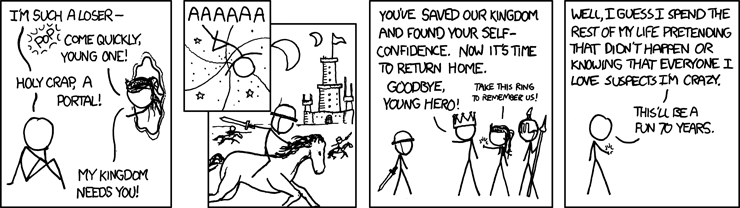
I've always wondered about this, actually, in the back of my mind:
http://xkcd.com/693
(Click on the image; it's a little small to read.)
Neil Gaiman's story "The Problem of Susan" addressed this in the Narnia-verse (Lewis himself touches upon the problem in the later books), but few of the subsequent Narnia-inspired world-hopping fantasy novels really deal with the problem of post-return adjustment, especially since the protagonists often spend years of their lives in these otherworlds, only to come back the same age as when they left. One would think that there would be some period of time immediately afterwards where the protagonists couldn't help acting oddly, out of habit, and were shipped off to a psychiatrist or something. (That would make an interesting story, come to think of it.)
This is a problem often found in the work of inexperienced fantasy writers; I see this sort of thing every day in the slush pile (which is, for the uninitiated, the flood of unsolicited submissions we get in the submissions inbox). Advice/food for thought for aspiring fantasy writers, from someone who reads (and judges) your submissions:
(a) What the deuce would a magical world need from some kid (it's invariably a teenager) from Earth that a native couldn't do better (and don't give me any of that "prophecy" drivel)?
(b) Why would you ever leave your admittedly ordinary life on Earth on the request of some elf-guy who randomly appears in your bedroom? How do you know they won't just bash you over the head and eat you? I've been told I'm entirely too trusting, but even I know better than to trust strangers who break into my house.
(c) What makes you think that someone didn't just slip something into your drink? If someone tells me I'm the savior of the world and makes some pretty sparkling lights, I'd assume I ate something funny, not that I needed to travel to another dimension and face the legions of the Dark Lord, or something equally preposterous.
I'd caveat that all of this can be done well. But generally, most of the people who think they can do it well really, really can't (and the ones who can and know they can are generally pretty modest about such things).
http://xkcd.com/693
(Click on the image; it's a little small to read.)
Neil Gaiman's story "The Problem of Susan" addressed this in the Narnia-verse (Lewis himself touches upon the problem in the later books), but few of the subsequent Narnia-inspired world-hopping fantasy novels really deal with the problem of post-return adjustment, especially since the protagonists often spend years of their lives in these otherworlds, only to come back the same age as when they left. One would think that there would be some period of time immediately afterwards where the protagonists couldn't help acting oddly, out of habit, and were shipped off to a psychiatrist or something. (That would make an interesting story, come to think of it.)
This is a problem often found in the work of inexperienced fantasy writers; I see this sort of thing every day in the slush pile (which is, for the uninitiated, the flood of unsolicited submissions we get in the submissions inbox). Advice/food for thought for aspiring fantasy writers, from someone who reads (and judges) your submissions:
(a) What the deuce would a magical world need from some kid (it's invariably a teenager) from Earth that a native couldn't do better (and don't give me any of that "prophecy" drivel)?
(b) Why would you ever leave your admittedly ordinary life on Earth on the request of some elf-guy who randomly appears in your bedroom? How do you know they won't just bash you over the head and eat you? I've been told I'm entirely too trusting, but even I know better than to trust strangers who break into my house.
(c) What makes you think that someone didn't just slip something into your drink? If someone tells me I'm the savior of the world and makes some pretty sparkling lights, I'd assume I ate something funny, not that I needed to travel to another dimension and face the legions of the Dark Lord, or something equally preposterous.
I'd caveat that all of this can be done well. But generally, most of the people who think they can do it well really, really can't (and the ones who can and know they can are generally pretty modest about such things).
Thursday, June 10, 2010
Ten Rules for Writing Fiction
Writers share their personal sets of ten(ish) rules for writing fiction:
http://www.guardian.co.uk/books/2010/feb/20/ten-rules-for-writing-fiction-part-one
It is rather interesting that the rules are so different for each author. This is a pretty hard-hitting list (Neil Gaiman, Margaret Atwood, Geoff Dyer, &c.). Goes to show that it doesn't really matter how you write, as long as you do it well.
http://www.guardian.co.uk/books/2010/feb/20/ten-rules-for-writing-fiction-part-one
It is rather interesting that the rules are so different for each author. This is a pretty hard-hitting list (Neil Gaiman, Margaret Atwood, Geoff Dyer, &c.). Goes to show that it doesn't really matter how you write, as long as you do it well.
Thursday, June 3, 2010
I, Cthulhu, or, What’s A Tentacle-Faced Thing Like Me Doing In A Sunken City Like This (Latitude 47° 9' S, Longitude 126° 43' W)?
Neil Gaiman's romp in the Lovecraft universe:
http://www.tor.com/index.php?option=com_content&view=blog&id=58523
Gaiman's a brilliant fanfiction writer. (He's also a brilliant writer, period, but then you already knew that.) This isn't his first foray into fanfiction (he wrote "The Problem of Susan" in response to The Chronicles of Narnia) nor into the Cthulhu mythos (his well-known story "A Study in Emerald" is a Sherlock Holmes and Cthulu crossover). It makes sense, given the nature of his work. Since American Gods, and the Sandman comics before that, he's worked in a rich literary and cultural tradition. With all the clever and nuanced allusions he makes, one would think he was raised in a library.
Anyhow, this was first brought to my attention many months ago by a good friend and teacher, Lisa. Good things are meant to be shared.
http://www.tor.com/index.php?option=com_content&view=blog&id=58523
Gaiman's a brilliant fanfiction writer. (He's also a brilliant writer, period, but then you already knew that.) This isn't his first foray into fanfiction (he wrote "The Problem of Susan" in response to The Chronicles of Narnia) nor into the Cthulhu mythos (his well-known story "A Study in Emerald" is a Sherlock Holmes and Cthulu crossover). It makes sense, given the nature of his work. Since American Gods, and the Sandman comics before that, he's worked in a rich literary and cultural tradition. With all the clever and nuanced allusions he makes, one would think he was raised in a library.
Anyhow, this was first brought to my attention many months ago by a good friend and teacher, Lisa. Good things are meant to be shared.
Tuesday, May 11, 2010
Neil Gaiman
I am constantly surprised by people who don't know who he is. Neil Gaiman is a rock star of the literary world (no, seriously, there was some newspaper or something that used those exact words). He's the author of such works as American Gods, Stardust, Coraline, Good Omens (co-authored with Terry Pratchett, another literary titan), and of course, the Sandman graphic novels. He's a genius, and I only hope that someday, I might have a tenth of his talent. Anyhow, he keeps a blog, which is smart and funny and full of interesting tidbits, here: http://journal.neilgaiman.com.
(The rest of his website, http://www.neilgaiman.com, is also chock full of cool material, including some fiction, but the blog does tend to have the latest news.)
(The rest of his website, http://www.neilgaiman.com, is also chock full of cool material, including some fiction, but the blog does tend to have the latest news.)
Subscribe to:
Posts (Atom)