I want to write a story entitled, "All My Imaginary Children, and Possibly Some Electric Eels".That is all.
Monday, October 31, 2011
If I Used Twitter
my random thought of the day would be:


Friday, October 28, 2011
Book Critiqua @ The Stanford Daily
I have a column this volume (read that aloud) in Intermission (arts section of The Stanford Daily). It's called "Book Critiqua" -- for those of you who aren't typography geeks, it's a play on the font "Book Antiqua." Anyhow, my inaugural column came out today, featuring Daniel Handler (aka Lemony Snicket). I attended his talk in San Jose, but the even cooler part was, I got to interview him! So here's the article, with a bunch of lovely soundbites:
http://www.stanforddaily.com/2011/10/28/a-not-so-unfortunate-visit-from-lemony-snicket
He's wonderful in person, and a great conversationalist. And not actually really creepy or anything like that, in case you were wondering.
http://www.stanforddaily.com/2011/10/28/a-not-so-unfortunate-visit-from-lemony-snicket
He's wonderful in person, and a great conversationalist. And not actually really creepy or anything like that, in case you were wondering.
Wednesday, October 26, 2011
io9: Vegetable Orchestra
A strange, wonderful idea:
http://io9.com/5817756/vegetable-orchestra-grow-your-own-guitar
It takes some imagination to come up with such a thing -- it sounds like something out of a children's book, or a Greek myth. It reminds me of those Giuseppe Arcimboldo paintings of vegetable men, like this one, which I believe is one of his most famous:
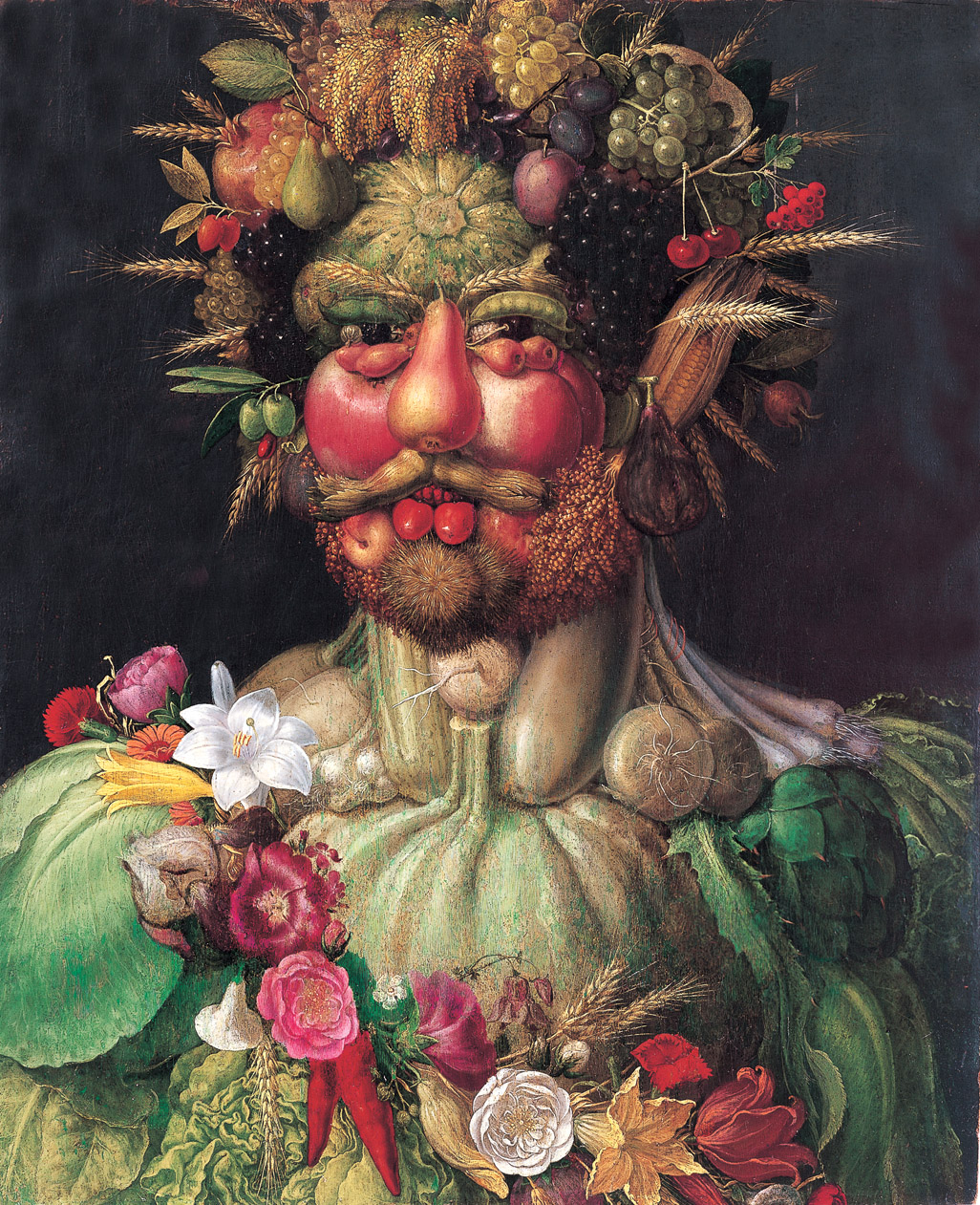
I kind of want to make a vegetable instrument (though I imagine it's much harder than it looks). Another experiment to try in our kitchen, perhaps?
http://io9.com/5817756/vegetable-orchestra-grow-your-own-guitar
It takes some imagination to come up with such a thing -- it sounds like something out of a children's book, or a Greek myth. It reminds me of those Giuseppe Arcimboldo paintings of vegetable men, like this one, which I believe is one of his most famous:
I kind of want to make a vegetable instrument (though I imagine it's much harder than it looks). Another experiment to try in our kitchen, perhaps?
Monday, October 24, 2011
If I Used Twitter
I would post, right now:
Writing a paper on Browning's "Childe Rolande" (quite creepy!), and G-chatting with my sister about secret elephants.
Friday, October 21, 2011
The Economist: Customs and Immigration... from the Moon
Those astronauts had a great sense of humor (and so, too, does The Economist):
http://www.economist.com/blogs/gulliver/2011/10/space-travel
I think my favorite part is the declaration of health.
http://www.economist.com/blogs/gulliver/2011/10/space-travel
I think my favorite part is the declaration of health.
Tuesday, October 18, 2011
Washington Post: Interactive Civil War Map
The Washington Post posted a bunch of articles and things about the American Civil War, in honor of the 150th anniversary of the war. This is one of the coolest of the lot:
http://www.washingtonpost.com/wp-srv/lifestyle/special/civil-war-interactive/civil-war-battles-and-casualties-interactive-map/
The design of the thing is sheer brilliance. Hit the play button to really get a sense of the progression of the war. Even though the map doesn't show them, you can sort of follow troop movements based on the shifting locations of major battles. I wish it had a way of indicating the generals involved on each side, but that would probably make the thing a little too complicated and unwieldy.
http://www.washingtonpost.com/wp-srv/lifestyle/special/civil-war-interactive/civil-war-battles-and-casualties-interactive-map/
The design of the thing is sheer brilliance. Hit the play button to really get a sense of the progression of the war. Even though the map doesn't show them, you can sort of follow troop movements based on the shifting locations of major battles. I wish it had a way of indicating the generals involved on each side, but that would probably make the thing a little too complicated and unwieldy.
Monday, October 17, 2011
Map of Top 100 SciFi & Fantasy Books
Something that Brett sent me a few weeks ago that every scifi/fantasy nerd should appreciate:

(You'll have to click on it to see everything.)
I'm glad that there's such diversity in this map, including quite a few books that wouldn't conventionally be found in the scifi/fantasy section of the bookstore. It's also wonderful that it doesn't portray The Lord of the Rings as the founding bedrock of the genre (not to understate Tolkien's genius); there were plenty of classic novels that should be recognized as scifi/fantasy (like Frankenstein and Cat's Cradle, by Mary Shelley and Kurt Vonnegut, respectively).
Sunday, October 16, 2011
Today
is the 253rd birthday of Noah Webster, who is most famous for his contributions to education and language, especially for the contemporarily eponymous dictionary (formerly American Dictionary of the English Language). Like most prominent men of his day, he was involved in politics (particularly immediately post-Revolution), and was also a champion of a number of sociopolitical causes. While I would not want to understate his contributions to the country on that front, it's safe to say that his seminal work was in reforming and standardizing the usage of English. It was a phenomenal achievement, and well worth commemorating today.
Saturday, October 15, 2011
Academia in the East and West
I was reminded of this quite excellent article, which I'd bookmarked a long while ago, after catching up with my friend over the summer:
http://scienceblogs.com/principles/2011/08/the_status_of_science_we_have.php
We were discussing sciences education, and the differences between the culture of academia in (East) Asia versus in the West. We observed that in Asia, there is a lot more interest in the sciences among students (grade school and undergraduate) than in the West. However, it seems that academia (in the sciences and otherwise), is dominated by Western institutions and Western publications. There have been attempts at many levels of institution and government to correct for deficiencies in each area; Western governments push for better science education, and Asian universities for more prestige in international academia. Both deficiencies, methinks, are problems endemic to their respective systems.
There are, broadly speaking, two distinct skill sets that academics ought have: that of teaching, and that of research. As argued in the above article, the Western system is skewed to reward the latter much more than the former. In every step of the process, from the new graduate student's first day to his becoming a respected professor, the Western academic is evaluated based upon the scholarly material that he produces. The quality of his teaching is secondary; the bulk of his effort is invested in honing his skills as a scholar, rather than as a teacher (so long as his teaching is not so poor as to inspire too much complaint). In fact, as the blog post argues, it is generally seen as a waste of time -- at least by the metric of career advancement -- to teach any more than is required, and certainly to engage in outreach beyond the university community. (My friend is a TA, so I'm inclined to take his word on this.)
Contrast this with academia in countries like China, Japan, and Korea. The culture in these countries respects and values good instructors at every level, so there is a lot of emphasis on effective teaching. This translates to interest in the sciences among students in middle and high school. In the Chinese system (with which I am more familiar, out of the three), this is further accentuated by the fact that students choose their emphasis -- a binary choice of humanities or sciences -- in high school. It's a pretty even split, and switching to the other side is discouraged. This ensures that about half the student population is at least nominally interested in the sciences.
But I digress. In Asia, at the university level, professors are expected to be able to command a lecture hall of hundreds. They're seen as founts of knowledge dispensing wisdom to their charges, essentially. Producing new knowledge, however, is a different kettle of fish. The system is such that until recently, professors didn't really need to publish. There was no real incentive for doing so; there's no need to gain legitimacy in one's field when one already has the support of an institution and a legion of awestruck students, and when there's no outside reward (or pressure) for such efforts.
The best system would be (as expected), some ideal combination of the two. Easier said than done, of course. But given increasing globalization (which is in itself another discussion), perhaps a merge of the two might yet be accomplished.
http://scienceblogs.com/principles/2011/08/the_status_of_science_we_have.php
We were discussing sciences education, and the differences between the culture of academia in (East) Asia versus in the West. We observed that in Asia, there is a lot more interest in the sciences among students (grade school and undergraduate) than in the West. However, it seems that academia (in the sciences and otherwise), is dominated by Western institutions and Western publications. There have been attempts at many levels of institution and government to correct for deficiencies in each area; Western governments push for better science education, and Asian universities for more prestige in international academia. Both deficiencies, methinks, are problems endemic to their respective systems.
There are, broadly speaking, two distinct skill sets that academics ought have: that of teaching, and that of research. As argued in the above article, the Western system is skewed to reward the latter much more than the former. In every step of the process, from the new graduate student's first day to his becoming a respected professor, the Western academic is evaluated based upon the scholarly material that he produces. The quality of his teaching is secondary; the bulk of his effort is invested in honing his skills as a scholar, rather than as a teacher (so long as his teaching is not so poor as to inspire too much complaint). In fact, as the blog post argues, it is generally seen as a waste of time -- at least by the metric of career advancement -- to teach any more than is required, and certainly to engage in outreach beyond the university community. (My friend is a TA, so I'm inclined to take his word on this.)
Contrast this with academia in countries like China, Japan, and Korea. The culture in these countries respects and values good instructors at every level, so there is a lot of emphasis on effective teaching. This translates to interest in the sciences among students in middle and high school. In the Chinese system (with which I am more familiar, out of the three), this is further accentuated by the fact that students choose their emphasis -- a binary choice of humanities or sciences -- in high school. It's a pretty even split, and switching to the other side is discouraged. This ensures that about half the student population is at least nominally interested in the sciences.
But I digress. In Asia, at the university level, professors are expected to be able to command a lecture hall of hundreds. They're seen as founts of knowledge dispensing wisdom to their charges, essentially. Producing new knowledge, however, is a different kettle of fish. The system is such that until recently, professors didn't really need to publish. There was no real incentive for doing so; there's no need to gain legitimacy in one's field when one already has the support of an institution and a legion of awestruck students, and when there's no outside reward (or pressure) for such efforts.
The best system would be (as expected), some ideal combination of the two. Easier said than done, of course. But given increasing globalization (which is in itself another discussion), perhaps a merge of the two might yet be accomplished.
Thursday, October 13, 2011
The Marrow of Life
I don't normally read The Stanford Review, but something struck me about this particular article:
http://blog.stanfordreview.org/2011/01/28/the-intensely-lonely-world-of-stanford-students/
It's not breathtakingly profound, or even anything that hasn't been said before, but it does make me think, sometimes, about what I'm doing here at Stanford. In twenty years, I'm not going to remember my midterms, my problem sets, the paper I pulled an all-nighter trying to finish. I know, rather, that I'll remember the wonderful friends I made, the late-night conversations, and the random crazy stunts we pulled. Those are the memories I should be making in my last year here. As Henry David Thoreau once wrote:
So, for those of you at Stanford, if there's something you think I'd like to try, or something you think I don't know much about, by all means, drag me to your event! If you just want to chat, stop by for dinner or tea. Chances are, I don't see you nearly as often as I'd like.
http://blog.stanfordreview.org/2011/01/28/the-intensely-lonely-world-of-stanford-students/
It's not breathtakingly profound, or even anything that hasn't been said before, but it does make me think, sometimes, about what I'm doing here at Stanford. In twenty years, I'm not going to remember my midterms, my problem sets, the paper I pulled an all-nighter trying to finish. I know, rather, that I'll remember the wonderful friends I made, the late-night conversations, and the random crazy stunts we pulled. Those are the memories I should be making in my last year here. As Henry David Thoreau once wrote:
I wanted to live deep and suck out all the marrow of life... (Walden, Chapter 2)I've promised myself: I'll do something interesting, fun, and maybe unexpected every week (or even more than once a week, if I can). It might be something simple and solitary, like finding a good poem, or learning to cook something new. It might be a fun activity with friends, like attending a dance event, or having a long and interesting conversation with somebody. And I'll try my damnedest not to let the relative isolation of my dorm (Mirrielees, which does have its perks, like a kitchenette and a bathroom in each suite), or the scattering of my friends, or my rather demanding course load, stop me.
So, for those of you at Stanford, if there's something you think I'd like to try, or something you think I don't know much about, by all means, drag me to your event! If you just want to chat, stop by for dinner or tea. Chances are, I don't see you nearly as often as I'd like.
Monday, October 10, 2011
Geoffrey Chaucer Hath a Blog
One of my English professors held a Middle English workshop last week, and showed us this:
http://houseoffame.blogspot.com/
It's brilliant and hilarious in a really nerdy, English-major-y way. (Chaucer himself was quite funny, and the blog does him justice.) I've been reading it a bit obsessively the past week. Go have a gander -- I promise you'll laugh. (If you have trouble with the Middle English, there are some translation resources in the sidebar.)
http://houseoffame.blogspot.com/
It's brilliant and hilarious in a really nerdy, English-major-y way. (Chaucer himself was quite funny, and the blog does him justice.) I've been reading it a bit obsessively the past week. Go have a gander -- I promise you'll laugh. (If you have trouble with the Middle English, there are some translation resources in the sidebar.)
Thursday, October 6, 2011
R.I.P. Rev. Fred Shuttlesworth
Civil Rights activist Rev. Fred Shuttlesworth passed away yesterday: http://www.nytimes.com/2011/10/06/us/rev-fred-l-shuttlesworth-civil-rights-leader-dies-at-89.html?ref=obituaries
I had the great honour of meeting him half a decade ago, when I was in high school, through a wonderful program called Sojourn to the Past. He was a warm, genuine person, who despite his age and vast life experience, took the time to speak with a bunch of students, to pass along the torch that he had borne so faithfully his entire life. He was truly an inspiration, and the world is a little less bright for his passing.
I had the great honour of meeting him half a decade ago, when I was in high school, through a wonderful program called Sojourn to the Past. He was a warm, genuine person, who despite his age and vast life experience, took the time to speak with a bunch of students, to pass along the torch that he had borne so faithfully his entire life. He was truly an inspiration, and the world is a little less bright for his passing.
Wednesday, October 5, 2011
R.I.P. Steve Jobs
The visionary of Apple died today: http://www.nytimes.com/2011/10/06/business/steve-jobs-of-apple-dies-at-56.html?_r=1&hp
I'm an Apple user. I'm typing up this very post on Mycroft, my Macbook. I've had one Macbook before him (a black one, named Marvin), I use an iPhone, and I have used various iPods before it. I have a distinct, albeit annoyingly unquantifiable, preference for Apple products (as opposed to comparable computers and phones) -- that's part of the magic.
There is little I can say about Steve Jobs that has not already been said. But I think that one of his greatest accomplishments is taking everyday, functional items -- the personal computer, the phone, the music player -- and making them beautiful. An often overlooked piece of his background: he audited a calligraphy class once, in college. This led to the diverse palette of computer fonts we have today. It's the little things like this that made him great; he didn't invent the computer, but he brought to it a certain irresistible aesthetic. Sometimes, it's all in the details.
Edit (11/28): William Gibson says it better, at http://imgur.com/hu40O
I'm an Apple user. I'm typing up this very post on Mycroft, my Macbook. I've had one Macbook before him (a black one, named Marvin), I use an iPhone, and I have used various iPods before it. I have a distinct, albeit annoyingly unquantifiable, preference for Apple products (as opposed to comparable computers and phones) -- that's part of the magic.
There is little I can say about Steve Jobs that has not already been said. But I think that one of his greatest accomplishments is taking everyday, functional items -- the personal computer, the phone, the music player -- and making them beautiful. An often overlooked piece of his background: he audited a calligraphy class once, in college. This led to the diverse palette of computer fonts we have today. It's the little things like this that made him great; he didn't invent the computer, but he brought to it a certain irresistible aesthetic. Sometimes, it's all in the details.
Edit (11/28): William Gibson says it better, at http://imgur.com/hu40O
Tuesday, October 4, 2011
Chinglish and Other Amusements from China
I realized that I never posted the various amusing and interesting pictures I took in China. (Many of them are of Chinglish bloopers.) Here are some of the funnier ones:
 This was taken in a mall in Hong Kong; I believe it was advertising an arcade or some such.
 The circular, UFO-like thing on the ground is an information booth. I suppose that's one way to attract attention!
 We found these in the shower of our hotel room. False excrement indeed (I should certainly hope so, given its intended use.)
 I had opened the drawer expecting a sewing kit, or perhaps a clothes-line. This... isn't quite string.
 I did not anticipate finding French fries or hash browns (especially smiley ones) in China, especially in the same box as chow mien and string beans. It reminds me of the cover of Watchmen, with the strategically-placed ketchup and all.
 Liquid yogurt is a rather common drink in China; "living fungus milk," however, is distinctly unappetizing.
 And this. I couldn't resist putting this up. It's my mother's big carry-on bag. Apparently it was a gift. (The arm in the picture is my father's.)


Saturday, October 1, 2011
Because I could not stop for Death (by Emily Dickinson)
In addition to the book list, I found time over the summer for some poetry -- both revisiting old favorites and finding some new ones. I haven't posted any poetry in a long while, so I thought I'd share this one. It's pretty well known; I first read it in middle school, I think. One of the really geeky reasons I like it is that Dickinson's characterization of Death reminds me a lot of Terry Pratchett's Death, who is perhaps my favorite Discworld character.
Because I could not stop for Death
by Emily Dickinson (1830-1886)
Because I could not stop for Death
by Emily Dickinson (1830-1886)
Because I could not stop for Death –
He kindly stopped for me –
The Carriage held but just Ourselves –
And Immortality.

We slowly drove – He knew no haste
And I had put away
My labor and my leisure too,
For His Civility –

We passed the School, where Children strove
At Recess – in the Ring –
We passed the Fields of Gazing Grain –
We passed the Setting Sun –

Or rather – He passed us –
The Dews drew quivering and chill –
For only Gossamer, my Gown –
My Tippet – only Tulle –

We paused before a House that seemed
A Swelling of the Ground –
The Roof was scarcely visible –
The Cornice – in the Ground –

Since then – 'tis Centuries – and yet
Feels shorter than the Day
I first surmised the Horses' Heads
Were toward Eternity –
The poem itself aside, there are a few small touches -- word choice, imagery, the like -- that I really enjoy in this piece. The "House that seemed / A Swelling of the Ground" is great; it makes me think of hobbit holes. I like how she says that the grain is "gazing" -- not a verb one would normally associate with plants, but it recalls both the grazing of farm animals and the classic imagery of gazing at sunsets, as per the line following. And I love, love the formatting of the last line, which ends, rather than with a period (as is conventional), but with an em-dash, like the rest of the poem. The slightly unsettling, unfinished quality lends so much more power and meaning to the concept of eternity.
Subscribe to:
Posts (Atom)