Showing posts with label biology. Show all posts

Saturday, January 24, 2015

BBC: Death... Not Quite Permanent?

I've been pondering life and death again (you know, as you do). We humans tend to think of the two as definite, opposing states of being. The vast majority of the time, we have no problem identifying someone as "alive" or "dead." But, as science fiction has predicted, we've arrived at an age when these concepts are no longer quite binary -- when it's possible to restore to life someone who's been, albeit briefly, declared dead. See this article from last year:

http://www.bbc.com/future/story/20140704-i-bring-the-dead-back-to-life

Cryonics and cryogenics has been a well-trodden trope in popular fiction for decades, from the works of Robert Heinlein and Arthur C. Clarke (of the "Golden Age of Science Fiction") to Captain America's decades of being frozen in a block of ice. Science is nowhere near such capabilities, of course, and it's important for the general public to understand what is and is not possible, to be able to distinguish between fact and fiction (and fiction that might well become fact in the future). Most of the scientists cited in the above BBC article, for example, are careful to qualify their work. But the mere possibility -- the mere notion that we might be capable of blurring the boundary between life and death -- calls into question some of humanity's most deep-seated beliefs.

One of the most memorable moments in genomics research (which could be considered the other end of the debate) came from Dr. Craig Venter, the geneticist and entrepreneur best known for his work in mapping the human genome and in artificially synthesizing life. When he was asked how he felt about "playing God," Venter famously replied, "I don't play."

Clever quip aside, the creation of life and the reversal of death are traditionally the provinces of myth. Much of human fascination with divinity and the supernatural stems from our desire to understand -- and in some small way, influence -- these opaque, immutable bookends to our time on earth. We, like all other living creatures, are by nature afraid of death, and seek to stave it off as long as we can. If given the option to return from the other side, I'd venture that most people would do so without hesitation. And who wouldn't want to bring back a newly-deceased loved one, if they could?

What, then, might it mean to live, if we could choose not to die? Issues of reproduction and overpopulation aside (though those, too, would become important challenges), would near-immortality change the nature of humanity? How and why would one decide to die? Tolkien's elves, incidentally, would be a close approximation of that dilemma.

I'm reminded of something a wise man once said, about that final journey:
"After all, to the well-organized mind, death is but the next great adventure."
~Albus Dumbledore, Harry Potter and the Sorcerer's Stone

Friday, November 21, 2014

Half the Earth for Wildlife

Here's a fascinating thought experiment: what if we set aside half the planet for wildlife?

It sounds like a pipe dream, too radical to consider seriously; humans, after all, have spread into every comfortable corner of the earth, and our population will only continue to rise. But the eminent biologist and conservationist E. O. Wilson believes that it's the best way to preserve biodiversity on this planet, and that it can be done:

http://www.smithsonianmag.com/science-nature/can-world-really-set-aside-half-planet-wildlife-180952379/

This would require, unsurprisingly, drastically reshaping the way we (as a species) consider the use of land and resources. Humanity has a fascination with the idea that we are the undisputed and rightful masters of the planet, that everything on this Earth is ours for the taking, consequences be damned. It's an incredibly shortsighted view, of course. From the first agricultural societies that learned to let certain fields lie fallow, to the English monarchs who decided to replant ship-worthy trees so that their heirs could build a navy to conquer half the world, to Theodore Roosevelt and his national parks, people have always recognized the value of safeguarding natural resources for future use and enjoyment.

E. O. Wilson's idea is really just taking the concept of a national park to a new level, albeit with judicious application of eminent domain and large-scale zoning laws. It wouldn't be the first time a government relocated groups of people in order to facilitate a greater national good, and this would be a much better cause than some of the previous incidences could claim. (I'm tempted to make some joke about flyover country, here.)

Even though the concept seems, in human terms, to be just a very large national park, its effect on our ecosystems is exponentially greater than that of our extant national parks. One mustn't underestimate the positive effects that uninterrupted migratory patterns would have on bolstering animal populations, especially those that are more sensitive to seasonal changes (and therefore more likely to be endangered in the first place). This scheme would revert, to the extent possible, a swath of land to its "original" state, before humanity molded it to suit our civilizations -- the state of nature, optimized for a balanced ecosphere. For all that we have done to alter the environment, that it would be possible to rectify the greater part of the damage we've caused in these parts, is itself no small feat.

We have reached a juncture after which the biodiversity of the planet will become increasingly more difficult to retain and salvage. Though Wilson's proposal is drastic, it is still, without a great stretch of the imagination, within our grasp. Some things are worth the cost -- surely the Earth is among them.


Saturday, September 7, 2013

io9: Why Eugenics is a Bad Idea (aside from all the obvious moral reasons)

I recently read Paolo Bacigalupi's short story collection Pump Six and Other Stories, which is deliciously creepy and dystopian. That anthology, and this io9 article (which I read at around the same time), got me thinking about human genetic engineering on a macroscopic scale:
http://io9.com/5925024/why-eugenics-will-always-fail

Our notions of eugenics can be roughly sorted into two categories: ways to optimize our species (for some agreed-upon and likely artificial optimal characteristics), and ways to eliminate genetic weaknesses (an extremely aggressive, sentient form of Darwinism). The former option represents selecting for a hypothetical upper bound, and the latter would be selecting against a lower bound.

When we talk about eugenics, most of us imagine the first option. The cultural connotation of the term "eugenics" includes the Holocaust, the book Brave New World, and the film "Gattaca" -- all of which involve human rights violations. In selecting for a certain ideal, a society makes mincemeat of the rights of those who fall below the arbitrary cut-off. Because eugenics usually comes with gross restrictions of free will -- and in many cases, murder -- we tend to see it as a purely moral evil. This usually brings about international intervention (the timeliness and effectiveness of said interventions being a different matter entirely), or at least the common recognition that such atrocities ought to be prevented.

The above io9 article lays out a few intuitive arguments against eugenics from a practical perspective, contending that -- morality aside -- it simply wouldn't be effective. They boil down to: imprecision, biodiversity, and the limitations of human foresight. (In essence, the short-term microscopic, the middle-term macroscopic, and the long-term in both. The article explains in further detail.) We don't know enough (and likely will never know enough) to get away with attempting to fashion our species in the image of some ideal -- not to mention that it would be impossible to get all seven billion of us to agree on said ideal in the first place. These are all, however, problems that arise when selecting for an upper bound, a hypothetical ideal specimen of humanity.

A (very) soft version of a scenario where we select against a lower bound is already in place, given amniocentesis and women's right to abort. Many women choose to abort after they receive an abnormal genetic diagnosis -- when the fetus has a genetic or congenital defect that would severely diminish the hypothetical child's lifespan or quality of life. The logic is that never existing -- which, for the record, is distinct from ceasing to exist after a period of existence -- is preferable to a life of pain and suffering with little ability to self-actualize. Self-actualization is incredibly important -- it's what makes us human and distinguishes us from other animals. This form of selection, which can be considered a mild and diffuse form of eugenics, increases the average human being's ability to self-actualize, thereby increasing (in a thought experiment where sentience is quantifiable on a scale) our species's average sentience through conscious choice by prospective parents -- a rough extension of natural sexual selection, in the way that most technologies exacerbate existing dilemmas and play upon existing quirks of human nature, rather than creating new ones where they didn't exist before. (To be clear, I recognize that I just exploded a can of worms -- that humans aren't generally more or less sentient than other humans, and that legally, ethically, metaphysically, &c. we all ought to be considered equally sentient, except in cases of limited ability to consent (i.e. children, mentally disabled persons), in which case laws are made to protect said people.)

The danger, then, is where the upper and lower bound options meet in the middle. (I'm resisting the obvious temptation to make some horrible joke about quantum mechanics and relativity here.) It's significant, therefore, that the former option is mandated by an external force and doesn't allow parents to meaningfully consent; the latter option is voluntarily initiated by the potential parents. The lower bound scenario never turns into the problematic upper bound scenario precisely because of this element of free will. The moment it moves from a bottom-up to a top-down approach -- when it veers too close to selection for an ideal, thereby impinging upon the rights of the sentient but non-ideal population -- it becomes the morally degenerate form of eugenics of genocide and dystopian science fiction. There lies the bright-line we should be aware of.

And that's all for now. I'd love to hear your thoughts!

Wednesday, June 5, 2013

The Rise of Agriculture: the Worst Mistake in Human History?

I recently found this article by Jared Diamond, a scholar and writer I admire (famously the author of Guns, Germs, and Steel):
http://www.ditext.com/diamond/mistake.html

It's an excellent piece, and not too long, so you should read it for yourself! The gist of it is: structured, populous (agrarian) societies naturally develop lopsided hierarchies, putting a portion of the population at significant disadvantage (compared to the unstructured, sparsely populated communities of hunter-gatherers). The quality of life of the average hunter-gatherer was actually better than that of the average farmer, despite the relative sophistication of the latter's society; the reason for the prevalence of agriculture and husbandry over hunting and gathering is that "quality over quantity" doesn't apply when one population can overwhelm another by sheer numbers. (I bet Leonidas of Sparta would have something to say about that!)

Another interesting point Diamond raises is that gender dynamics tend to be more equal in hunter-gatherer societies -- partially because such conditions are less conducive to hierarchy in general (see above), and also because the practical day-to-day circumstances of the hunter-gatherer lifestyle cannot support any house-bound, "idle" population, be they women or an aristocracy. Women who had to be on their feet all the time simply couldn't bear as many children in quick succession -- especially since the children had to be as mobile/portable as everyone else. The patriarchy couldn't simply turn them into brood mares, because the women contributed valuable labor and the children had to be spaced at large enough intervals that their mothers only ever had to carry (whether in utero or on her back) one child at a time. (Methinks twins wouldn't have fared as well in these societies.)

This is actually quite relevant to our own times. Notice how, as women have become increasingly educated (on par with men, especially if we consider university completion rates) and increasingly productive in the work force (issues of equal pay aside), they tend to have fewer children, and said children are born later in the mother's life. Unchecked childbearing, it appears, has always been a way for the patriarchy to turn women into second-class citizens. (Anti-abortion/birth control Republicans, I'm looking at you!)

Tuesday, April 16, 2013

Today

is the 55th anniversary of the death of Rosalind Franklin, an unsung heroine of biophysics (Watson and Crick got all the credit, including the Nobel Prize that she should have been jointly awarded). Women like Franklin -- like Marie Curie, like Ada Lovelace -- were among my childhood idols.

I am reminded of a blog post I wrote a few months ago, wherein I discuss feminism and dead people. Perhaps mine is not the generation in which we achieve true gender equality, but it is inevitable -- I have faith that the inexorable progress of our species is headed in such a direction -- and I hope to see it within my lifetime. Someday, female scientists, artists, leaders, and thinkers will be extraordinary for their accomplishments alone; someday, no one will even think to mention that a Nobel Prize winner was female -- that she won will be accomplishment enough.

And here are some pictures of very colorful (very pretty) corn in honor of Franklin's work on the structure of DNA:
http://milkwood.net/2012/05/12/glass-gem-corn-and-other-heirloom-jewels-of-the-corn-cabinet/

Monday, February 11, 2013

NYTimes: Richard III, Lost and Found

In recent news -- making both archaeological and regular news headlines around the world -- the bones of Richard III were discovered under a parking lot in Leicester:

http://www.nytimes.com/2013/02/05/world/europe/richard-the-third-bones.html?hp

I'm inclined to be more sympathetic towards Richard III than literature portrays him (Shakespeare's play was an instrument of the Tudor smear campaign against the Plantagenets). He probably suffered from "younger sibling syndrome," as did many "spare heirs" of monarchs in the Middle Ages -- see Scar vs. Mufasa in The Lion King (and play "spot the Shakespeare references"). This was also probably exacerbated by his uninspiring physical appearance -- see Tyrion Lannister in George R. R. Martin's A Song of Ice and Fire series. (Especially in those days, physical birth defects were seen as portents of ill fortune.) Richard came by the throne in a slightly roundabout way that involved some unsavory tactics; certainly, he can't have been completely innocent in the Princes in the Tower episode. But he was by and large a competent administrator who contributed significantly to the nascent English legal system and, notably, lifted most public and private censorship of written work -- not a move to be taken lightly, especially given the political turmoil surrounding his ascension and reign. He was ruthless, to be sure, sometimes excessively so, but his were much more violent times. (Nasty, brutish, and short would be about right.) Richard III was not, among his peers, particularly remarkable in his ruthlessness -- which the Tudors, Shakespeare, and partisan historians conveniently forget.

Anyhow. I imagine it must have been a fascinating experience for the modern-day descendants of Richard III, a few of whom contributed some DNA to the project.

Friday, January 18, 2013

BBC: This is Why We Should Let Young People Sleep In

This article reminds me of a diary entry I from my high school days:
http://news.bbc.co.uk/2/hi/uk_news/magazine/7932950.stm

I think this warrants some explanation. See, I used to keep a diary in high school. Looking back at it, I realize I may not have been very good at actual diary-keeping. There are entries written entirely in Tengwar -- which, while a good system for maintaining secrecy, is also somewhat inhibitive to actually reading said entries -- and long digressions about Napoleon and epidemiology and black holes (different entries), and not actually that much about how my day went. So, while I can't read these diaries and get a particularly good sense of what daily life was like in high school, I now remember that for a brief period in 2005, I thought that the Spanish flu pandemic of 1918 was the most fascinating event of the millenium. Or something.

Anyhow, in said diary, there's an entry from 2006 wherein I complain about how early I had to wake up for school (6:30 am). In that entry, I came up with what I thought was a pretty logical theory explaining why teenagers didn't like to wake up early. I postulated that it was an evolutionary advantage for adolescents in hunter-gatherer societies to be awake late in the night in order to keep a continuous lookout for the tribe; this would have been necessary because people were still living in fairly un-defended dwellings, where they could easily be attacked by carnivorous predators. Naturally, it seems like the elderly go to bed early and wake up extremely early (just look at all the old people doing Tai Chi in the park!), and real adults keep what society considers normal hours. Therefore, it would be up to the adolescents to bridge the gap between say, midnight, when the adults go to bed, 5:00 AM, when the elderly wake up. Nighttime is when the big nocturnal predators hunt -- and also when mammalian prey, which included homo sapiens, was most vulnerable, because of their reliance on sight over the other four senses. Adolescents tend to have the best night vision and the fastest reflexes, making them the ideal group to keep watch in the darkest hours.

Of course, this evolutionary advantage is no longer so advantageous, as teenagers now have to operate on a largely adult schedule. I think it causes a lot more teenage stress than adults generally believe. (I think this applies to people in their twenties, too -- like me.) This program sounds like a good way of addressing it, and it's a pity I didn't have something like this when I was in high school: http://news.bbc.co.uk/2/hi/uk_news/england/tyne/7932108.stm

Now I'm a "real" adult, so I guess I have to stick to the nine-to-five, even though it's not natural to my biorhythms. I guess it's better than eight-to-three.

Bovine Compasses?

I was reading this what-if on xkcd yesterday, which, in the context of photosynthetic cows, noted that cattle have a natural tendency to align themselves north-south. Apparently there's even been research on the subject: http://www.pnas.org/content/early/2008/08/22/0803650105.

Short of photosynthetic cows -- or even cows equipped with solar panels, as xkcd suggests -- I wonder what sorts of applications this bovine property might have. A cow would make a particularly large, unwieldy, and recalcitrant compass (and presumably you'd never know if it was actually facing north-south, or whether there was simply something tasty/interesting in the general direction of its head). A herd of cows, though -- that might be promising. Perhaps a cowboy, if stranded during a solar eclipse (or just a really cloudy day), could use his herd of cows to determine the direction in which they ought to be heading?

Sunday, June 10, 2012

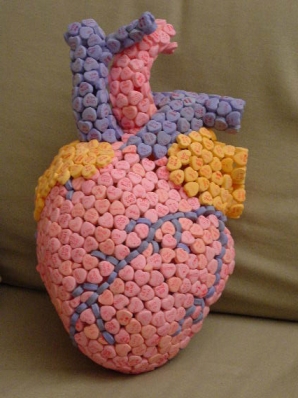
Candy Heart

This is wonderful:


http://scienceroll.com/2007/11/26/anatomical-heart-made-from-candy-hearts/

It's a model heart made from (if you can't tell from the picture) those candy hearts with the pink messages on them.

Is it just me, or does anyone else think that this would make a really cute St. Valentine's Day present (especially in the case of broke college students)? (Of course, there's the question of what to do with such an object. If it were made of entirely edible materials, I suppose one could eat it.)

Edit: And here's how to actually make something along these lines (especially with regard to preservation of the specimen) -- http://makeprojects.com/Project/How-to-Preserve-a-Candy-Portrait/395/1#.T9cQ6uLMAys

Sunday, March 4, 2012

NYTimes: Genes on the March

A very interesting, if somewhat inaccurate (well, I'm just being nitpicky here) piece on genetic history, à la Mongolian warlord: 
http://opinionator.blogs.nytimes.com/2012/03/03/genes-on-the-march/?hp

There's likely Khan blood somewhere in my family, though the probability's lower than that of the average Chinese, seeing as we're from the south. Even if there were, though, I doubt any of my relatives would be too pleased, given the most logical method of transmission, as it were.

Thursday, January 26, 2012

io9: Why Are Monkeys' Faces All So Bizarrely Different?

Just a fun science-y piece I found:
http://io9.com/5875354/why-are-monkeys-faces-all-so-bizarrely-different?tag=biology

It makes me wonder about people who are ostentatious with regard to personal ornamentation (especially facial ornamentation). Are heavily bearded men less expressive? For that matter, is it possible that women's supposedly superior communication skills have something to do with our lack of facial hair? (Is this why Santa Claus's interpersonal communication is largely relegated to the iconic "Ho ho ho"?)

Also, that monkey's face is priceless. :)

Friday, December 30, 2011

BBC: Vaccine Developed Against Ebola

This is news:
http://www.bbc.co.uk/news/science-environment-16011748

I remember reading Richard Preston's The Hot Zone when I was in middle school, shortly after taking a summer course on epidemiology. It was probably one of the scarier experiences of my childhood. I've always had a rather active imagination, and I was busy identifying symptoms, thinking that I had come down with bubonic plague, or leprosy, or some such disease every other day. Ebola took it to a whole new level; I think I had about a week when I was convinced I was about to die. I wish this vaccine had existed back then -- if only for my own peace of mind.

Sunday, November 13, 2011

BBC: Human-Induced Fires Sow Seeds of the Future

"Natural" selection at work:
http://www.bbc.co.uk/news/science-environment-15674495

It's an interesting, if not surprising, case of observable evolution, much like the moths adapting to soot-stained England a century or two ago.

Saturday, September 17, 2011

MSNBC: Don't Eat Armadillos, or If You Do, Get Tested for Leprosy

Exactly as it says:
http://www.msnbc.msn.com/id/42788111

Apparently, armadillo tastes pretty good -- rather like a game bird. The eating thereof used to be fairly common in the South; the idea that commonly edible meat consists of beef, pork, fowl, and seafood (and occasionally venison) is actually rather new in human history. Of course, the fact that common meats are usually bred and controlled in the modern day, and therefore much less likely to contain pathogens, contributes to the narrowing of our palates.

And the line, "I would not cuddle armadillos" is priceless.

Thursday, September 15, 2011

NYTimes: Odd Exceptions in the Family Planning Rulebook

An interesting article, especially given the friends I made in China, all of whom were only children:

http://www.nytimes.com/2011/04/07/world/asia/07sidebar.html

The last line is so ridiculously illogical that I nearly spewed tea on the keyboard. Really? That's what ultrasounds and amniocentesis are for. It's not as though the Chinese have anything against abortion, by and large.

I can see the logic to both sides of the One Child Policy debate. China's huge population means that some method of restricting population growth is necessary (especially in the days when it was first enacted). At the same time, the lack of a social safety net, especially provisions for the elderly, mean that the burden falls on the children to care for their aging parents -- which, traditionally, has been the case, but which has been exacerbated by the lack of siblings with whom to divide this often significant burden. Obviously, parents would want to have multiple children, which means exploiting whatever loopholes are available to them -- including, apparently, nonexistent disabilities. (Also, there's the not insignificant problem of favoring male children over female ones, especially in a culture that's still somewhat traditional.)

I imagine that as China's population stabilizes, the state-mandated controls on childbirth will ease up. Legislation (of the sensible variety) seems to be moving in that direction; for example, if both parents are only children, they are permitted two offspring. In some ways, it's a more extreme, top-down version of natural, self-correcting fluctuations in ecological population density; instead of massive infant mortality and starvation, the government is heading of the problem at conception. Now, as the population is stabilizing, hopefully the Chinese government is recognizing these shifts and scaling back their artificial restraints.

Wednesday, July 27, 2011

io9: Death by Fan in South Korea

As someone with an Asian mother, I'm no stranger to odd superstitions and health advice, especially quoted from "reputable" Chinese newspapers. This one's pretty good:

http://io9.com/5818197/in-south-korea-falling-asleep-in-front-of-a-fan-is-the-kiss-of-death

Reminds me a bit of my mum's "X causes cancer" line, where X is whatever I happen to be eating at the moment.

Friday, July 8, 2011

BBC: Parakeets Intimidate Garden Birds

Much like many other non-native species introduced into a very different habitat, parakeets appear to cause problems (thankfully, non-lethal ones) in the local ecosystem:

http://www.bbc.co.uk/nature/13524396

We used to get a lime green bird or two in our backyard every year (we might still, but I unfortunately don't have extended periods of time to spend gazing out the kitchen window anymore). My sister and I were always very excited to see them -- to see any colorful bird, really, considering we usually get sparrows and pigeons. Bluejays and cardinals were great, too, but the green ones were really something. As children, we never surmised that they might have been former house pets, though even then, we knew they had to come from elsewhere. We'd kept parakeets before, but they were budgerigars -- blue and white ones -- and looked significantly different.

This sort of story is increasingly common, what with increased human encroachment on previously virgin lands, and especially in this case, human tastes in animal companions. It's striking to me how much humanity influences its surroundings on a tiny, daily level. Reminds me of this BBC article I posted half a year ago.

Thursday, June 30, 2011

NYTimes: Meat without Slaughter

A most interesting article on synthetic meat and its moral implications, from one of my favorite New York Times blogs (Dot Earth):

http://dotearth.blogs.nytimes.com/2011/05/16/meat-without-slaughter/

I can sort of understand why some people might be "squicked" (for lack of a better term) by the idea, but I'd be all for synthetic meat, if it were indeed identical to (or better than) naturally-begotten meat and the production process were better for the environment than the current one (which I imagine wouldn't be all that hard for synthetics to achieve). I'd be curious to know what a moral vegetarian (that is, someone who abstains from meat for ethical reasons) thinks of it.

Monday, May 30, 2011

NYTimes: Could Conjoined Twins Share a Mind?

A fascinating article I found this morning:
http://www.nytimes.com/2011/05/29/magazine/could-conjoined-twins-share-a-mind.html?_r=1&hpw

It's rather long, but well worth the read. Craniopagus twins are probably the most interesting sort of conjoined twins, in that it affects not only their physical existence, but also their mental independence. Imagine being (somewhat) mentally linked to your sibling! (That's a scary thought, given me and my sister -- the world is not prepared for such madness.) It also opens the door to all sorts of ethical dilemmas (how would you legally treat them as two distinct persons, &c.?).

It seems like it would make excellent fodder for a novel (I'm sure it's already been written about.) -- anyone have a good book about craniopagus twins to recommend?

Wednesday, May 18, 2011

NYTimes: Europe's Plagues Came from China

A very interesting article (from a while back) on the Black Plague in medieval Europe:

http://www.nytimes.com/2010/11/01/health/01plague.html?_r=1&ref=global-home

There have been, for quite a while, theories that the plague originated the East, but I don't think there have been any definitive or substantial studies conducted until this one. Given the relative urbanization along the coast of China in those days, at least compared with Dark Ages Europe, it makes a lot of sense. Cities, then and now, are breeding grounds for disease. And other, good things, too, of course, but plague was perhaps the most transformative.