Saturday, December 31, 2011

Friday, December 30, 2011

BBC: Vaccine Developed Against Ebola

This is news:
http://www.bbc.co.uk/news/science-environment-16011748

I remember reading Richard Preston's The Hot Zone when I was in middle school, shortly after taking a summer course on epidemiology. It was probably one of the scarier experiences of my childhood. I've always had a rather active imagination, and I was busy identifying symptoms, thinking that I had come down with bubonic plague, or leprosy, or some such disease every other day. Ebola took it to a whole new level; I think I had about a week when I was convinced I was about to die. I wish this vaccine had existed back then -- if only for my own peace of mind.

Thursday, December 29, 2011

Look What I Got for Christmas!

A ukulele!


It's a concert-sized Lanikai (LU-21C). I did my research (looking at online reviews, mostly), and it seems like this is a solid choice for a beginner (good quality for the price, decent sound, etc.).

There's a story behind it. Remember this post (about the Neil Gaiman and Amanda Palmer show that I attended last month)? If you don't want to read the whole article (it's short, though), the relevant bits are: she performed her song "Dear Old House," which became one of my favorite pieces on the spot (give it a listen below), and then her "Ukulele Anthem," one of the most memorable lines of which explains that it only takes an hour to learn to play the ukulele, which is comparable to the time required "to teach someone to build a standard pipe bomb." I was intrigued. I wanted a ukulele.


Then, my sister asked me what I wanted for Christmas. It appeared that my parents were a bit stumped as to what to get me. Ergo, I asked for a ukulele. They were a little confused as to what the instrument actually is (I don't imagine that "ukulele" is a word one would encounter in the standard Chinese-English dictionary), but I explained that it was a bit like a guitar, only smaller and Hawaiian. They were afraid it would be made of pineapples or coconuts or something [edit: there apparently actually exists a type of ukulele known as a pineapple ukulele], and I think they were secretly a bit relieved that it was a completely normal-looking, if slightly small, instrument. And so we went to the local Sam Ash when I got back to New York, and my father bought me one. I just learned to play "Hallelujah" by Leonard Cohen. I'm working on "Dear Old House," too, but the chords are harder.

 And that is what I got for Christmas.

NYTimes: Medieval Chess Sets at the Cloister

These look really awesome:
http://www.nytimes.com/2011/11/18/arts/design/the-game-of-kings-medieval-ivory-chessmen-from-the-isle-of-lewis-at-the-cloisters.html?_r=1&src=dayp

I'm in New York for another week or so. Anyone want to go see them with me?

Edit: I didn't actually end up going (I'm coming home for spring break, though!), but I was reading the exhibit blog, which is fascinating.
http://metmuseum.org/exhibitions/listings/2011/the-game-of-kings-medieval-ivory-chessmen-from-the-isle-of-lewis/exhibition-blog

Angry Birds = High Fashion?

Something for all the techies:
http://fashion.telegraph.co.uk/columns/belinda-white/TMG8943600/Wife-of-Rovio-chief-wears-Angry-Birds-dress-to-the-Finnish-Palace.html

I don't claim to be in any way fashion savvy, but even I'd hesitate to wear that particular dress for any occasion other than Hallowe'en (let alone to the Palace!).

Monday, December 26, 2011

If I Used Twitter

tonight's post would be:
froyo + pickled egg + pickled pig's feet (the latter 2 in ginger + vinegar + soy sauce) = 3am snack with sister, 6 hrs before ski trip

Saturday, December 10, 2011

World History in Facebook Updates

Something funny that Wendy found a few days ago, over which I spent the better part of an afternoon giggling:
http://www.collegehumor.com/facebook-history

Just some entertainment over finals week. It's rather Eurocentric (well, Western-centric), but on an English-language site, that's to be expected, unfortunately.

I'm sure that those of you who use Facebook will find this even funnier than I did.

Monday, December 5, 2011

Today

is the 141st anniversary of the death of Alexandre Dumas (the elder). Although he made his literary debut as a playwright, he is most famous as the author of The Count of Monte Cristo and The Three Musketeers.

When I first read the Musketeers books and The Count of Monte Cristo, I wasn't quite old enough to pick up on all the greater themes that a literature class might have brought to the table. It was all swashbuckling adventure fiction in my eyes. I wanted to be d'Artagnan for a while (though I had enough sense not to want to be Edmond Dantès; I was never really a vengeful sort of child). I think I told my mum once that I wanted to take up fencing, but I remember she was properly horrified (thought it unbecoming of a little girl, probably), so I never brought it up again. Then I told my father I wanted a feathered hat, and he was amused, and told me he'd find me one for Hallowe'en (which was at the time several months away, so he forgot about it by October). This was my version of "playing dress-up" or "knights and ladies" or whatever small children played.

Anyhow, Alexandre Dumas, a significant influence on my childhood. I rediscovered this particular breed of fiction in my teens, in the form of Steven Brust's Khaavren Romances (also fun reads, and heavily stylistic). If you like one (and are open to some genre-crossing), you'll like the other.

Saturday, December 3, 2011

Meowing Choirboys

Courtesy of Brett:


I love the dynamic between them. I wonder how old they are, to have such control (especially in the area of comic timing)?

Tuesday, November 29, 2011

Beauty and Madness

 I've been reading some William Morris for a literature class on medievalism (both medieval literature and Victorian medievalism). This line, in particular, struck me:
 I was half mad with beauty on that day...
~ William Morris, "The Defence of Guenevere"
I've noticed that beautiful people, and people who create beautiful things, are often a little mad. (By "beautiful people," I mean people who have beautiful souls or minds, not attractive exteriors.) There's a sort of fragile beauty, the sort where you can hear the madness vibrating under the surface, like an impossibly light glass orb that might shatter if you touch it. It's the wildness of it, the thrill of unpredictability. It's the beauty of the endangered predator, the tiger that doesn't know it's one of the last of its kind, that can still kill you where you stand.

Madness itself can be beautiful, in its own way (hence the Gothic novel). There's a certain purity to madness, in that everything that affects a lunatic ultimately comes from within her own head (much of it is exhibited as response to stimuli, but the response is atypical -- i.e. not socially dictated). The greater part of the significance that literature assigns to madness is the uniqueness of its perspective.

Western culture idealizes individualism to an extent unmatched in other societies -- and that applies to Western intellectual culture as well. I think of it, sometimes, as the "genius in a box" phenomenon. People are attracted to the image of great ideas springing fully formed from the aether, like Athena from Zeus's head. They like thinking that geniuses are born, not made, and that they achieve their success purely through their own inscrutable methods. Of course, this construct doesn't quite reflect reality; as Newton once said, "If I have seen a little further it is by standing on the shoulders of giants." (His expression of the sentiment is the most famous, but not the first; the earliest known attribution is to Bernard of Chartres.) I actually just read, for a history of science class, an interesting book by Peter Galison entitled Einstein's Clocks, Poincaré's Maps, which argues (perhaps a tad overzealously) that Einstein, the quintessential representation of genius in modern Western culture, was inspired in the formation of his theories of relativity by the mathematician Henri Poincaré. One can't be a pioneer in one's field without having a good grasp of the work that preceded one's own. Genius is hardly ever as isolated as the romantic ideal would have it.

The thing is, genius is isolating only insofar as society renders it so. There were plenty of intellectuals throughout history who, in addition to being brilliant, were also scintillating conversationalists, consummate socialites and courtiers, and infamous Lotharios -- Renaissance men, as it were. It's terribly unfortunate that in the modern day, intelligence is seen as a social liability (that's probably a reflection on the state of American society, but we'll not go there tonight). But it's that isolation that makes it seem mysterious, unattainable -- and therefore beautiful.

A bit of a digression, I suppose. Perhaps not quite what Morris was going for, but that's how I read it.

Thursday, November 24, 2011

NYTimes: What's in a Name?

Seeing as it's Thanksgiving -- a celebration of family and loved ones -- I thought that this would be an appropriate article to post; it's an observation on an inevitable quandary in naming trends, given recent (within the past several decades) developments in gender equality and increasingly diverse modern familial structures:

http://www.nytimes.com/2011/11/24/fashion/babies-surnames-to-hyphenate-or-not.html?_r=1&ref=fashion?src=dayp

I've given this a fair bit of thought. As a heterosexual female, Western social customs would have me relinquish my surname in favor of my hypothetical husband's, if I were to marry at some point in my life. I'm not so keen on that, myself; I'm rather attached to my last name. It has a history behind it, a connection to generations of family and culture.

Ergo, one of my goals in life is to achieve a level of "success" (definition variable) such that if the time comes, it would appear to be logical (rather than vain or self-serving) to keep my surname. It's rather sad that society is still at a stage where a woman needs a reason to keep her maiden name, while a man may do so merely by virtue of his Y chromosome. I hope that someday, English-speaking society will have progressed such that women keep their own names as a matter of course, and some equitable system exists whereby children's surnames are evenly distributed between their sire and dam.

I'm not sure about hypothetical children (haven't given them much thought -- I'm many years too young for that!) but I imagine it would depend a lot on the ethnic origins of their father. Surnames in some languages lend themselves more readily to hyphenation than those in others. I'd want them to have a Chinese name, too. If the father were non-Chinese, I'd like to give them my own Chinese family name to use in contexts that would require it; phonetically deriving one from the father's surname seems a little cheap, next to a name with history and family.

Interestingly, in Chinese society, women retain the use of their maiden names throughout life; it's only when referring to them specifically as "wife of so-and-so" that they go by the equivalent of "Mrs." Gender equality is, in some respects (this is a pretty significant caveat), more apparent in modern Chinese society (i.e. beginning with my generation). I think it has a lot to do with the One Child Policy, in that if parents have only one child, they will give it the best they can in the way of opportunity and attention. There is much less opportunity for parents to favor sons over daughters (after the birth of the child; female infanticide is still a problem in some areas), because they typically only have one child to dote upon. The surname given to the child is still the father's, so it's not a perfect system, by any means, but in this specific practice, it's a bit closer to gender equality than in English-speaking countries.

Friday, November 18, 2011

Physics from Hell

Speaking of Galileo:


It's quite fascinating how this entire body of mythology developed as a way of rationalizing a historical document in light of scientific advances over the course of centuries. It led to some pretty interesting literalist interpretations, as shown above. (Obviously, Biblical literalism yielded some rather significant results, mostly through its loss of scientific credibility. Ironic, but not surprising.)

Brett's Non-Apple Apple Cake

Yesterday was Brett's birthday. So I baked him a cake -- a non-apple apple cake. That basically means it was a cake that looked like an apple, but didn't actually have apple in it (it was a simple pound cake with strawberry jam filling):


It's something of an inside joke, because Brett has a bit of an obsession with green apples (he used to go through about ten of them a day). Back when we ate at dining halls, he would purloin dozens of them from the cafeteria, stuffing his backpack full of them and stashing them in his desk. The filing drawer (you can picture the volume of those) was usually half-full of apples. It got to the point where our friends nicknamed him "Apples." So everyone who came to his showering (another Stanford tradition -- friends surprise the birthday boy/girl at exactly midnight of their birthday, and toss them in the shower) got a laugh out of the cake.

Tuesday, November 15, 2011

Poetry vs. the Inquisition

A thought on the power of poetry, or perhaps just the abstruseness of some of the stuff:
If Galileo had said in verse that the world moved, the inquisition might have let him alone.
~ Thomas Hardy
Of course, if Galileo had written the Dialogue in the style of Vergil, he might never have achieved the posthumous scientific success that he did. (Then again, there were Renaissance men in his day, scientist-poet-philosophers. I wish our modern education system allowed for that -- but that's for a different post all together.)

Hardy was himself a great poet, so he knows whereof he speaks.

Sunday, November 13, 2011

BBC: Human-Induced Fires Sow Seeds of the Future

"Natural" selection at work:
http://www.bbc.co.uk/news/science-environment-15674495

It's an interesting, if not surprising, case of observable evolution, much like the moths adapting to soot-stained England a century or two ago.

Friday, November 11, 2011

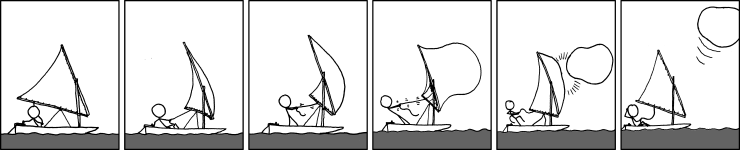
xkcd: Sail

Today's xkcd, which I thought was really cute and quite clever:


That is all.

Thursday, November 10, 2011

Page One, a Documentary

I attended an on-campus screening of the documentary Page One: Inside the New York Times (co-sponsored by The Stanford Daily and the communications department, I think) today. It was, I believe, showing at a number of smaller theatres over the summer, as well as at Sundance. I enjoyed it -- it was at once realistic and optimistic, and quite well-made, besides.

The heavy focus on the advent of citizen journalism and the much-hyped "death of (print) newspapers" mirrors the self-publishing and e-book issues in book publishing today -- something that I know better than I do than the news industry. In both cases, it's a matter of negotiating relatively peaceful change, especially where technology is concerned, under threat of obsolescence. News media, methinks, is less hidebound than book publishing in that regard.

It was interesting to note that much of the citizen journalism going on today is responsive and aggregative -- that is, bloggers and websites responding to reporting by traditional media outlets, and aggregating material from professional news media. Citizen journalism is just not sufficiently reliable and or comprehensive, at least not yet -- and I'm not convinced that it will ever be, because consistent, good, and consistently good journalism requires infrastructure (which in turn requires the sort of resources that civilian journalists can rarely access) and training (which is usually acquired at journalism school and/or through working in the field, under the guidance of more experienced journalists). Certainly, there are isolated incidences in which passersby on the ground are first to gain access to material simply because the spontaneity of some news precludes real-time coverage. But on the whole, I think the documentary has proven that professional journalism is not dead.

Wednesday, November 9, 2011

The Stanford Daily: Gaiman and Palmer in SF

Neil Gaiman and Amanda Palmer performed a show in San Francisco last week, and I covered it for The Daily (pretty much exactly what it says on the tin, above):

http://www.stanforddaily.com/2011/11/04/gaiman-and-palmer-read-rock-and-talk/

It was awesome. I want a ukulele. 

Saturday, November 5, 2011

Bonfire Toffee

Seeing as it's the Fifth of November, a few friends and I are watching V for Vendetta. I made Bonfire Toffee for the occasion, using a recipe from the BBC Food Programme:

http://www.bbc.co.uk/radio4/factual/foodprogramme_recipe_toffee1.shtml

It's really sticky and tastes strongly of molasses. I've tested it on my friends, and they like it!

Thursday, November 3, 2011

A Transcendentalist Microwave

A picture of our microwave:


It's Lucas's doing. Not that I don't approve, of course.

Tuesday, November 1, 2011

Why I'm Not Doing NaNoWriMo This Year

It's November, which means it's the time of year when thousands of writers around the world buckle down and write a novel. In a month.

I've done it four times, and I've won it three (see the sidebar). But this is not a been-there, done-that kind of post. In fact, I've been quite excited by the novel I have brewing in my head -- it's been living there for a few months, so real that I could almost touch it. (I wonder if it wiggles, like Jello?)

Rather, it's to do with this post. It's my last year here, with all of these wonderful people, and I don't want to spend a month locked in my room away from them. I have the rest of my life to do that. I want to have more pie nights, and attend lectures, and play midnight Catan. The novel can wait another year. Stanford won't -- it'll whoosh past if I'm not careful. (That, ironically, reminds me of this Douglas Adams quotation.)

So that's that.

Monday, October 31, 2011

If I Used Twitter

my random thought of the day would be:
I want to write a story entitled, "All My Imaginary Children, and Possibly Some Electric Eels".
That is all.

Friday, October 28, 2011

Book Critiqua @ The Stanford Daily

I have a column this volume (read that aloud) in Intermission (arts section of The Stanford Daily). It's called "Book Critiqua" -- for those of you who aren't typography geeks, it's a play on the font "Book Antiqua." Anyhow, my inaugural column came out today, featuring Daniel Handler (aka Lemony Snicket). I attended his talk in San Jose, but the even cooler part was, I got to interview him! So here's the article, with a bunch of lovely soundbites:

http://www.stanforddaily.com/2011/10/28/a-not-so-unfortunate-visit-from-lemony-snicket

He's wonderful in person, and a great conversationalist. And not actually really creepy or anything like that, in case you were wondering.

Wednesday, October 26, 2011

io9: Vegetable Orchestra

A strange, wonderful idea:
http://io9.com/5817756/vegetable-orchestra-grow-your-own-guitar

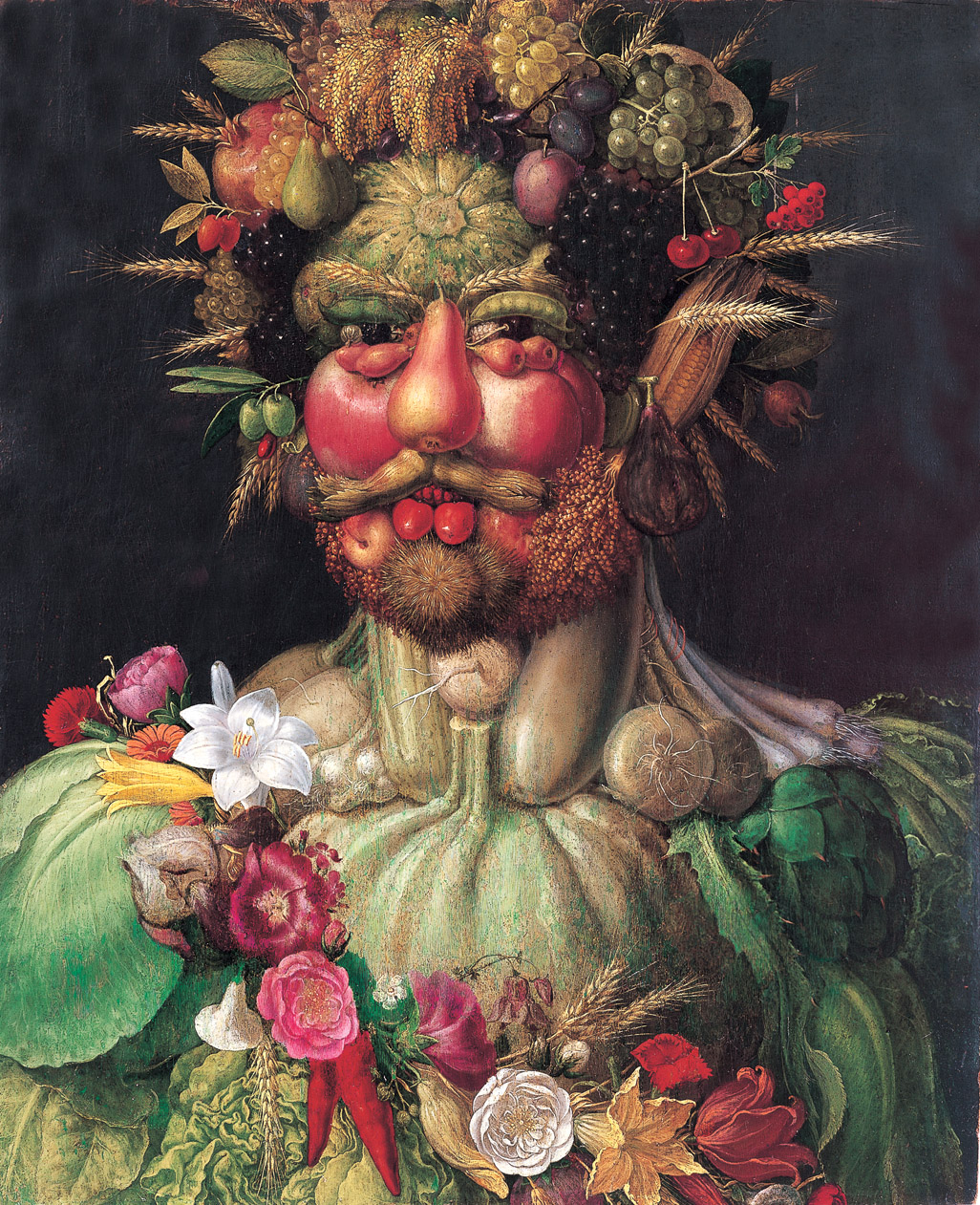
It takes some imagination to come up with such a thing -- it sounds like something out of a children's book, or a Greek myth. It reminds me of those Giuseppe Arcimboldo paintings of vegetable men, like this one, which I believe is one of his most famous:


I kind of want to make a vegetable instrument (though I imagine it's much harder than it looks). Another experiment to try in our kitchen, perhaps?

Monday, October 24, 2011

If I Used Twitter

I would post, right now:
Writing a paper on Browning's "Childe Rolande" (quite creepy!), and G-chatting with my sister about secret elephants.

Friday, October 21, 2011

The Economist: Customs and Immigration... from the Moon

Those astronauts had a great sense of humor (and so, too, does The Economist):

http://www.economist.com/blogs/gulliver/2011/10/space-travel

I think my favorite part is the declaration of health.

Tuesday, October 18, 2011

Washington Post: Interactive Civil War Map

The Washington Post posted a bunch of articles and things about the American Civil War, in honor of the 150th anniversary of the war. This is one of the coolest of the lot:

http://www.washingtonpost.com/wp-srv/lifestyle/special/civil-war-interactive/civil-war-battles-and-casualties-interactive-map/

The design of the thing is sheer brilliance. Hit the play button to really get a sense of the progression of the war. Even though the map doesn't show them, you can sort of follow troop movements based on the shifting locations of major battles. I wish it had a way of indicating the generals involved on each side, but that would probably make the thing a little too complicated and unwieldy.

Monday, October 17, 2011

Map of Top 100 SciFi & Fantasy Books

Something that Brett sent me a few weeks ago that every scifi/fantasy nerd should appreciate: 


(You'll have to click on it to see everything.)

I'm glad that there's such diversity in this map, including quite a few books that wouldn't conventionally be found in the scifi/fantasy section of the bookstore. It's also wonderful that it doesn't portray The Lord of the Rings as the founding bedrock of the genre (not to understate Tolkien's genius); there were plenty of classic novels that should be recognized as scifi/fantasy (like Frankenstein and Cat's Cradle, by Mary Shelley and Kurt Vonnegut, respectively).

Sunday, October 16, 2011

Today

is the 253rd birthday of Noah Webster, who is most famous for his contributions to education and language, especially for the contemporarily eponymous dictionary (formerly American Dictionary of the English Language). Like most prominent men of his day, he was involved in politics (particularly immediately post-Revolution), and was also a champion of a number of sociopolitical causes. While I would not want to understate his contributions to the country on that front, it's safe to say that his seminal work was in reforming and standardizing the usage of English. It was a phenomenal achievement, and well worth commemorating today.

Saturday, October 15, 2011

Academia in the East and West

I was reminded of this quite excellent article, which I'd bookmarked a long while ago, after catching up with my friend over the summer:

http://scienceblogs.com/principles/2011/08/the_status_of_science_we_have.php

We were discussing sciences education, and the differences between the culture of academia in (East) Asia versus in the West. We observed that in Asia, there is a lot more interest in the sciences among students (grade school and undergraduate) than in the West. However, it seems that academia (in the sciences and otherwise), is dominated by Western institutions and Western publications. There have been attempts at many levels of institution and government to correct for deficiencies in each area; Western governments push for better science education, and Asian universities for more prestige in international academia. Both deficiencies, methinks, are problems endemic to their respective systems.

There are, broadly speaking, two distinct skill sets that academics ought have: that of teaching, and that of research. As argued in the above article, the Western system is skewed to reward the latter much more than the former. In every step of the process, from the new graduate student's first day to his becoming a respected professor, the Western academic is evaluated based upon the scholarly material that he produces. The quality of his teaching is secondary; the bulk of his effort is invested in honing his skills as a scholar, rather than as a teacher (so long as his teaching is not so poor as to inspire too much complaint). In fact, as the blog post argues, it is generally seen as a waste of time -- at least by the metric of career advancement -- to teach any more than is required, and certainly to engage in outreach beyond the university community. (My friend is a TA, so I'm inclined to take his word on this.)

Contrast this with academia in countries like China, Japan, and Korea. The culture in these countries respects and values good instructors at every level, so there is a lot of emphasis on effective teaching. This translates to interest in the sciences among students in middle and high school. In the Chinese system (with which I am more familiar, out of the three), this is further accentuated by the fact that students choose their emphasis -- a binary choice of humanities or sciences -- in high school. It's a pretty even split, and switching to the other side is discouraged. This ensures that about half the student population is at least nominally interested in the sciences.

But I digress. In Asia, at the university level, professors are expected to be able to command a lecture hall of hundreds. They're seen as founts of knowledge dispensing wisdom to their charges, essentially. Producing new knowledge, however, is a different kettle of fish. The system is such that until recently, professors didn't really need to publish. There was no real incentive for doing so; there's no need to gain legitimacy in one's field when one already has the support of an institution and a legion of awestruck students, and when there's no outside reward (or pressure) for such efforts.

The best system would be (as expected), some ideal combination of the two. Easier said than done, of course. But given increasing globalization (which is in itself another discussion), perhaps a merge of the two might yet be accomplished.

Thursday, October 13, 2011

The Marrow of Life

I don't normally read The Stanford Review, but something struck me about this particular article:
http://blog.stanfordreview.org/2011/01/28/the-intensely-lonely-world-of-stanford-students/

It's not breathtakingly profound, or even anything that hasn't been said before, but it does make me think, sometimes, about what I'm doing here at Stanford. In twenty years, I'm not going to remember my midterms, my problem sets, the paper I pulled an all-nighter trying to finish. I know, rather, that I'll remember the wonderful friends I made, the late-night conversations, and the random crazy stunts we pulled. Those are the memories I should be making in my last year here. As Henry David Thoreau once wrote:
I wanted to live deep and suck out all the marrow of life... (Walden, Chapter 2)
I've promised myself: I'll do something interesting, fun, and maybe unexpected every week (or even more than once a week, if I can). It might be something simple and solitary, like finding a good poem, or learning to cook something new. It might be a fun activity with friends, like attending a dance event, or having a long and interesting conversation with somebody. And I'll try my damnedest not to let the relative isolation of my dorm (Mirrielees, which does have its perks, like a kitchenette and a bathroom in each suite), or the scattering of my friends, or my rather demanding course load, stop me.

So, for those of you at Stanford, if there's something you think I'd like to try, or something you think I don't know much about, by all means, drag me to your event! If you just want to chat, stop by for dinner or tea. Chances are, I don't see you nearly as often as I'd like.

Beluga Shenanigans

I thought this was really cute. That is all.

Monday, October 10, 2011

Geoffrey Chaucer Hath a Blog

One of my English professors held a Middle English workshop last week, and showed us this:
http://houseoffame.blogspot.com/

It's brilliant and hilarious in a really nerdy, English-major-y way. (Chaucer himself was quite funny, and the blog does him justice.) I've been reading it a bit obsessively the past week. Go have a gander -- I promise you'll laugh. (If you have trouble with the Middle English, there are some translation resources in the sidebar.)

Thursday, October 6, 2011

R.I.P. Rev. Fred Shuttlesworth

Civil Rights activist Rev. Fred Shuttlesworth passed away yesterday: http://www.nytimes.com/2011/10/06/us/rev-fred-l-shuttlesworth-civil-rights-leader-dies-at-89.html?ref=obituaries

I had the great honour of meeting him half a decade ago, when I was in high school, through a wonderful program called Sojourn to the Past. He was a warm, genuine person, who despite his age and vast life experience, took the time to speak with a bunch of students, to pass along the torch that he had borne so faithfully his entire life. He was truly an inspiration, and the world is a little less bright for his passing.

Wednesday, October 5, 2011

R.I.P. Steve Jobs

The visionary of Apple died today: http://www.nytimes.com/2011/10/06/business/steve-jobs-of-apple-dies-at-56.html?_r=1&hp

I'm an Apple user. I'm typing up this very post on Mycroft, my Macbook. I've had one Macbook before him (a black one, named Marvin), I use an iPhone, and I have used various iPods before it. I have a distinct, albeit annoyingly unquantifiable, preference for Apple products (as opposed to comparable computers and phones) -- that's part of the magic.

There is little I can say about Steve Jobs that has not already been said. But I think that one of his greatest accomplishments is taking everyday, functional items -- the personal computer, the phone, the music player -- and making them beautiful. An often overlooked piece of his background: he audited a calligraphy class once, in college. This led to the diverse palette of computer fonts we have today. It's the little things like this that made him great; he didn't invent the computer, but he brought to it a certain irresistible aesthetic. Sometimes, it's all in the details.

Edit (11/28): William Gibson says it better, at http://imgur.com/hu40O

Tuesday, October 4, 2011

Chinglish and Other Amusements from China

I realized that I never posted the various amusing and interesting pictures I took in China. (Many of them are of Chinglish bloopers.) Here are some of the funnier ones:

This was taken in a mall in Hong Kong; I believe it was advertising an arcade or some such.

The circular, UFO-like thing on the ground is an information booth. I suppose that's one way to attract attention!

We found these in the shower of our hotel room. False excrement indeed (I should certainly hope so, given its intended use.)

I had opened the drawer expecting a sewing kit, or perhaps a clothes-line. This... isn't quite string.

I did not anticipate finding French fries or hash browns (especially smiley ones) in China, especially in the same box as chow mien and string beans. It reminds me of the cover of Watchmen, with the strategically-placed ketchup and all.

Liquid yogurt is a rather common drink in China; "living fungus milk," however, is distinctly unappetizing.

And this. I couldn't resist putting this up. It's my mother's big carry-on bag. Apparently it was a gift. (The arm in the picture is my father's.)

Saturday, October 1, 2011

Because I could not stop for Death (by Emily Dickinson)

In addition to the book list, I found time over the summer for some poetry -- both revisiting old favorites and finding some new ones. I haven't posted any poetry in a long while, so I thought I'd share this one. It's pretty well known; I first read it in middle school, I think. One of the really geeky reasons I like it is that Dickinson's characterization of Death reminds me a lot of Terry Pratchett's Death, who is perhaps my favorite Discworld character. 

Because I could not stop for Death
by Emily Dickinson (1830-1886)

Because I could not stop for Death – 
He kindly stopped for me –  
The Carriage held but just Ourselves –  
And Immortality.

We slowly drove – He knew no haste
And I had put away
My labor and my leisure too,
For His Civility – 

We passed the School, where Children strove
At Recess – in the Ring –  
We passed the Fields of Gazing Grain –  
We passed the Setting Sun – 

Or rather – He passed us – 
The Dews drew quivering and chill – 
For only Gossamer, my Gown – 
My Tippet – only Tulle – 

We paused before a House that seemed
A Swelling of the Ground – 
The Roof was scarcely visible – 
The Cornice – in the Ground – 

Since then – 'tis Centuries – and yet
Feels shorter than the Day
I first surmised the Horses' Heads 
Were toward Eternity – 
 The poem itself aside, there are a few small touches -- word choice, imagery, the like -- that I really enjoy in this piece. The "House that seemed / A Swelling of the Ground" is great; it makes me think of hobbit holes. I like how she says that the grain is "gazing" -- not a verb one would normally associate with plants, but it recalls both the grazing of farm animals and the classic imagery of gazing at sunsets, as per the line following. And I love, love the formatting of the last line, which ends, rather than with a period (as is conventional), but with an em-dash, like the rest of the poem. The slightly unsettling, unfinished quality lends so much more power and meaning to the concept of eternity.

Wednesday, September 28, 2011

Snippets from Summer Reading (Just My Type, by Simon Garfield)

Something to live by:
By all means break the rules, and break them beautifully, deliberately, and well. That is one of the ends for which they exist.
~ Robert Bringhurst, The Elements of Typographic Style (Just My Type, p258)
Something to amuse (but nonetheless wise):
The good type designer ... realizes that, for a new fount to be successful, it has to be so good that only very few recognize its novelty. If my friends think that the tail of my lower-case r or the lip of my lower-case e is rather jolly, you may know that the fount would have been better had neither been made.
~ Stanley Morison, of The Times (Just My Type, p259)
It's an excellent book, besides.

Thursday, September 22, 2011

Summer Book List

I've decided to keep a list of books I've read this summer (for pleasure, not for work). There are a whole host of reasons: I'd be interested in my rate of reading (that is, the number of books I go through per month, or something like that), the breakdown of my reading habits (genre, rate/frequency of rereading, &c.), the amount of money I actually spend on books (as an undergraduate living at home, it's one of my biggest expenses, though one of the perks of working at a publishing house is all the free books I get!), and statistics of that nature.

Housekeeping: I bump this post to the top of the blog every time I add another book. It is in chronological order, with the most recently finished book at the bottom. The titles below link to the Amazon page (the exact edition I read, or as close to it as possible), and the authors link to the authors' Wikipedia pages, where available.

Reading
Love in the Time of Cholera by Gabriel García Márquez
Neuromancer** by William Gibson

Read
Water for Elephants by Sara Gruen
State of Wonder by Ann Patchett
The Secret Life of Bees by Sue Monk Kidd
Kraken by China Miéville
The Island of Dr. Moreau by H. G. Wells
Who the Hell is Pansy O'Hara? by Jenny Bond and Chris Sheedy
River Town by Peter Hessler
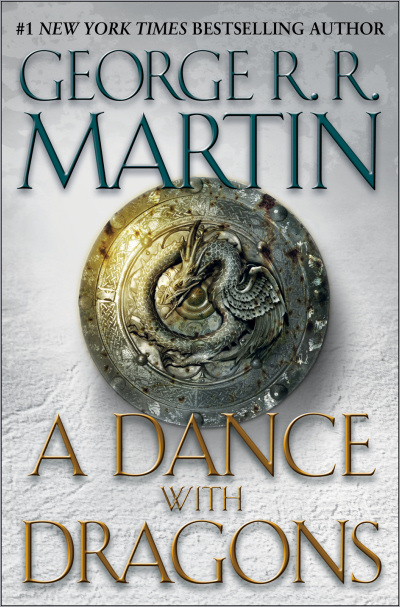
A Dance with Dragons by George R. R. Martin
The Code of the Woosters by P. G. Wodehouse
Sailing to Sarantium by Guy Gavriel Kay
Lord of Emperors by Guy Gavriel Kay
Shadowflame by Dianne Sylvan
Ten Discoveries That Rewrote History by Patrick Hunt
Galileo* by Bertolt Brecht
The Little Prince* by Antoine de Saint Exupéry
Hamlet* by William Shakespeare
Hallowe'en Party by Agatha Christie
Jonathan Strange & Mr. Norrell** by Susanna Clarke
Queen Defiant by Anne O'Brien
Urban Code by Anne Mikoleit and Moritz Pürckhauer
Just My Type by Simon Garfield

*reread
**started a long time ago, but didn't finish until now

Tuesday, September 20, 2011

Today

was wonderful. Absolutely amazing. If I could have more days like this one -- even just a few -- I would be very, very happy. This post is rather self-indulgent, methinks -- just a chronicling of today, because it's the sort of day I'd like to remember. (I'm told that many people just write about their days on their blogs, so perhaps this is something closer to normal.)

I woke up at a reasonable hour -- 11:00 -- later than I normally do, but not so late that it seems that half the day has passed me by. And without an alarm -- this is a small but significant part of a perfect day, in that it leaves no dreams unfinished, which, even if one doesn't remember the dreams upon waking, is important. Waking in the middle of a dream often gives me a slightly unsettled feeling, as though I have unfinished business with somebody in my head.

I went to Columbia to visit a dear friend from high school whom I haven't seen in much too long. I arrived a few minutes early, so I got to watch him hold office hours. Despite his sometimes cantankerous nature and rather cynical view of humanity, he's actually a very good TA. He'll be an excellent professor someday, and that makes me happy.

He bought me bubble tea; I am extremely jealous of Columbia's bubble tea. It's decent -- not amazing, but pretty good. Why does Columbia have bubble tea in its cafeteria, when Stanford, which is in California, and is probably 25% Asian, does not? It's vexing, it is.

We talked for a few hours, and migrated around the campus. It's bigger on the inside (like magical wardrobes), with a surprising amount of grass and some really fat sparrows. I finally, finally got a decent photo of my friend, who hates photographs (he claims, just to be difficult, that photography will steal his soul). Also, for those of you who know him, he still looks a something like a llama, though he's less like one in character, now. He's mellowed out in college, to some degree.

After Columbia, I had a few hours to kill before I met a friend for dinner, so I went downtown, to a lovely indie bookstore called McNally Jackson. It has a quirky little café attached, which makes these dainty Earl Grey biscuits, and this really rich, not-too-sweet hot chocolate -- probably the best hot chocolate I've had all summer (the barista was very pleased when I told him this). I found a book called Urban Code, which has a very minimalistic, elegant cover (see image), and which I ended up buying, even though I've acquired quite a few books this summer, and haven't the time to read them all. I also spotted the new Neal Stephenson book Reamde, which also has a really nice book jacket (the texture is wonderful) that's visually quite similar to Urban Code; I valiantly resisted the temptation to buy it, because it was thirty-something dollars and a rather enormous, unwieldy hardcover. I might end up getting it on Kindle, if I end up reviewing it for The Daily.

On the way to dinner, I spotted a giant colorful chandelier-like sculpture suspended over a small side-street. (It's just a block or two from McNally Jackson, but the exact location escapes me.) The road itself was cordoned off, so I could just stand in the middle of the street for a few minutes, admiring the artwork. The street itself was nothing too special -- some old buildings, a lonely-looking warehouse, a few small stores -- which made the sculpture all the more wonderful a find.


And then, at the corner of Cooper Square and Astor Place, I happened upon all these lampposts decorated in neon zip-ties! (The ones across the street were even more colorful.) Apparently, as my friend told me later, the zip-tie art had been around for quite a while, but I hadn't been to that area in quite a long time.


We went to a Japanese restaurant, where we ordered exactly the right amount of food, with room to spare for dessert (when eating out with Chinese families, the dads always tend to over-order). This was also aided by the fact that I'd forgotten about lunch -- I didn't realize this until I was recounting my day to my friend and she pointed out, "So your caloric intake thus far today consisted of bubble tea, hot chocolate, and a very small cookie?"

Anyhow, we talked, like old times, and then we got dessert at a really good patisserie called Veniero's, where I had surprisingly reasonably-priced gelato and a smidgen of her delicious strawberry shortcake. And then we took the subway back into Queens together, and it was still early enough that when I came above-ground, I walked home in the twilight, alone under a deep blue sky.

Monday, September 19, 2011

Why being an English major is more fun (and more scandalous) than you'd think

I'm looking at my book lists for this quarter, and one of the required readings is called 'Tis a Pity She's a Whore. (It's an English play from the reign of Charles I, and I'm told it's quite good.)

They would never have gotten away with that in grade school.

Saturday, September 17, 2011

MSNBC: Don't Eat Armadillos, or If You Do, Get Tested for Leprosy

Exactly as it says:
http://www.msnbc.msn.com/id/42788111

Apparently, armadillo tastes pretty good -- rather like a game bird. The eating thereof used to be fairly common in the South; the idea that commonly edible meat consists of beef, pork, fowl, and seafood (and occasionally venison) is actually rather new in human history. Of course, the fact that common meats are usually bred and controlled in the modern day, and therefore much less likely to contain pathogens, contributes to the narrowing of our palates.

And the line, "I would not cuddle armadillos" is priceless.

Friday, September 16, 2011

io9: Pigeon-Guided Missile Could Have Changed the Course of WWII

Well, in theory, it could have worked:
http://io9.com/5828298/pigeon+guided-missile-could-have-changed-the-course-of-world-war-ii

Carrier pigeons have actually been used in war, of course, but using them as missiles takes it to a whole new level.

For another, more humorous use of homing pigeons, check out the last section of the Wikipedia article.

Thursday, September 15, 2011

NYTimes: Odd Exceptions in the Family Planning Rulebook

An interesting article, especially given the friends I made in China, all of whom were only children:

http://www.nytimes.com/2011/04/07/world/asia/07sidebar.html

The last line is so ridiculously illogical that I nearly spewed tea on the keyboard. Really? That's what ultrasounds and amniocentesis are for. It's not as though the Chinese have anything against abortion, by and large.

I can see the logic to both sides of the One Child Policy debate. China's huge population means that some method of restricting population growth is necessary (especially in the days when it was first enacted). At the same time, the lack of a social safety net, especially provisions for the elderly, mean that the burden falls on the children to care for their aging parents -- which, traditionally, has been the case, but which has been exacerbated by the lack of siblings with whom to divide this often significant burden. Obviously, parents would want to have multiple children, which means exploiting whatever loopholes are available to them -- including, apparently, nonexistent disabilities. (Also, there's the not insignificant problem of favoring male children over female ones, especially in a culture that's still somewhat traditional.)

I imagine that as China's population stabilizes, the state-mandated controls on childbirth will ease up. Legislation (of the sensible variety) seems to be moving in that direction; for example, if both parents are only children, they are permitted two offspring. In some ways, it's a more extreme, top-down version of natural, self-correcting fluctuations in ecological population density; instead of massive infant mortality and starvation, the government is heading of the problem at conception. Now, as the population is stabilizing, hopefully the Chinese government is recognizing these shifts and scaling back their artificial restraints.

Wednesday, September 7, 2011

NYTimes: Atlantis, or, the End of an Era

The last mission of the NASA space shuttle program departed today:

http://www.nytimes.com/2011/07/09/science/space/09shuttle.html?_r=1&ref=global-home

I realize I'm unusually nostalgic when it comes to space exploration, and the shuttle in particular (I discuss it in a previous post, which, ironically, is about what was projected to be Atlantis's last flight.), but I still can't quite believe that the last shuttle is being decommissioned.

NASA is exploring alternatives in human spaceflight, but it will be a long while before the United States achieves anything close to its shuttle-based capabilities with other technologies. In the interim, I would be concerned for the space program, especially its ability to make an impression on potential recruits. Nothing inspires starstruck kids as much as human spaceflight -- I would know (as a child, I harbored dreams of becoming an astronaut).

While private ventures, like SpaceX, are doing an admirable job of innovating for the next generation of human spaceflight, much like the European explorers setting sail in the 1600s who were often funded by merchants and investors, they ultimately still need the backing of a government that can chart the course of not one mission, but an entire exploration program. Since human spaceflight does not produce immediate profits, require a longer view than most private ventures can tolerate, and involves more intricate international (political) interaction than most other industries, the government's role is still critical.

Let's see what takes the place of the space shuttle. In the hearts and minds of many space enthusiasts, it will continue to represent an era of great accomplishments and greater dreams.

Or, this Abstruse Goose, anyone?

Saturday, August 20, 2011

Blog Hiatus

I'm flying to China tomorrow, and won't be back until early September. Given the blog censorship situation there, I likely won't be posting at all until my return. (There is a workaround. We'll see.) Meanwhile, I leave you with this:


I thought it was adorable, if slightly odd.

Wednesday, August 17, 2011

Hipster Ipsum

A funny, ironic (of course) article I found on Boing Boing:

http://boingboing.net/2011/08/15/hipster-ipsum-filler-text-for-your-next-design-project.html

Lorem ipsum is itself derived from Cicero (and I use "derived from" very loosely in this context, considering how mangled it actually is), so I suppose further adulteration isn't too far from the spirit of the thing.

Oh, and see the illustration, of course. :-)

Sunday, August 14, 2011

The Real Wonder Woman: WWII Hero Nancy Wake Dies at 98

Working with science fiction and fantasy, I see a lot of fictional heroines who kick some serious butt. They seem to be all the rage these days -- women who wield flaming swords, rescue their men from the clutches of fell beasts, and single-handedly take on the entire Dark Lord's army. Sometimes it goes overboard in its eagerness to affirm feminist ideals (culinary ability isn't the first step to subservience, really). But there is some real life precedent for all of this:

http://www.bust.com/blog/2011/08/12/the-real-wonder-woman-wwii-hero-nancy-wake-dies-at-98.html

How's that for female empowerment? (Note, of course, that the premise of her mission's success was at least partially that the enemy would categorically underestimate her based on her gender.)

Tuesday, August 9, 2011

Microsoft Printing Dress: Wear What You Tweet

This is a really amazing bit of textile wizardry:
http://news.cnet.com/8301-17938_105-20089642-1/microsoft-printing-dress-wear-what-you-tweet/

It certainly looks much too impractical for everyday use (not to mention, I can't imagine that a lot of people would want to wear that on a day-to-day basis), but the concept is quite fascinating nonetheless. I can see it having niche appeal, mostly among technorati, and perhaps some specialized applications. Imagine being paid to wear scrolling advertisements, much like people nowadays are paid to advertise products on their websites, or their cars (like those VW beetle skins that show up now and again), or their storefronts. Maybe it'll be a futuristic version of the branding that is now ubiquitous on clothing and personal accessories. It reminds me a bit of Gibson's Pattern Recognition, actually, only in a less depressing way.

Sunday, August 7, 2011

NYTimes: Book Tours at Google

Who says fuzzies and techies don't mix? This article says otherwise:

http://www.nytimes.com/2011/05/13/us/13bcgoogle.html?src=recg

Google seems like a great place for authors to stop on tour, precisely because it (and Silicon Valley in general) has this pseudo-college campus feel. Just like at university, where students are encouraged to attend lectures and presentations outside of their specialties and even their comfort zones, it seems like these author talks are a way for techies to branch out after college. (I imagine these sorts of events are among the parts of college I'll miss most.) And given all the smart, literate (and nerdy) people at a place like Google, I'll wager the audience is perfect for book talks.

Thursday, August 4, 2011

Dog Tries to Play Fetch with Statue

Just a funny video that I happened upon:


We have a few statues like this on benches at school. I imagine that similar things must have happened with them at some point.

Monday, August 1, 2011

Overheard in the Office #3

Not so much "overheard" as "was said in a meeting":

"I never know why people can't just write about a nice dismemberment."

Everyone here is lovely and (mostly) harmless, really.

Friday, July 29, 2011

The Stanford Daily: A Dance with Dragons

The review, as promised:
http://www.stanforddaily.com/2011/07/28/review-a-dance-with-dragons/

As you can tell, I thought it was wonderful. I've been a fan of Martin's since A Storm of Swords, which was a long time ago. (In other words, being not quite the most objective reviewer, but I expect that critics rarely ever are. That's what makes them interesting to read, half the time.)

Wednesday, July 27, 2011

Never Praise a Toaster

The toaster broke down yesterday. In spite of my father's halfhearted attempts to resuscitate it, it is dead. My parents will be buying a new toaster this weekend.

This event was greeted by my father with a mixture of glee and indignation. The former was because they've been waiting for it to give out since 1983, so that they could get a new one. The latter was because he had remarked, just the other day, upon the durability of the toaster -- and then it broke down. He then solemnly vowed never to praise the new one, so that it won't get any ideas.

io9: Death by Fan in South Korea

As someone with an Asian mother, I'm no stranger to odd superstitions and health advice, especially quoted from "reputable" Chinese newspapers. This one's pretty good:

http://io9.com/5818197/in-south-korea-falling-asleep-in-front-of-a-fan-is-the-kiss-of-death

Reminds me a bit of my mum's "X causes cancer" line, where X is whatever I happen to be eating at the moment.

Friday, July 22, 2011

Toothpick Miniature of the San Francisco Bay

I found this, and it's breathtaking. I'm not sure I'd have the patience to build something like this, honestly, but I can certainly gawk at someone else's creation:


Scott Weaver's Rolling through the Bay from Learning Studio on Vimeo.

Wednesday, July 20, 2011

Wall Street Journal: How to Undress a Victorian Lady in Your Next Historical Romance

I was directed to this article by a number of people, but I think Nicole sent it first (no, it's not adult content -- it's The Wall Street Journal, after all):

http://online.wsj.com/article/SB10001424052702304911104576443871615544338.html

I really appreciate the effort some authors expend to get the details right. Historical fiction has a lot in common with science fiction, where the technology ought to be theoretically plausible, and fantasy, where the imagined world ought to be internally consistent and realistic within its constraints -- which is why we have people like Asimov writing science fiction, people like Tolkien writing fantasy, and a bevy of actual historians writing historical fiction. It's hard to do these genres well if you don't have the background.

I have made my own period costumes, and sporadically partake in historical reenactment (and yes, I do own a corset). I do my research; Stanford's libraries are excellent for this purpose. And as I sometimes mention on this blog, I'm a history major -- but I'm still, compared to film industry costumers, an amateur. Inaccuracies in books, films, etc. bother me quite a bit, because I always find myself thinking, if I, as a hobbyist with limited resources, can get it right (or at least moreso than this film), why can't a professional crew? (Some of my friends apparently enjoy watching bad quasi-medieval action flicks with me just to watch me go off about all the things the studio got wrong. Not sure what that says about me -- or them, for that matter.)

Anyhow. A pet peeve of mine.

Tuesday, July 19, 2011

BBC: Ten Strange Ways Tudors Died

Not so much royal Tudors, but Englishmen and women who lived (and died) during the Tudor dynasty:

http://www.bbc.co.uk/news/magazine-13762313

Lifespans were significantly shorter back then (the most common culprit being disease, and probably childbirth) but these are some more interesting, historically accurate ways to go. For a fair number of them, I would say they brought it upon themselves. Can you imagine what their families might have had inscribed on their tombstones?

Tuesday, July 12, 2011

Overheard in the Office #2

"Are you pregnant?!"

That is all.

Time: A Dance with Dragons!

The long-awaited A Dance with Dragons is out today!


Lev Grossman reviews it for Time, here:
http://www.time.com/time/arts/article/0,8599,2081774,00.html

I'm really glad to see that it lives up to all the hype. I know a lot of people (myself included) were a bit disappointed with A Feast for Crows, but I think a lot of the problems with it were simply due to its not being a single complete volume unto itself. It and Dance are really two very intertwined halves of the same volume. So this book should make it all better.

I can't wait to start reading it after work! (My own review thereof, for The Stanford Daily, is forthcoming.)

Friday, July 8, 2011

BBC: Parakeets Intimidate Garden Birds

Much like many other non-native species introduced into a very different habitat, parakeets appear to cause problems (thankfully, non-lethal ones) in the local ecosystem:

http://www.bbc.co.uk/nature/13524396

We used to get a lime green bird or two in our backyard every year (we might still, but I unfortunately don't have extended periods of time to spend gazing out the kitchen window anymore). My sister and I were always very excited to see them -- to see any colorful bird, really, considering we usually get sparrows and pigeons. Bluejays and cardinals were great, too, but the green ones were really something. As children, we never surmised that they might have been former house pets, though even then, we knew they had to come from elsewhere. We'd kept parakeets before, but they were budgerigars -- blue and white ones -- and looked significantly different.

This sort of story is increasingly common, what with increased human encroachment on previously virgin lands, and especially in this case, human tastes in animal companions. It's striking to me how much humanity influences its surroundings on a tiny, daily level. Reminds me of this BBC article I posted half a year ago.

Tuesday, July 5, 2011

Adverbs, and the Killing Thereof

A humorous take on the not-so-funny problems with the way writing is taught in American grade schools:

http://www.therejectionist.com/2011/02/dear-superior-person_25.html

I remember, vaguely (it was a decade ago), the extremes to which grade school instructors went in instilling "show, don't tell" into the repertoires of their unsuspecting charges. It is, as with most rules, best applied in moderation. Fancy verbs and superfluous adverbs are annoying and frilly, and often make the text that much less readable. Beginner mistakes, to be sure, but ones that are utterly preventable -- and indeed, wouldn't crop up in the first place, if it weren't for these notions about grade school writing.

Mark Twain said it best: "If you see an adverb, kill it!"

Saturday, July 2, 2011

Unintentional Humor at the Chinese Supermarket, Part III

It's been a while since I posted some of these, and I've accumulated quite a few new photographs, so here's some supermarket Chinglish (and other strange Asian things) for your amusement:

Umm... sounds gross. Like mud pies -- something little kids threw together that their parents would pretend to eat while tossing the thing in the trash.

Crab lumps? And "special" meat. Sounds like public school cafeteria "mystery meat." That, or meat injected with hallucinogens. Maybe that's why it's $9.99.

Is the bow supposed to somehow make the fan more appealing to shoppers?

Amusing on a number of levels. Persian pickles grown in Mexico. Also, Persian pickles are actually a term for the teardrop shapes one finds in paisley patterns.

And that is one huge apple. It's half the size of my sister's head! (Brett, this one's for you!)

Weird Things Customers Say in Bookshops

Just found this very funny blog post series (thanks to Neil Gaiman's blog):

http://jen-campbell.blogspot.com/search/label/weird%20things%20customers%20say

I'm both amused and appalled. I'll be checking back. :)

Thursday, June 30, 2011

NYTimes: Meat without Slaughter

A most interesting article on synthetic meat and its moral implications, from one of my favorite New York Times blogs (Dot Earth):

http://dotearth.blogs.nytimes.com/2011/05/16/meat-without-slaughter/

I can sort of understand why some people might be "squicked" (for lack of a better term) by the idea, but I'd be all for synthetic meat, if it were indeed identical to (or better than) naturally-begotten meat and the production process were better for the environment than the current one (which I imagine wouldn't be all that hard for synthetics to achieve). I'd be curious to know what a moral vegetarian (that is, someone who abstains from meat for ethical reasons) thinks of it.

Saturday, June 25, 2011

NYTimes: New York Legalizes Same-Sex Marriage!

Happened just yesterday:
http://www.nytimes.com/2011/06/25/nyregion/gay-marriage-approved-by-new-york-senate.html

Needless to say, it's a triumph for my home state. I'm still a little shocked that it happened in New York before it did in California (that Prop. 8 fiasco, and all). But mostly, I'm proud. I'm proud that after the long, hard-fought struggle, they -- we, the people -- made it happen.

A brief history of said struggle: http://www.nytimes.com/2011/06/26/nyregion/the-road-to-gay-marriage-in-new-york.html?ref=global-home

I have to hand it to the governor, to those Republicans who voted in favor of the bill despite their party line, to the Democrats (all but one), to the donors and organizers and everyone who worked so hard for the dreams and natural rights of a downtrodden minority. I wish I were here, then. But that's small potatoes.

Thursday, June 23, 2011

How to Get the Most Out of Your iPhone as a Reporting Tool

I think it was someone at The Stanford Daily who sent me this article:

http://www.mediabistro.com/10000words/how-to-get-the-most-out-of-your-iphone-as-a-reporting-tool_b3226#more-3226

Having used my iPhone in the field, I can attest to its journalistic value. I've recorded interviews, taken bunches of still photographs (alas, no video, seeing as I have an older model), and even used it in lieu of pen and paper (though I still prefer paper to the iPhone notepad). It's probably even more of a game-changer for those journalists who do more live (or somewhat-live) reporting; a lot of my articles are book reviews and such.

I'm not sure if this matters to anyone who isn't a journalist, but I thought there might be interest.

Sunday, June 19, 2011

Owl Hunts Invisible Prey

Speaking of birds, here's a cute video my sister showed me a few days ago:


I want one! I think a large component of my early enthusiasm for Harry Potter formed around the arresting idea of keeping a pet owl to carry my mail. It's a literal amalgamation of two things I love: owls and handwritten letters.

I have no idea what it thinks is on/behind that door, but I'm sure it makes perfect sense in its own little head. Its expression is wonderful -- but then again, I suppose that's not really its doing. It reminds me of kittens with ping pong balls. (My father likes telling stories about how kittens are adorably stupid -- they can keep on chasing a ping pong ball for ages not realizing that they're never going to catch it.)

Thursday, June 16, 2011

Sunday, June 12, 2011

If I Used Twitter

tonight's post would have been:
Wheat Thins + fish sauce + strawberry cookies + ice cream = 3am snack with sister.
 It's good to be home. :-)

Thursday, June 9, 2011

Finals are over!

An eminently appropriate HistoricLOL:


All I have left is packing, storage, things of that nature. I'm flying home on Friday.

Wednesday, June 8, 2011

Rock-Paper-Scissors-Lizard-Spock

The classic game, new and updated for the 23rd century:

http://en.wikipedia.org/wiki/Rock-paper-scissors-lizard-Spock

I am amused.

I found this not long ago on a Wikipedia crawl (you know, where you just keep clicking on interesting links until you look up half an hour later and find that you've ended up on a page completely unrelated to the one you started with). I think I was looking at cathedrals at one point.

Edit: I am told that I am completely behind the times, and that this game is old news in the nerd (and especially the Trek) community. I can't say I'm surprised.

Friday, June 3, 2011

The Onion: Franz Kafka International Airport

Today is the 87th anniversary of the death of Franz Kafka. Seeing as he would probably have approved of our celebrating his death more so than his birth -- he was like that -- here's a clever, funny Onion video that one of my English professors, Elizabeth Tallent (who is absolutely amazing -- if you're at Stanford, do yourself a favor and take a class with her before you graduate!), showed our short story class:


Enjoy -- I did!

Thursday, June 2, 2011

The Stanford Daily: Essential Summer Reading

My last article of the year:

http://www.stanforddaily.com/2011/06/02/essential-summer-reading/

These are pretty much all on my to read or reread list. I'm especially looking forward to "A Dance with Dragons" and "On China," the former because I've been waiting for it since high school (oh, GRRM, please don't do this to us again!), and the latter because I'm taking a class on modern China this quarter.

Anyhow, if you were looking for things to do this summer (maybe on your commute to and from work?), check out the above.

Monday, May 30, 2011

DDR, Regency-Style

From HistoricLOL:


I am amused.

(DDR is the only video game I've really played and am any good at.)

NYTimes: Could Conjoined Twins Share a Mind?

A fascinating article I found this morning:
http://www.nytimes.com/2011/05/29/magazine/could-conjoined-twins-share-a-mind.html?_r=1&hpw

It's rather long, but well worth the read. Craniopagus twins are probably the most interesting sort of conjoined twins, in that it affects not only their physical existence, but also their mental independence. Imagine being (somewhat) mentally linked to your sibling! (That's a scary thought, given me and my sister -- the world is not prepared for such madness.) It also opens the door to all sorts of ethical dilemmas (how would you legally treat them as two distinct persons, &c.?).

It seems like it would make excellent fodder for a novel (I'm sure it's already been written about.) -- anyone have a good book about craniopagus twins to recommend?

Saturday, May 28, 2011

All Roads Lead to Philosophy

 According to Wednesday's xkcd, if you click through the first non-italicized, non-parenthetical link on any Wikipedia page, and keep clicking through every subsequent page, you will eventually reach the article "Philosophy". Naturally, I had to try this:

Wednesday, May 25, 2011

Happy Towel Day!

For those of you unfamiliar with the holiday, Towel Day celebrates the life and works of the author and humorist Douglas Adams, who is best known for the "trilogy" The Hitchhiker's Guide to the Galaxy. He was a great writer and a great humanitarian. As Richard Dawkins said upon Adams's death a decade ago, "Science has lost a friend, literature has lost a luminary, the mountain gorilla and the black rhino have lost a gallant defender."

I have my towel. Do you?

Tuesday, May 24, 2011

Pendula Madness

Watch this when very tired and/or over-caffeinated:


And this, creative use of pool balls and all:


So
hypnotic...

NYTimes: Dragon Fruit has a Knack for Getting Noticed

The New York Times has discovered the dragon fruit: 
http://www.nytimes.com/2011/05/11/dining/dragon-fruit-has-a-knack-for-getting-noticed.html

I'm passably familiar with this odd-looking fruit; it's rather common in Chinese supermarkets when it's in season, and especially in China. It's interesting how America/Western Europe picks up products and practices from elsewhere in the world, and then all of a sudden, with a bit of marketing, they become the next big thing. Then again, that's been happening for hundreds of years (tea, anyone?).

I think it dates back to the Classical Roman idea of the exotic (it applies to most empires in human history -- Rome just happened to be one of the better-documented ones). The Romans often conquered because they were interested in the goods produced by far-flung lands -- silk from Asia, cotton from Egypt, horses from the Arabian Peninsula, &c. Trade quickly resulted in a demand for more specialized luxury products, such as spices and exotic pets, which were valuable for their scarcity, difficulty of transport, unfamiliarity, and distant origins -- sometimes more so for these incidental factors than for their inherent trade value.

Nowadays, there are all these health-, beauty-, and palate-related fads that claim to provide some benefit intrinsic to their provenances. Stripped down, they're much the same thing.

Sunday, May 22, 2011

MSNBC: Endeavour Crew Recreates Star Trek Movie Poster

The space shuttle Endeavour embarked on its last mission four days ago (after its decommissioning, the only remaining operational shuttle of the original NASA fleet will be the Atlantis). Traditionally, every mission has a themed poster. This mission, STS-134, modeled its poster on the recent Star Trek film poster, which I think is quite fitting, and quite clever. (The inner geek (or maybe not-so-inner geek) in me just had a field day.)

http://www.msnbc.msn.com/id/43038704/ns/technology_and_science-space/t/endeavour-crew-recreates-star-trek-movie-poster/

What would have been even better would be if it were the shuttle Enterprise, but that was mostly a test shuttle and was decommissioned early in the shuttle program. Still, a girl can dream.