I have, on occasion, made my views on religion known to readers of this blog. (I don't think religion and politics should be taboo topics of conversation, so long as disagreements are civil and rational.) I consider myself secularly spiritual. I personally think of religion as a blend of mythology and morality, but I have great respect for religious people who live by the true tenets of their creed (which I don't think include holy wars, persecution of minorities, or evangelism), and I believe that the hearts of most religions are benevolent and peace-loving. I appreciate the value of the moral guidance and comfort that religion can bring to believers in difficult times. This is an example of such:
http://www.nytimes.com/2012/12/26/opinion/dowd-why-god.html?hp&_r=0&gwh=02A7DB3DBD76598A7F25B51569ED6491
This man reminds me of Victor Hugo's Bishop of Digne, one of the first and finest examples of religious men I'd encountered.
Merry Christmas.
Wednesday, December 26, 2012


Thursday, December 20, 2012
NASA's Take on Gangnam Style
I found this on io9, and it's too good not to share:
One of the more amusing things in this video (there are many) is the varying levels of enthusiasm and embarrassment among the NASA employees. Some people are extremely excited to be part of it, some are rather embarrassed to be dancing on YouTube for the world to see (and having fun while they're at it), some are Not Amused, some are gritting their teeth and dancing in the name of science, and some (mostly the ones at the end) are probably secretly shaking their heads and thinking, "kids these days." I can only imagine what it must have taken to persuade a bunch of scientists to put this thing together -- which is probably not all that much, come to think of it. This is a pretty geeky idea of a good time! (Also, a fun form of science outreach, which we need more of these days.)
One of the more amusing things in this video (there are many) is the varying levels of enthusiasm and embarrassment among the NASA employees. Some people are extremely excited to be part of it, some are rather embarrassed to be dancing on YouTube for the world to see (and having fun while they're at it), some are Not Amused, some are gritting their teeth and dancing in the name of science, and some (mostly the ones at the end) are probably secretly shaking their heads and thinking, "kids these days." I can only imagine what it must have taken to persuade a bunch of scientists to put this thing together -- which is probably not all that much, come to think of it. This is a pretty geeky idea of a good time! (Also, a fun form of science outreach, which we need more of these days.)
Tuesday, December 18, 2012
Gun Control in the United States, an Open Letter
Dear Mr. President,
I voted for you, because I believed and still believe that your vision for America's future is much like my own: a country where every child has access to a good education, healthcare, and three square meals a day; where we, as a country, promote peace and understanding around the world; where we develop the new technologies that will improve the standard of living here and abroad. This vision is gravely threatened by gun violence, which deprives innocents of the first of the three unalienable rights supposedly guaranteed to all citizens -- life.
It's the Commander in Chief's duty to protect the people of this country. You have demonstrated, Mr. President, that you are capable of doing so; we saw you order the strike on Osama bin Laden with the clear-eyed decisiveness that your job requires. You gave us the rhetoric, the reassurance, and the follow-through on that particular project. You have the chance to do something like that again. It won't be a military exercise this time, where an executive order and a talented team can accomplish, as if by fiat, a coup like your last. It will be a tough slog, a thankless and likely ugly legislative battle that may well demand an aggressive stance against the gun lobby and the far right, rather than the compromise and civility that you so favor. (Perhaps it might be time to unleash our inimitable Vice President on Congress?)
It won't be pretty; it won't be perfect. But it is necessary. Surely you can see this. Surely it is worth fighting for. Please fight for it. We need your boots on the ground as well as your blazing rhetoric. We need your head as well as your heart.
If you need more convincing, or a more professional opinion, this Washington Post column says it better than I did:
http://www.washingtonpost.com/opinions/eugene-robinson-on-guns-take-action-now/2012/12/17/5f300f98-4888-11e2-ad54-580638ede391_story.html?hpid=z3
Yes, we can. We can ensure that these children did not die in vain. Mr. President, yes we can heal this nation. It starts with better gun control.
With hope,
Sarah
I voted for you, because I believed and still believe that your vision for America's future is much like my own: a country where every child has access to a good education, healthcare, and three square meals a day; where we, as a country, promote peace and understanding around the world; where we develop the new technologies that will improve the standard of living here and abroad. This vision is gravely threatened by gun violence, which deprives innocents of the first of the three unalienable rights supposedly guaranteed to all citizens -- life.
It's the Commander in Chief's duty to protect the people of this country. You have demonstrated, Mr. President, that you are capable of doing so; we saw you order the strike on Osama bin Laden with the clear-eyed decisiveness that your job requires. You gave us the rhetoric, the reassurance, and the follow-through on that particular project. You have the chance to do something like that again. It won't be a military exercise this time, where an executive order and a talented team can accomplish, as if by fiat, a coup like your last. It will be a tough slog, a thankless and likely ugly legislative battle that may well demand an aggressive stance against the gun lobby and the far right, rather than the compromise and civility that you so favor. (Perhaps it might be time to unleash our inimitable Vice President on Congress?)
It won't be pretty; it won't be perfect. But it is necessary. Surely you can see this. Surely it is worth fighting for. Please fight for it. We need your boots on the ground as well as your blazing rhetoric. We need your head as well as your heart.
If you need more convincing, or a more professional opinion, this Washington Post column says it better than I did:
http://www.washingtonpost.com/opinions/eugene-robinson-on-guns-take-action-now/2012/12/17/5f300f98-4888-11e2-ad54-580638ede391_story.html?hpid=z3
Yes, we can. We can ensure that these children did not die in vain. Mr. President, yes we can heal this nation. It starts with better gun control.
With hope,
Sarah
Wednesday, December 12, 2012
Obituaries as a Measure of Gender Equality
I stumbled upon this article about feminism and obituaries (obits can be fascinating!). It's worth reading; it certainly made me stop and think:
http://jezebel.com/5967871/major-newspapers-dgaf-when-notable-women-die
I have two somewhat opposing assessments of the situation:
http://jezebel.com/5967871/major-newspapers-dgaf-when-notable-women-die
I have two somewhat opposing assessments of the situation:
- This not quite the catastrophe for feminism that the article makes it out to be, for historical reasons. The women who have died in the past several years were in their prime decades ago, before women were really in a position to establish themselves in the way men did. Women who died in the current century were likely in their prime in the 1950s and 60s -- in the days when universities, politics, technology, culture, and high-paying jobs in general were still dominated by (white, heterosexual) men, and when feminist ideals were just becoming part of mainstream American society. It makes sense that there were more "great men" than "great women" from that era, because women lacked opportunity. It takes a long time to solve for centuries -- if not millenia -- of gender inequality. If we could see the obituaries written half a century or a century from today (our own obituaries, or those of our younger siblings and possible children), the gender ratio will reflect the progress that has been and will continue to be made.
- There are certainly women who achieved great things fifty years ago who have not been acknowledged, and who would probably not have been overlooked if they were men with similar accomplishments. They were neglected by a male-centric culture much as ethnic, religious, and other minorities were by a WASP-centric culture. The social changes that these women fought for were labelled "women's issues;" the literature that they produced was marginalized as "women's lit;" and the doctors, scientists, lawyers, writers, and intellectuals of the day were prevailed upon to pursue specialties that could be safely (if not correctly) considered, by their male counterparts, exclusively female territory -- areas such as obstetrics/gynecology, family law, romance novels, feminist criticism, &c. The fact that these specialties affect women more than they do men does not make them intrinsically any less important or valid in their respective fields; rather, they were systematically labeled as less valuable by the predominately male elite, whose opinions shaped the views of countless others -- male and female. Ergo, the writers of obituaries might consider a pioneer in obstetrics, say, less influential than one in cardiology. They might consider a women's rights activist less important than an environmentalist, or an anti-war protestor. Changing this mentality, which still affects women today, is necessary to achieving gender equality in symbolic as well as practical terms.
It is therefore important to acknowledge, in today's obituaries of famous women, the hurdles that they overcame in accomplishing what they did, even if obit columns feature a glaring lack of gender parity. The gender ratio of obituaries published in my lifetime will still be skewed, which makes each woman's obit more significant. (Here's to hoping that there are female obituary writers helping the process along!) Society seems to be, by and large, moving in the direction of greater equality; undoubtedly the day when obituaries achieve gender parity will come.
Monday, December 10, 2012
Abstruse Goose: The Beneficence of Others
My mother reads the Chinese newspapers, which are chock-full of articles that aren't quite news (recipes, health tips, celebrity gossip, &c.). There was recently a spate of (somewhat alarmist) reports about a few instances of people falling, or even being pushed, onto subway tracks here in New York; she has subsequently warned my sister and I, in all seriousness, that we had to hypervigilant, in case crazy people randomly went about pushing us into the paths of oncoming trains.
I thought this Abstruse Goose was fitting:

Sunday, December 9, 2012
Social Dance in New York
One of the things I miss most about college is social dance. I was told by people in the Bay Area dance community that there is little waltz in New York, but a lot of good swing dancing. I've attended exactly one dance event in the city thus far; I enjoyed it, even though the turnout was unusually low (thanks to a rainstorm), but noticed that the style here is rather different (more structured, for one).
I came across this article about swing dancing in the city:
http://www.nytimes.com/2011/12/23/arts/dance/swing-dance-clubs-go-retro-in-new-york-city.html?pagewanted=all&_r=0
Of course, this means I'll have to really learn how to swing if I'm to dance here. (I know enough to hold my own for a few dances, but I was always more of a waltz person.) There are also classes at a lot of New York dance halls, but that's a whole other level of commitment.
I came across this article about swing dancing in the city:
http://www.nytimes.com/2011/12/23/arts/dance/swing-dance-clubs-go-retro-in-new-york-city.html?pagewanted=all&_r=0
Of course, this means I'll have to really learn how to swing if I'm to dance here. (I know enough to hold my own for a few dances, but I was always more of a waltz person.) There are also classes at a lot of New York dance halls, but that's a whole other level of commitment.
Sunday, December 2, 2012
Another November, Another Novel
I won!

That is, I produced, according to the official NaNoWriMo word counter, 50,023 words of fiction in the month of November. And this is a story I intend to keep and work on, that I'm not sick of after a month of staring at it nonstop, so I'm quite pleased.
Doing NaNoWriMo at home was quite a different experience from doing it in college. For one, Thanksgiving threw off my writing schedule more than I anticipated. At Stanford, Thanksgiving break was actually quite productive in terms of wordcount; there were no classes, little (pressing) homework, and most of the other students went home -- leaving me a few solid days of writing (and hanging out with the friends left on campus, when I was feeling burnt out). At home, I suddenly had all of these social engagements for the holiday, which left me very little time to write. You can see from my stats that I was on target, writing about 1667 words per day for the first two weeks of November. There's this horrible flatline period right around the holiday when I didn't get in any writing. And, in a bout of insanity, I somehow managed to produce a little over 10,000 words in the last twenty-four hours of NaNo.
Now that I've got a lot of raw material (much of which I will likely end up binning), I need to do all of the research I didn't do before November rolled around. This might end up changing the story some -- who knows? I'm really looking forward to hunkering down and reading up on English history over the next few months.
And I did end up meeting some cool people through NaNo write-ins and such. Huzzah for new friends!
Monday, November 19, 2012
From China (or Just Home), With Love
This is what my bed looks like this week:

You wouldn't be able to tell from the picture, but the bears, chicks, and leaves are actually embroidered felt patches. It's like I'm sleeping in a cocoon made of children's television shows and Sanrio-filled dreams. (I'm guessing that my mother bought the bedcovers/pillowcase in China.) Adorable, but makes me feel like I'm five again.

You wouldn't be able to tell from the picture, but the bears, chicks, and leaves are actually embroidered felt patches. It's like I'm sleeping in a cocoon made of children's television shows and Sanrio-filled dreams. (I'm guessing that my mother bought the bedcovers/pillowcase in China.) Adorable, but makes me feel like I'm five again.
Sunday, November 18, 2012
A Dispatch from the Garret (a.k.a. NaNoWriMo 2012)
As most of you know -- and if you didn't before, you probably noticed the widget in the sidebar here -- I'm doing NaNoWriMo again this year.
This is my first time really doing NaNoWriMo in New York. My first two years of it were during high school, which I attended here in the City, but this is the first year in which I'm really participating in the community and its range of social activities (mostly meeting other writers and pounding away at our laptops in coffeeshops, which is actually social in a weird way). It's been a lot of fun -- I hope the community doesn't dissolve after November, which I'm told often happens. I hope to make some friends by the end of this.
I'm also quite excited about my novel. I'm trying something new this year. I've done a lot of fantasy novels of various stripes; this year's is historical fiction, which entails a lot of research. I didn't do nearly enough before the month started, as I realized by the second week or so; I expect to spend quite a bit of time the next few months reading up on the construction of early Gothic cathedrals, and British evacuees during the Blitzkrieg, and the inner workings of art museums. I can't wait! I've got this lovely old textbook on medieval English sculpture waiting on my desk.
And so, back to writing. (I'm already behind!)
This is my first time really doing NaNoWriMo in New York. My first two years of it were during high school, which I attended here in the City, but this is the first year in which I'm really participating in the community and its range of social activities (mostly meeting other writers and pounding away at our laptops in coffeeshops, which is actually social in a weird way). It's been a lot of fun -- I hope the community doesn't dissolve after November, which I'm told often happens. I hope to make some friends by the end of this.
I'm also quite excited about my novel. I'm trying something new this year. I've done a lot of fantasy novels of various stripes; this year's is historical fiction, which entails a lot of research. I didn't do nearly enough before the month started, as I realized by the second week or so; I expect to spend quite a bit of time the next few months reading up on the construction of early Gothic cathedrals, and British evacuees during the Blitzkrieg, and the inner workings of art museums. I can't wait! I've got this lovely old textbook on medieval English sculpture waiting on my desk.
And so, back to writing. (I'm already behind!)
Sunday, November 11, 2012
President Obama Thanks Campaign Volunteers
This is our president.
To borrow a phrase from his 2008 victory speech, if there's any question that he cares -- that he has genuine compassion for the people who work for him, the next generation, Americans of all stripes -- this is your answer. I, and I'm sure many of my peers, would be proud to be part of the future that he sees for this country and for us.
(Also, I'm thinking, Malia and Sasha have an awesome dad.)
To borrow a phrase from his 2008 victory speech, if there's any question that he cares -- that he has genuine compassion for the people who work for him, the next generation, Americans of all stripes -- this is your answer. I, and I'm sure many of my peers, would be proud to be part of the future that he sees for this country and for us.
(Also, I'm thinking, Malia and Sasha have an awesome dad.)
Tuesday, November 6, 2012
Vote Today!
It's Election Day. Please vote. No matter who you vote for or whether you live in a swing state, your vote matters.
That is all.
That is all.
Sunday, November 4, 2012
NYTimes: Bloomberg Endorses Obama, Cites Climate Change and Sandy
This. Climate change has been given such short shrift this campaign even though, as this recent disaster has shown, it is of utmost importance. Thank you, Mayor Bloomberg, for reaching out to Democrats to point this out:
http://www.nytimes.com/2012/11/02/nyregion/bloomberg-endorses-obama-saying-hurricane-sandy-affected-decision.html?smid=tw-nytmetro
This is not just an environmental issue. Climate change is a national security issue, an economic issue, a health issue. There's been a War on Terrorism, a War on Poverty -- how about a War on Global Warming?
We need a leader with longterm vision, who understands that his policies affect more than just the here and now, that his children and his children's children -- future generations and the whole planet -- are at stake. It's hard, sometimes, for system of a four-year election cycles to deliver such a leader. We might have one in a second-term Obama; we know we don't in Romney.
Seeing is believing. Let's hope there are more believers now.
http://www.nytimes.com/2012/11/02/nyregion/bloomberg-endorses-obama-saying-hurricane-sandy-affected-decision.html?smid=tw-nytmetro
This is not just an environmental issue. Climate change is a national security issue, an economic issue, a health issue. There's been a War on Terrorism, a War on Poverty -- how about a War on Global Warming?
We need a leader with longterm vision, who understands that his policies affect more than just the here and now, that his children and his children's children -- future generations and the whole planet -- are at stake. It's hard, sometimes, for system of a four-year election cycles to deliver such a leader. We might have one in a second-term Obama; we know we don't in Romney.
Seeing is believing. Let's hope there are more believers now.
Saturday, November 3, 2012
Escaping Baby Pandas!
Something cute and fluffy (literally!) to cheer you up after the hurricane:
Aren't they adorable?
Tuesday, October 30, 2012
Updates on the Storm Front
For all of you who are concerned in the wake of Sandy: I'm alive, my family is safe, we have power and water, and our house is fine. My office is in the blackout zone, so the building has no power and even our servers and emergency hotline are down; I won't be returning to work until they get electricity back. (Not to mention that public transportation is down and Manhattan is essentially cut off from the rest of the city.)
I hope everyone else in the Northeast is safe!
Update 11/03: The office building finally has power back!
I hope everyone else in the Northeast is safe!
Update 11/03: The office building finally has power back!
Monday, September 10, 2012
BBC: Etiquette Ninjas at the Cinema
A novel and clever way of getting people to behave at the movies:
http://www.bbc.co.uk/news/entertainment-arts-19622445
I think one of the biggest reasons people -- especially people who are normally reasonable and well-mannered -- misbehave in certain specific situations, like at cinemas and behind the wheel, is because they think they won't be held accountable. There's a veneer of anonymity that strips away self-consciousness of, and shame about, bad behaviours. Having "etiquette ninjas" point out their rudeness instantly draws attention to the wrongdoer as a misbehaving individual, in a public setting where people don't want to be embarrassed. It's an excellent way of bringing those civilizing qualities back, with humor and style.
http://www.bbc.co.uk/news/entertainment-arts-19622445
I think one of the biggest reasons people -- especially people who are normally reasonable and well-mannered -- misbehave in certain specific situations, like at cinemas and behind the wheel, is because they think they won't be held accountable. There's a veneer of anonymity that strips away self-consciousness of, and shame about, bad behaviours. Having "etiquette ninjas" point out their rudeness instantly draws attention to the wrongdoer as a misbehaving individual, in a public setting where people don't want to be embarrassed. It's an excellent way of bringing those civilizing qualities back, with humor and style.
Thursday, August 30, 2012
How to Explain Gay Rights to an Idiot
It's got pictures!
http://atheist-overdose.tumblr.com/post/29153516004/how-to-explain-gay-rights-to-an-idiot-follow-for
Simple logic at its finest.
http://atheist-overdose.tumblr.com/post/29153516004/how-to-explain-gay-rights-to-an-idiot-follow-for
Simple logic at its finest.
Sunday, August 12, 2012
Why Grammar is Important (one of many reasons)
After reading this article, I feel vindicated in my grammar-and-vocabulary nitpicking (nitpickery?):
http://blogs.hbr.org/cs/2012/07/i_wont_hire_people_who_use_poo.html
(It's unfortunate that the URL abbreviates the way it does.)
I wouldn't hire someone who used poor grammar, either. Improper use of language, I think, bespeaks a disorderly mind. Mastery of words, elegance of expression, clarity -- these things are important. Spellcheck can only do so much, and even though I (like anyone else who writes in a word processor) use it too, it's a crutch that shouldn't be a substitute for a solid grasp of spelling and grammar. (I suspect that statisticians feel the same way about calculators.) Just because it exists, as a tool to be used sparingly, doesn't mean that it ought to be necessary.
http://blogs.hbr.org/cs/2012/07/i_wont_hire_people_who_use_poo.html
(It's unfortunate that the URL abbreviates the way it does.)
I wouldn't hire someone who used poor grammar, either. Improper use of language, I think, bespeaks a disorderly mind. Mastery of words, elegance of expression, clarity -- these things are important. Spellcheck can only do so much, and even though I (like anyone else who writes in a word processor) use it too, it's a crutch that shouldn't be a substitute for a solid grasp of spelling and grammar. (I suspect that statisticians feel the same way about calculators.) Just because it exists, as a tool to be used sparingly, doesn't mean that it ought to be necessary.
Wednesday, August 1, 2012
Pies (cont'd)
I'd mentioned Midnight Pie in my last post, so I thought I'd add to the list of baked goods I'd posted back in March. Here are the pies that I've made in my last quarter or so of college:
Rhubarb apple banana walnut
Strawberry banana
Blueberry blackberry
Apple x3
The first one was a bit of an adventure. Julie and Stefan brought over some rhubarb that they'd procured, but it wasn't quite enough to fill a pie. So, we ransacked the fridge and pantry to find fruits to stuff the pie crust, and came up with a banana and one or two apples, and a little sack of walnuts. We knew that apples, bananas, and walnuts went well together, but I'd never even had rhubarb before, so I had little idea of how the end result would taste. It was quite good -- I'd definitely make it again!
Rhubarb apple banana walnut
Strawberry banana
Blueberry blackberry
Apple x3
The first one was a bit of an adventure. Julie and Stefan brought over some rhubarb that they'd procured, but it wasn't quite enough to fill a pie. So, we ransacked the fridge and pantry to find fruits to stuff the pie crust, and came up with a banana and one or two apples, and a little sack of walnuts. We knew that apples, bananas, and walnuts went well together, but I'd never even had rhubarb before, so I had little idea of how the end result would taste. It was quite good -- I'd definitely make it again!
Saturday, July 28, 2012
Thoughts on the Past Four Years, Part 2
It's rare, I think, to encounter a person who recalls her college years with no regrets whatsoever. (Of course, it is often said that mistakes are learning experiences, that what doesn't kill you makes you stronger, &c. I have no quarrel with such statements.) Most regrets, and certainly most of mine, are results of omission -- things I wish I'd done, or wish I'd done sooner, and didn't. I describe them here mostly to set my own thoughts in order, but also in hopes that it might prove instructive for readers, in any stage of life. To wit...
I wish I'd decided on the humanities earlier. I sometimes tell people that I "wasted" four quarters (that's about 1.3 academic years, for those of you more familiar with semester schools) on pre-med, that I wish I hadn't waited until the middle of my sophomore year to switch to a history major. I put the verb "waste" in quotation marks because I think, of course, that medicine as a profession or a field of study is itself eminently worthwhile -- and in general, science for its own sake is a wonderful thing. I only mean it in the most pragmatic of terms for myself; I had a finite number of quarters at university, and the sooner I chose my major(s), the sooner I could begin immersing myself in the classes and community that comes with them. There were quite a few humanities classes that I wish I could have taken, but I never had the time for, because I had to be very careful with intra-major distribution requirements and such (seeing as I knew it would be a very close call trying to essentially complete two majors in fewer than three years). Declaring my major as late in the game as I did -- I declared my first major literally a week before the absolute final deadline year -- led to a few other regrets...
I wish I'd made more friends in the humanities. My friend circle(s), in university, were populated largely by engineers and other techies. A majority of them are computer scientists, with somewhat overlapping swaths of mathematicians, physicists, and mechanical engineers. I was -- only somewhat jokingly, methinks -- designated the group's "token fuzzy." This was largely due to circumstance. Because I had been taking a lot of math and science as a freshman, I ended up meeting most of my friends in those classes, and through them meeting more engineers, and so on. (Another common source of college friends is one's freshman dorm, but the majority of my dorm enjoyed alcohol, parties in loud and dark rooms, and other social pursuits that didn't interest me.) By the time I'd "turned fuzzy" in the middle of sophomore year, most of my classmates already had established friend groups, as did I.
It's not that I wish I had a different group of friends, or that I would somehow "trade" them for others, if I could -- I am very glad of the friends I have made. It's merely that it got tiring, or isolating, sometimes, to be with people who talked mostly about the intricacies of computer science and such over dinner -- which would often fly right over my head, because my friends are incredible at what they do, and even if they weren't, I would have been hard-pressed tell. I occasionally got lonely for people who appreciated the beauty of not only well-written proofs and elegant code, but also particular turns of phrase or feats of argumentative brilliance. It sometimes seemed that we didn't have enough in common for me to converse with them as meaningfully as they did amongst themselves; I sometimes feared that I didn't -- couldn't -- know them in the way that they knew each other, and that perhaps the reverse was true as well. ("Sometimes" is the operative word, here; my social experience was by and large a happy one.)
I wish I'd stepped down my involvement in the debate team earlier. To be clear -- I really enjoy debate. As anyone who knows me can attest, I can be argumentative at the drop of a hat, often for the sheer fun of it. That's why I stayed with the team for so long. I'd been considering -- and waffling about -- quitting in part because I wasn't sure where else I could get the same quality of discussion of, and intellectual engagement with, the type of topics that debaters so love. (See the above point about divergent interests. Techies by and large don't consider political/legal theory good dinner conversation.) But by the end of junior year, I was quite burnt out. Travelling for debate tournaments meant that I was off-campus from Thursday evening to Sunday morning two or three times a quarter, which meant that I often forwent fun weekend activities (like dancing and films) with my largely non-debating friends. I'd been a debater since high school, and I'd felt the onset of debate fatigue since the beginning of junior year. I hung in there for another year more out of habit and sunk-cost syndrome (which is a psychological factor, as any economist can tell you) than out of true passion. In retrospect, if I hadn't done debate in college, or even if I had quit earlier, I would have been forced (by my own restlessness) to find other activities, and might have ended up involved in several that I rather wish I'd done more of while I had the chance. (Of course, debate wasn't the only reason for my not doing some of the things I wish I did; see below...)
I wish I'd been more involved in the following activities:
(a) Wushu: For the uninitiated, Wushu is a Chinese martial art that, as practiced today, is a sport and an art form, much like karate, capoeira, or gymnastics. I started going to practices the beginning of my freshman year, having had some training in gymnastics when I was small, and some competitive swimming when I was slightly less small, and not much idea of what I was getting myself into, other than that I'd gone to a demonstration and it looked really cool. (Plus, weapons! Eventually. Weapons are generally a plus for me.)
The problem was, practices were twice a week in the evenings, with one practice falling on Friday. Because I would have to fly to debate tournaments on Thursday evenings, I would have to miss practices -- and as a complete newcomer to the activity where quite a few people had been doing it for years, skipping practice wasn't a good idea. It came to the point where I had to choose between debate and Wushu. As evidenced, I chose debate. (If I had chosen Wushu instead, my college lifestyle would undoubtedly have been healthier, come to think of it.)
(b) Social dance: I've written a few blog posts about this, I think. My friend group started dancing around the end of my freshman year and the beginning of sophomore year. I was one of the last people to get involved, because I was a bit shy about it (not in a gender-normative way, mind you -- social dance is less old-fashioned than one might expect). This in itself became a sticking point for me, as it quickly became apparent at dance events that I was somewhat less experienced, and I was always a tad concerned that my friends might get bored dancing with me.
Again, one of the problems that appeared was that there are weekly dance events (Friday Night Waltz), which, as the name suggests, occur on Friday nights. To be fair, the issue wasn't solely debate -- I often had assignments due on Fridays that I, for one reason or another, found myself finishing on Friday evenings, right before the deadline (yes, probably my own fault, I know). I tried to counteract the inevitable deadly silence of working in my room while my friends were out dancing with Midnight Pie, wherein I started baking an hour or two before midnight and invited everyone over for post-waltz pie. It was conceptually lovely, but practically dicey, because my dancer friends had their own conflicting ritual, namely post-waltz boba or burgers. Having leftover pie at the end of the night is not actually a good thing -- the first thought that comes to mind isn't "breakfast tomorrow will be awesome" so much as "it would have been nice if I'd had enough people over to finish the pie."
Ultimately, I think I enjoyed the dance community a little more than I did the actual activity itself (though I do like dancing quite a bit!). It's one of the things I'll miss most about Stanford, and like the below, I wish I'd had more time with it.
(c) Musical theatre: During my senior year, I was costume director for a musical that one of my friends co-wrote. I'd been recruited on the basis of a Tudor gown I'd made in junior year; my friend had seen me wearing it in the hallway of our dorm, and he immediately offered me the position. (Well, the real story is funnier: he wasn't quite ready to recruit his production crew at that point, so he said to me very excitedly, "Remind me to ask you something in six months!" without giving any indication of what it was he'd intended to ask. I knew about the musical at that point, but didn't quite connect the dots until he actually offered me the position months later.)
Anyhow, a number of people involved in the show asked my why I didn't try out -- these included one of the co-writers, some of the cast and crew, and a few of the adults working in the theatre housing the production. See, I have the occasional habit (an oxymoron?) of humming or singing as I sew and do other such repetitive tasks. Ergo, I was mistaken for a cast member several times, mostly while sitting on the edge of the stage before dress rehearsals, stitching under the stage lights and singing to myself. I ended up giving different reasons to different people; I alternately explained that (1) I had my hands full with costuming, and didn't think I could feasibly be in both cast and crew, (2) I didn't have stage-acting experience, (3) the musical is set in 1840s Nantucket and I would be visually unconvincing as a whaler's wife. (These appear to be listed in order of decreasing validity. Especially the last -- it's an excuse, and I know it.) But the question got me thinking -- I've been interested in musical theatre for most of my life. If I'd come to it earlier -- before I'd filled my extracurricular slate, at a time when I could reasonably expect to be involved in the community for two or three years -- would I have done it? Would my undergraduate years have been richer for it?
(d) Music: Speaking of music, as I'd mentioned months earlier, I got a ukulele over winter break, whereupon I basically spent the rest of my holiday learning to play it. Seeing as I sing, write poetry, and newly learned the ukulele, the next logical step was to start writing songs. I finished my first not long after I returned to school, and then wrote another, and another. Sometime soon thereafter, two of my friends were DJing a dance event and, seeing as they knew quite a few musicians, decided that it would be fun to have some live music. When we were rehearsing, I played one of the songs I wrote for some of these musician-friends, who thought it would be fun to play at the dance. (I didn't actually tell them I'd written it until halfway through the rehearsal.) That was the beginning.
We started meeting up semi-regularly to jam. There were also gigs -- I performed solo a few times at English department events and arts events around campus, and with the group (its number and composition changed a few times in the months we were active). We played with a volunteer organization a few times. Our largest audience was at Big Dance, which is, as the name implies, the major social dance event occurring annually in the spring; we played a half-hour set for a hundred or so dancers. Then one of our other friend approached us with his class project -- he wanted to record some of the songs I'd written, in a studio. And so we did.
This thing, this music thing -- which started out as a few lyrics and tunes on my uke, in my bedroom -- became so much more than I'd expected. I wish I'd had more time to play with this group, to actually get together for a composition session, to put a few years into it while I was in college. It feels like we got nipped in the bud by graduation, right as things were just getting going. It'll be much harder to start over in a "new" city, outside of a college environment, without the people I'd been playing with these few months.
I'll devote a separate post to music and songwriting and ukuleles one of these days. I have some videos from Big Dance, some audio tracks (as I'd mentioned). But this post is long enough as is, so I'll leave it here for now.
I wish I'd decided on the humanities earlier. I sometimes tell people that I "wasted" four quarters (that's about 1.3 academic years, for those of you more familiar with semester schools) on pre-med, that I wish I hadn't waited until the middle of my sophomore year to switch to a history major. I put the verb "waste" in quotation marks because I think, of course, that medicine as a profession or a field of study is itself eminently worthwhile -- and in general, science for its own sake is a wonderful thing. I only mean it in the most pragmatic of terms for myself; I had a finite number of quarters at university, and the sooner I chose my major(s), the sooner I could begin immersing myself in the classes and community that comes with them. There were quite a few humanities classes that I wish I could have taken, but I never had the time for, because I had to be very careful with intra-major distribution requirements and such (seeing as I knew it would be a very close call trying to essentially complete two majors in fewer than three years). Declaring my major as late in the game as I did -- I declared my first major literally a week before the absolute final deadline year -- led to a few other regrets...
I wish I'd made more friends in the humanities. My friend circle(s), in university, were populated largely by engineers and other techies. A majority of them are computer scientists, with somewhat overlapping swaths of mathematicians, physicists, and mechanical engineers. I was -- only somewhat jokingly, methinks -- designated the group's "token fuzzy." This was largely due to circumstance. Because I had been taking a lot of math and science as a freshman, I ended up meeting most of my friends in those classes, and through them meeting more engineers, and so on. (Another common source of college friends is one's freshman dorm, but the majority of my dorm enjoyed alcohol, parties in loud and dark rooms, and other social pursuits that didn't interest me.) By the time I'd "turned fuzzy" in the middle of sophomore year, most of my classmates already had established friend groups, as did I.
It's not that I wish I had a different group of friends, or that I would somehow "trade" them for others, if I could -- I am very glad of the friends I have made. It's merely that it got tiring, or isolating, sometimes, to be with people who talked mostly about the intricacies of computer science and such over dinner -- which would often fly right over my head, because my friends are incredible at what they do, and even if they weren't, I would have been hard-pressed tell. I occasionally got lonely for people who appreciated the beauty of not only well-written proofs and elegant code, but also particular turns of phrase or feats of argumentative brilliance. It sometimes seemed that we didn't have enough in common for me to converse with them as meaningfully as they did amongst themselves; I sometimes feared that I didn't -- couldn't -- know them in the way that they knew each other, and that perhaps the reverse was true as well. ("Sometimes" is the operative word, here; my social experience was by and large a happy one.)
I wish I'd stepped down my involvement in the debate team earlier. To be clear -- I really enjoy debate. As anyone who knows me can attest, I can be argumentative at the drop of a hat, often for the sheer fun of it. That's why I stayed with the team for so long. I'd been considering -- and waffling about -- quitting in part because I wasn't sure where else I could get the same quality of discussion of, and intellectual engagement with, the type of topics that debaters so love. (See the above point about divergent interests. Techies by and large don't consider political/legal theory good dinner conversation.) But by the end of junior year, I was quite burnt out. Travelling for debate tournaments meant that I was off-campus from Thursday evening to Sunday morning two or three times a quarter, which meant that I often forwent fun weekend activities (like dancing and films) with my largely non-debating friends. I'd been a debater since high school, and I'd felt the onset of debate fatigue since the beginning of junior year. I hung in there for another year more out of habit and sunk-cost syndrome (which is a psychological factor, as any economist can tell you) than out of true passion. In retrospect, if I hadn't done debate in college, or even if I had quit earlier, I would have been forced (by my own restlessness) to find other activities, and might have ended up involved in several that I rather wish I'd done more of while I had the chance. (Of course, debate wasn't the only reason for my not doing some of the things I wish I did; see below...)
I wish I'd been more involved in the following activities:
(a) Wushu: For the uninitiated, Wushu is a Chinese martial art that, as practiced today, is a sport and an art form, much like karate, capoeira, or gymnastics. I started going to practices the beginning of my freshman year, having had some training in gymnastics when I was small, and some competitive swimming when I was slightly less small, and not much idea of what I was getting myself into, other than that I'd gone to a demonstration and it looked really cool. (Plus, weapons! Eventually. Weapons are generally a plus for me.)
The problem was, practices were twice a week in the evenings, with one practice falling on Friday. Because I would have to fly to debate tournaments on Thursday evenings, I would have to miss practices -- and as a complete newcomer to the activity where quite a few people had been doing it for years, skipping practice wasn't a good idea. It came to the point where I had to choose between debate and Wushu. As evidenced, I chose debate. (If I had chosen Wushu instead, my college lifestyle would undoubtedly have been healthier, come to think of it.)
(b) Social dance: I've written a few blog posts about this, I think. My friend group started dancing around the end of my freshman year and the beginning of sophomore year. I was one of the last people to get involved, because I was a bit shy about it (not in a gender-normative way, mind you -- social dance is less old-fashioned than one might expect). This in itself became a sticking point for me, as it quickly became apparent at dance events that I was somewhat less experienced, and I was always a tad concerned that my friends might get bored dancing with me.
Again, one of the problems that appeared was that there are weekly dance events (Friday Night Waltz), which, as the name suggests, occur on Friday nights. To be fair, the issue wasn't solely debate -- I often had assignments due on Fridays that I, for one reason or another, found myself finishing on Friday evenings, right before the deadline (yes, probably my own fault, I know). I tried to counteract the inevitable deadly silence of working in my room while my friends were out dancing with Midnight Pie, wherein I started baking an hour or two before midnight and invited everyone over for post-waltz pie. It was conceptually lovely, but practically dicey, because my dancer friends had their own conflicting ritual, namely post-waltz boba or burgers. Having leftover pie at the end of the night is not actually a good thing -- the first thought that comes to mind isn't "breakfast tomorrow will be awesome" so much as "it would have been nice if I'd had enough people over to finish the pie."
Ultimately, I think I enjoyed the dance community a little more than I did the actual activity itself (though I do like dancing quite a bit!). It's one of the things I'll miss most about Stanford, and like the below, I wish I'd had more time with it.
(c) Musical theatre: During my senior year, I was costume director for a musical that one of my friends co-wrote. I'd been recruited on the basis of a Tudor gown I'd made in junior year; my friend had seen me wearing it in the hallway of our dorm, and he immediately offered me the position. (Well, the real story is funnier: he wasn't quite ready to recruit his production crew at that point, so he said to me very excitedly, "Remind me to ask you something in six months!" without giving any indication of what it was he'd intended to ask. I knew about the musical at that point, but didn't quite connect the dots until he actually offered me the position months later.)
Anyhow, a number of people involved in the show asked my why I didn't try out -- these included one of the co-writers, some of the cast and crew, and a few of the adults working in the theatre housing the production. See, I have the occasional habit (an oxymoron?) of humming or singing as I sew and do other such repetitive tasks. Ergo, I was mistaken for a cast member several times, mostly while sitting on the edge of the stage before dress rehearsals, stitching under the stage lights and singing to myself. I ended up giving different reasons to different people; I alternately explained that (1) I had my hands full with costuming, and didn't think I could feasibly be in both cast and crew, (2) I didn't have stage-acting experience, (3) the musical is set in 1840s Nantucket and I would be visually unconvincing as a whaler's wife. (These appear to be listed in order of decreasing validity. Especially the last -- it's an excuse, and I know it.) But the question got me thinking -- I've been interested in musical theatre for most of my life. If I'd come to it earlier -- before I'd filled my extracurricular slate, at a time when I could reasonably expect to be involved in the community for two or three years -- would I have done it? Would my undergraduate years have been richer for it?
(d) Music: Speaking of music, as I'd mentioned months earlier, I got a ukulele over winter break, whereupon I basically spent the rest of my holiday learning to play it. Seeing as I sing, write poetry, and newly learned the ukulele, the next logical step was to start writing songs. I finished my first not long after I returned to school, and then wrote another, and another. Sometime soon thereafter, two of my friends were DJing a dance event and, seeing as they knew quite a few musicians, decided that it would be fun to have some live music. When we were rehearsing, I played one of the songs I wrote for some of these musician-friends, who thought it would be fun to play at the dance. (I didn't actually tell them I'd written it until halfway through the rehearsal.) That was the beginning.
We started meeting up semi-regularly to jam. There were also gigs -- I performed solo a few times at English department events and arts events around campus, and with the group (its number and composition changed a few times in the months we were active). We played with a volunteer organization a few times. Our largest audience was at Big Dance, which is, as the name implies, the major social dance event occurring annually in the spring; we played a half-hour set for a hundred or so dancers. Then one of our other friend approached us with his class project -- he wanted to record some of the songs I'd written, in a studio. And so we did.
This thing, this music thing -- which started out as a few lyrics and tunes on my uke, in my bedroom -- became so much more than I'd expected. I wish I'd had more time to play with this group, to actually get together for a composition session, to put a few years into it while I was in college. It feels like we got nipped in the bud by graduation, right as things were just getting going. It'll be much harder to start over in a "new" city, outside of a college environment, without the people I'd been playing with these few months.
I'll devote a separate post to music and songwriting and ukuleles one of these days. I have some videos from Big Dance, some audio tracks (as I'd mentioned). But this post is long enough as is, so I'll leave it here for now.
Thursday, July 12, 2012
Abstruse Goose: In Cabin'd Ships at Sea
Whitman in the modern age (courtesy of Brett):

http://abstrusegoose.com/477
(You may have to click on the image to make the font a more legible size.)
It frustrates me to no end when people claim that poetry written long ago is irrelevant to life today. Part of the appeal of literature is its timelessness -- that while the specific time and place depicted might be past, human nature has not changed over the centuries. (I maintain that the Oedipus Cycle is one of the original family dramas. Would anything that messed up air on modern television? (Wait, A Game of Thrones is now on HBO. I take that back.))
Seriously, if you think poetry is outdated, quote your girlfriend some Yeats or Neruda or Shakespeare. Or, if you have a boyfriend, some Anne Bradstreet or Elizabeth Barrett Browning.
Saturday, July 7, 2012
Thoughts on the Past Four Years, Part 1
Our commencement was last month. Since then, I've been traveling -- visiting with friends and relatives in California -- and moving my possessions and the detritus of the past four years from California back to New York. I just got home on Tuesday, at some ungodly hour of morning. I've spent most of my time since unpacking and rearranging my room (and evicting my sister from it, as she's apparently taken up residence while I've been in school). It's more complicated that one might think, given that I have to consolidate/shift/toss a lot of my old stuff to make room for everything I've brought back. It's probably the most thorough cleaning my room's ever gotten. I got bored (of course) and consequently nostalgic, so I thought I'd take a break and begin setting down some of the mad whirlwind of thoughts that I have regarding my time at Stanford.
It was not an easy journey, both in terms of my pursuits and my direction. I had, at various points of these past four years, been tested on all fronts: academics, extra-curriculars, people, career. (The Stanford Duck Syndrome, if you will -- paddling furiously to stay afloat, while appearing mostly calm above the surface. The acronym, SDS, also somewhat ironically doubles for the Stanford Debate Society. Go figure.) Looking back, I'm not completely satisfied with my college experience -- there are things I would have done differently, things I wish I'd known going in -- but it was a tremendous period of personal growth.
Academics were challenging throughout, much more so than high school. It seems like a no-brainer, but as one of my grade school friends likes to point out, college is often easier than high school for the specialist and harder than high school for the generalist. I was a jack-of-all-trades in grade school, equally comfortable in the humanities and the sciences (I was, for example, simultaneously captain of the math and debate teams). If only because my high school had more of a humanities bent -- it ran a bit like a small liberal arts college -- I was considered quite good at the sciences among my peers (big fish in a small pond, as it were). I actually got to Stanford thinking that I would be pre-med -- mostly because my parents thought that it suited me -- and considered majoring in math or biology. The best example: I remember taking -- and then dropping -- the hard freshman math class (the H in 51H variously stood for "honors" and "hard" and "hellish," I'm told). It was very interesting material and I met some of my closest friends there, but I just didn't have the time and energy necessary to really do well, what with the other courses I was taking (yes, even as a first-quarter freshman I insisted on maxing out my course load) and the world-class calibre of students in the class (several of them math campers, including a few who did SUMaC, both my year and other years). Dropping the class was a surprisingly difficult choice to make. It was the first time I'd really encountered what I considered to be massive failure, and I felt as though I were giving up -- that completing the class could simply have been a matter of will. Accepting personal limits was never something I've done well, or gracefully, so that in itself was a learning experience.
For most of my freshman year, my courseload consisted of techie classes punctuated with the one series of humanities classes that all of us were required to take, known as IHUM (Introduction to the Humanities). My IHUM sequence was called "Ancient Empires," covering the civilizations of antiquity and taught by the wonderful archaeologist and professor Ian Morris. I quickly discovered that IHUM was my favorite course of the year, my sanity break from all the maths and chemistry and such. I should have realized then that I wasn't doing what I really wanted to be doing -- but I didn't know what it was that I actually wanted out of my college career, and for my future beyond.
My sophomore year consisted of change -- lots of it. I was learning myself, learning my strengths and weaknesses, figuring out what it was I wanted to do with the rest of my time at Stanford and my life thereafter. I had something of a personal crisis in the middle of my sophomore year, after having already taken four quarters of pre-med classes: I realized that pre-med just wasn't for me. By then, I'd tried all of the so-called "Asian" professions at least once; I'd interned over the past few summers at a hospital, on Wall Street, and at a law firm. While I enjoyed each of the internships (more as learning experiences than as career options), I couldn't quite see myself in any of the above industries for the rest of my life. Learning what I didn't want was important -- I'm just glad that I figured out what I did want, just in time (see this post from the end of sophomore year).
I'd begun taking history and creative writing classes for fun. I wanted to do more of it, but wasn't quite ready to give up premed and dash all my parents' hopes for me. But over the summer, I found myself working at Penguin as an editorial intern, and really absolutely loving it. It was something of a coincidence -- I'd applied because I liked the idea of working with books, but I didn't know anything about the industry going into the job. By the end of the summer, I didn't want to leave.
And so I went back for seconds in 2011. In the interim, I declared my history major at the last possible moment in my junior year -- I asked Prof. Morris to be my advisor, because he's awesome and because it was fitting. His class was what first made me consider majoring in history, after all. I began taking more English classes and wanting to do that as well. It wasn't a creative writing course, but ultimately a short story class (which I may have mentioned here), that sold me on the English major. (It seems that there is a recurring trope in my life where I am convinced to declare a major after taking an amazing class in the department, and end up asking the instructor to be my advisor. Elizabeth Tallent became my English faculty advisor.)
If all of that hadn't convinced me that publishing was right for me, one particular episode of my second Penguin summer did. One day towards the end of my internship, I was very casually handed a shiny new hardcover of Those Across the River -- a book I'd first read as a submission the previous summer, which I'd really liked and talked up to a few editors I worked with. I reread it that very night. The incredible rush that comes from holding in my hands a book that I, in some tiny way, had a part in bringing to fruition -- it's a pretty heady feeling.
That's how I ended up where I am, now. A job (and hopefully a career) in publishing, a degree in history and English, and back in New York City, my hometown. It's been a wild ride, to be sure -- not all of it went as smoothly or as well as I would have liked, but I survived, and am a more complete human being for it.
More to come. (Perhaps that ending was a little too... conclusive. There's more, really.)
It was not an easy journey, both in terms of my pursuits and my direction. I had, at various points of these past four years, been tested on all fronts: academics, extra-curriculars, people, career. (The Stanford Duck Syndrome, if you will -- paddling furiously to stay afloat, while appearing mostly calm above the surface. The acronym, SDS, also somewhat ironically doubles for the Stanford Debate Society. Go figure.) Looking back, I'm not completely satisfied with my college experience -- there are things I would have done differently, things I wish I'd known going in -- but it was a tremendous period of personal growth.
Academics were challenging throughout, much more so than high school. It seems like a no-brainer, but as one of my grade school friends likes to point out, college is often easier than high school for the specialist and harder than high school for the generalist. I was a jack-of-all-trades in grade school, equally comfortable in the humanities and the sciences (I was, for example, simultaneously captain of the math and debate teams). If only because my high school had more of a humanities bent -- it ran a bit like a small liberal arts college -- I was considered quite good at the sciences among my peers (big fish in a small pond, as it were). I actually got to Stanford thinking that I would be pre-med -- mostly because my parents thought that it suited me -- and considered majoring in math or biology. The best example: I remember taking -- and then dropping -- the hard freshman math class (the H in 51H variously stood for "honors" and "hard" and "hellish," I'm told). It was very interesting material and I met some of my closest friends there, but I just didn't have the time and energy necessary to really do well, what with the other courses I was taking (yes, even as a first-quarter freshman I insisted on maxing out my course load) and the world-class calibre of students in the class (several of them math campers, including a few who did SUMaC, both my year and other years). Dropping the class was a surprisingly difficult choice to make. It was the first time I'd really encountered what I considered to be massive failure, and I felt as though I were giving up -- that completing the class could simply have been a matter of will. Accepting personal limits was never something I've done well, or gracefully, so that in itself was a learning experience.
For most of my freshman year, my courseload consisted of techie classes punctuated with the one series of humanities classes that all of us were required to take, known as IHUM (Introduction to the Humanities). My IHUM sequence was called "Ancient Empires," covering the civilizations of antiquity and taught by the wonderful archaeologist and professor Ian Morris. I quickly discovered that IHUM was my favorite course of the year, my sanity break from all the maths and chemistry and such. I should have realized then that I wasn't doing what I really wanted to be doing -- but I didn't know what it was that I actually wanted out of my college career, and for my future beyond.
My sophomore year consisted of change -- lots of it. I was learning myself, learning my strengths and weaknesses, figuring out what it was I wanted to do with the rest of my time at Stanford and my life thereafter. I had something of a personal crisis in the middle of my sophomore year, after having already taken four quarters of pre-med classes: I realized that pre-med just wasn't for me. By then, I'd tried all of the so-called "Asian" professions at least once; I'd interned over the past few summers at a hospital, on Wall Street, and at a law firm. While I enjoyed each of the internships (more as learning experiences than as career options), I couldn't quite see myself in any of the above industries for the rest of my life. Learning what I didn't want was important -- I'm just glad that I figured out what I did want, just in time (see this post from the end of sophomore year).
I'd begun taking history and creative writing classes for fun. I wanted to do more of it, but wasn't quite ready to give up premed and dash all my parents' hopes for me. But over the summer, I found myself working at Penguin as an editorial intern, and really absolutely loving it. It was something of a coincidence -- I'd applied because I liked the idea of working with books, but I didn't know anything about the industry going into the job. By the end of the summer, I didn't want to leave.
And so I went back for seconds in 2011. In the interim, I declared my history major at the last possible moment in my junior year -- I asked Prof. Morris to be my advisor, because he's awesome and because it was fitting. His class was what first made me consider majoring in history, after all. I began taking more English classes and wanting to do that as well. It wasn't a creative writing course, but ultimately a short story class (which I may have mentioned here), that sold me on the English major. (It seems that there is a recurring trope in my life where I am convinced to declare a major after taking an amazing class in the department, and end up asking the instructor to be my advisor. Elizabeth Tallent became my English faculty advisor.)
If all of that hadn't convinced me that publishing was right for me, one particular episode of my second Penguin summer did. One day towards the end of my internship, I was very casually handed a shiny new hardcover of Those Across the River -- a book I'd first read as a submission the previous summer, which I'd really liked and talked up to a few editors I worked with. I reread it that very night. The incredible rush that comes from holding in my hands a book that I, in some tiny way, had a part in bringing to fruition -- it's a pretty heady feeling.
That's how I ended up where I am, now. A job (and hopefully a career) in publishing, a degree in history and English, and back in New York City, my hometown. It's been a wild ride, to be sure -- not all of it went as smoothly or as well as I would have liked, but I survived, and am a more complete human being for it.
More to come. (Perhaps that ending was a little too... conclusive. There's more, really.)
Sunday, June 10, 2012
Candy Heart
This is wonderful:

http://scienceroll.com/2007/11/26/anatomical-heart-made-from-candy-hearts/
It's a model heart made from (if you can't tell from the picture) those candy hearts with the pink messages on them.
Is it just me, or does anyone else think that this would make a really cute St. Valentine's Day present (especially in the case of broke college students)? (Of course, there's the question of what to do with such an object. If it were made of entirely edible materials, I suppose one could eat it.)
Edit: And here's how to actually make something along these lines (especially with regard to preservation of the specimen) -- http://makeprojects.com/Project/How-to-Preserve-a-Candy-Portrait/395/1#.T9cQ6uLMAys
http://scienceroll.com/2007/11/26/anatomical-heart-made-from-candy-hearts/
It's a model heart made from (if you can't tell from the picture) those candy hearts with the pink messages on them.
Is it just me, or does anyone else think that this would make a really cute St. Valentine's Day present (especially in the case of broke college students)? (Of course, there's the question of what to do with such an object. If it were made of entirely edible materials, I suppose one could eat it.)
Edit: And here's how to actually make something along these lines (especially with regard to preservation of the specimen) -- http://makeprojects.com/Project/How-to-Preserve-a-Candy-Portrait/395/1#.T9cQ6uLMAys
Saturday, June 9, 2012
R.I.P. Ray Bradbury
He died this week (on the 5th). The New York Times obituary:
http://www.nytimes.com/2012/06/07/books/ray-bradbury-popularizer-of-science-fiction-dies-at-91.html?_r=1&ref=arts&gwh=DAB304701677810DA93A673A1510F1D2
I first learned of it from Neil Gaiman's blog, actually. He was tapped to write a tribute piece in The Guardian, and he paints a beautiful portrait of this science fiction maestro:
http://www.guardian.co.uk/books/2012/jun/06/ray-bradbury-neil-gaiman-appreciation
We all knew that Bradbury was a pioneer of the genre. We all admired his skill, his imagination, his understanding of human nature. This reveals a side of him that, sadly, many of us never encountered -- the genuine, kind human being. People like that are precious.
Here's another:
http://www.bbc.com/future/story/20120608-meeting-the-master-ray-bradbury
I love his devotion to the book as an object (something I'm more than a little afraid that e-readers will kill off), especially seeing as he was a science fiction writer. (I have an e-reader, but I feel the same way about books, which increasingly makes me appear a troglodyte among my peers.) I love his enthusiasm. And of course, as Gaiman so eloquently depicted it, his kindness.
Rest in peace, Mr. Bradbury.
http://www.nytimes.com/2012/06/07/books/ray-bradbury-popularizer-of-science-fiction-dies-at-91.html?_r=1&ref=arts&gwh=DAB304701677810DA93A673A1510F1D2
I first learned of it from Neil Gaiman's blog, actually. He was tapped to write a tribute piece in The Guardian, and he paints a beautiful portrait of this science fiction maestro:
http://www.guardian.co.uk/books/2012/jun/06/ray-bradbury-neil-gaiman-appreciation
We all knew that Bradbury was a pioneer of the genre. We all admired his skill, his imagination, his understanding of human nature. This reveals a side of him that, sadly, many of us never encountered -- the genuine, kind human being. People like that are precious.
Here's another:
http://www.bbc.com/future/story/20120608-meeting-the-master-ray-bradbury
I love his devotion to the book as an object (something I'm more than a little afraid that e-readers will kill off), especially seeing as he was a science fiction writer. (I have an e-reader, but I feel the same way about books, which increasingly makes me appear a troglodyte among my peers.) I love his enthusiasm. And of course, as Gaiman so eloquently depicted it, his kindness.
Rest in peace, Mr. Bradbury.
Tuesday, June 5, 2012
BBC: The Japanese Quest for the Perfect Fruit
Asian gifting (and general social niceties) taken to a horticultural extreme:
http://www.bbc.co.uk/news/world-radio-and-tv-17352173
It's an interesting social phenomenon, but seriously, that technology and effort could be put to so much better use! If horticulturalists in Japan had only chosen to attempt, say, breeding better crop plants and alleviating hunger in the developing world, imagine all the good they could be doing. It reminds me a little of the way the Japanese electronics industry developed; for a long time, they were among the most reliable manufacturers of electronics in the world, and yet, they stuck to making things like televisions, and kitchen appliances, and little toy robot things. They innovated, of course, but it was mostly on a small scale -- how to make a better circuit board and the like -- rather than dreaming big, as big as they could have. And now, given the way the Japanese economy's looking, it might be just a little too late.
Anyhow, I don't know how that turned from "look at this interesting, slightly ridiculous cultural quirk" to "let's solve all the world's problems." But -- just look at all those melons in a row!
http://www.bbc.co.uk/news/world-radio-and-tv-17352173
It's an interesting social phenomenon, but seriously, that technology and effort could be put to so much better use! If horticulturalists in Japan had only chosen to attempt, say, breeding better crop plants and alleviating hunger in the developing world, imagine all the good they could be doing. It reminds me a little of the way the Japanese electronics industry developed; for a long time, they were among the most reliable manufacturers of electronics in the world, and yet, they stuck to making things like televisions, and kitchen appliances, and little toy robot things. They innovated, of course, but it was mostly on a small scale -- how to make a better circuit board and the like -- rather than dreaming big, as big as they could have. And now, given the way the Japanese economy's looking, it might be just a little too late.
Anyhow, I don't know how that turned from "look at this interesting, slightly ridiculous cultural quirk" to "let's solve all the world's problems." But -- just look at all those melons in a row!
Saturday, June 2, 2012
The Oven Bird (by Robert Frost)
I'm taking a Poetry and Poetics course this quarter, and I just finished writing a paper on this particular Frost poem. I'd never read it before this class, but I've come to really like it. (That's the funny thing about papers/assignments; by the end, you come to either love or hate whatever it is you've been working on.) Anyhow, I thought I'd share:
The Oven Bird
by Robert Frost (1916)
There is a singer everyone has heard,
Loud, a mid-summer and a mid-wood bird,
Who makes the solid tree trunks sound again.
He says that leaves are old and that for flowers
Mid-summer is to spring as one to ten.
He says the early petal-fall is past
When pear and cherry bloom went down in showers
On sunny days a moment overcast;
And comes that other fall we name the fall.
He says the highway dust is over all.
The bird would cease and be as other birds
But that he knows in singing not to sing.
The question that he frames in all but words
Is what to make of a diminished thing.
Frost, here, is lamenting the end of an era, which I thought was eminently appropriate to our impending graduation. (Does putting it in writing make it real?) Perhaps that's why the poem resonated with me so, more so than it might have at another point in my life. I know well that Frost is writing about being a middle-aged poet, thinking he's past his prime or being eclipsed by the younger generation of more experimental contemporary poets, but it's a similar sentiment. There's this sinking feeling that accompanies the idea of leaving the Stanford bubble, of being a continent away from the people I've come to know and love. It does feel like the best few years of my life might be slipping through my fingers -- though of course, I hope I'll do greater things with myself in future. I have regrets, I have anxieties, and I have the deep-seated, overwhelming sense of nostalgia for a passing age that Frost portrays so well in "The Oven Bird."
The Oven Bird
by Robert Frost (1916)
There is a singer everyone has heard,
Loud, a mid-summer and a mid-wood bird,
Who makes the solid tree trunks sound again.
He says that leaves are old and that for flowers
Mid-summer is to spring as one to ten.
He says the early petal-fall is past
When pear and cherry bloom went down in showers
On sunny days a moment overcast;
And comes that other fall we name the fall.
He says the highway dust is over all.
The bird would cease and be as other birds
But that he knows in singing not to sing.
The question that he frames in all but words
Is what to make of a diminished thing.
Frost, here, is lamenting the end of an era, which I thought was eminently appropriate to our impending graduation. (Does putting it in writing make it real?) Perhaps that's why the poem resonated with me so, more so than it might have at another point in my life. I know well that Frost is writing about being a middle-aged poet, thinking he's past his prime or being eclipsed by the younger generation of more experimental contemporary poets, but it's a similar sentiment. There's this sinking feeling that accompanies the idea of leaving the Stanford bubble, of being a continent away from the people I've come to know and love. It does feel like the best few years of my life might be slipping through my fingers -- though of course, I hope I'll do greater things with myself in future. I have regrets, I have anxieties, and I have the deep-seated, overwhelming sense of nostalgia for a passing age that Frost portrays so well in "The Oven Bird."
Thursday, May 31, 2012
io9: Blowfish-Man Film
This is somewhat disturbing, and so quintessentially Japanese:
http://io9.com/5914061/watch-a-man-turn-into-a-blowfish-in-one-horrifying-short?tag=trailer-frenzy
I'll admit, I watched that trailer about five times, with what I'm sure was an expression of horrified fascination on my face. The CGI is really something; it's in that zone between extremely realistic and "you know it's impossible even though your eyes tell you otherwise." It evokes the sort of feeling that Neil Gaiman's or China Miéville's writing does; the milieu is rather Lovecraftian.
http://io9.com/5914061/watch-a-man-turn-into-a-blowfish-in-one-horrifying-short?tag=trailer-frenzy
I'll admit, I watched that trailer about five times, with what I'm sure was an expression of horrified fascination on my face. The CGI is really something; it's in that zone between extremely realistic and "you know it's impossible even though your eyes tell you otherwise." It evokes the sort of feeling that Neil Gaiman's or China Miéville's writing does; the milieu is rather Lovecraftian.
Wednesday, May 30, 2012
Washington Post: Is Mitt Romney a Unicorn?
Something amusing:
http://www.washingtonpost.com/opinions/mitt-romney-a-unicorn-fighting-birthers-with-their-own-ploy/2012/05/29/gJQAvNDRzU_story.html?hpid=z2
The sad thing is that people actually take the birther thing seriously. It would be poetic justice (but even sadder) if somehow the "Mitt Romney is a unicorn" meme caught on with that crowd.
http://www.washingtonpost.com/opinions/mitt-romney-a-unicorn-fighting-birthers-with-their-own-ploy/2012/05/29/gJQAvNDRzU_story.html?hpid=z2
The sad thing is that people actually take the birther thing seriously. It would be poetic justice (but even sadder) if somehow the "Mitt Romney is a unicorn" meme caught on with that crowd.
Friday, May 18, 2012
The Stanford Daily: An Interview with Vienna Teng
Vienna Teng, one of my favourite musicians in the world, is performing at TEDxStanford on Saturday. I got to interview her for The Stanford Daily; the resulting article is here:
http://www.stanforddaily.com/2012/05/18/vienna-teng-stanford-renaissance-woman/
She's extremely nice, and a great conversationalist to boot. I'm not sure what else to say about it (most of it's in the article, though of course, my editor and I had to cut quite a bit), but I think we had more in common that I thought we would, going into the interview.
Anyhow, I'll be seeing her perform this weekend. She said she'd sign my ukulele -- I'm excited!
http://www.stanforddaily.com/2012/05/18/vienna-teng-stanford-renaissance-woman/
She's extremely nice, and a great conversationalist to boot. I'm not sure what else to say about it (most of it's in the article, though of course, my editor and I had to cut quite a bit), but I think we had more in common that I thought we would, going into the interview.
Anyhow, I'll be seeing her perform this weekend. She said she'd sign my ukulele -- I'm excited!
Monday, May 7, 2012
xkcd: The Modern Major-General on Higher Education
Today's xkcd:
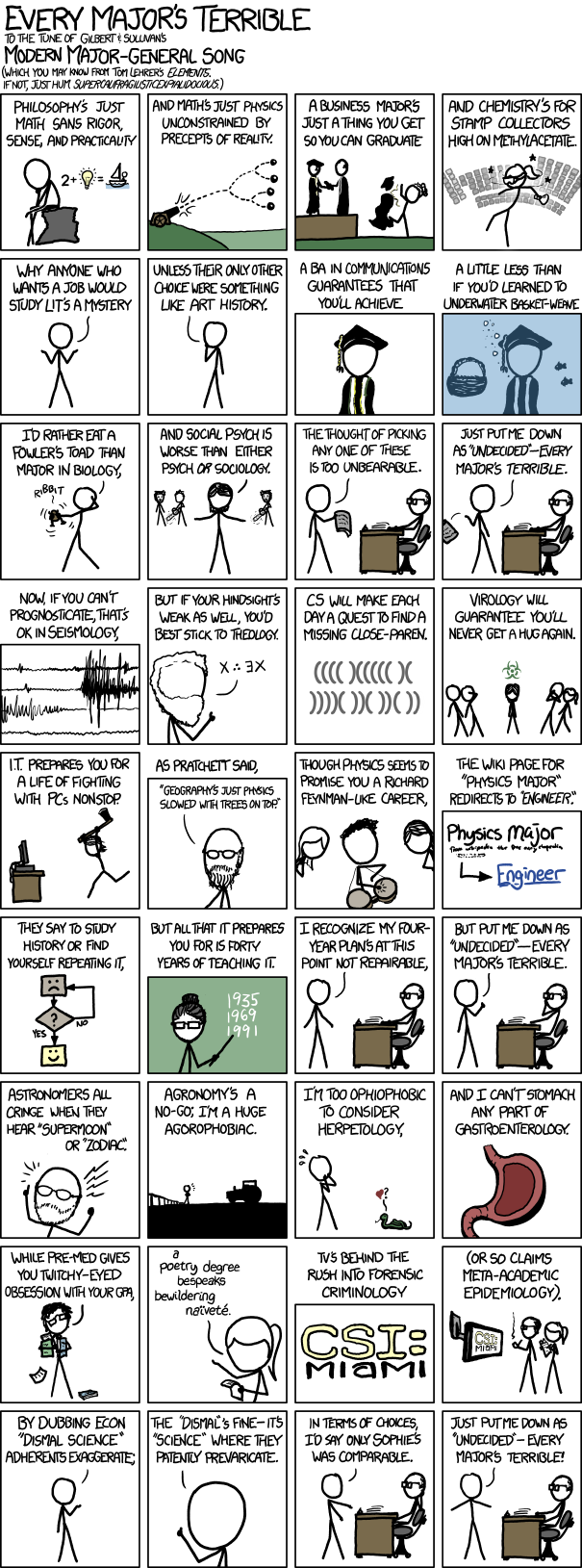
Did you sing it? All the way through?
I thought it was rather clever. There's one spot (that I noticed, at least) that didn't quite scan, but it's still a really impressive filk!
Also, I was reminded of the song "What Do You Do With a B.A. in English?" from Avenue Q.
Did you sing it? All the way through?
I thought it was rather clever. There's one spot (that I noticed, at least) that didn't quite scan, but it's still a really impressive filk!
Also, I was reminded of the song "What Do You Do With a B.A. in English?" from Avenue Q.
Friday, April 27, 2012
NYTimes: A Quantum Theory of Mitt Romney
I spotted this article a few weeks ago. The little part of me that loves theoretical physics (I list Dyson and Feynman among my favorite authors, yes) thinks this is the wittiest political commentary of the election cycle:
http://www.nytimes.com/2012/04/01/opinion/sunday/a-quantum-theory-of-mitt-romney.html
Something (okay, quite a few things) about Romney just doesn't sit right with me. Probably all the hot air.
http://www.nytimes.com/2012/04/01/opinion/sunday/a-quantum-theory-of-mitt-romney.html
Something (okay, quite a few things) about Romney just doesn't sit right with me. Probably all the hot air.
Friday, April 13, 2012
Queen Victoria on Tom Lehrer
Among the great accomplishments of Tom Lehrer, mathematician and musician:
http://www.gocomics.com/thenewadventuresofqueenvictoria/2012/04/09
(Wikipedia says that the above is actually untrue. Yes, I did look up "Jell-o Shot" on Wikipedia.)
http://www.gocomics.com/thenewadventuresofqueenvictoria/2012/04/09
(Wikipedia says that the above is actually untrue. Yes, I did look up "Jell-o Shot" on Wikipedia.)
Friday, April 6, 2012

Monday, April 2, 2012
The Ones Left Behind poster!
The promotional poster for The Ones Left Behind is out!

Simon's (the male lead) costume is composed mostly of pieces on loan from the drama department, but Muireann's (the female lead) is my design. Tommy (the composer) and I wandered around in a little Asian fabric shop in San Jose for a good hour, looking for the perfect fabric. It's made of this great satiny material -- it looks even better in person, and should show up wonderfully under the stage lights.
Anyhow, as it says on the poster, ticket reservations are open! They're free, so you should all come see the show!
Anyhow, as it says on the poster, ticket reservations are open! They're free, so you should all come see the show!
Friday, March 30, 2012
Happy Bunsen Burner Day!
In honor of the 201st birthday of Robert Bunsen, I thought it would be eminently appropriate to share this picture -- it's probably the most beautiful Bunsen burner I've ever seen:
http://hiox.org/13831-bunsen-burner-day.php
Yes, I've seen quite a few. Mostly at a distance, or on Youtube, but still.
http://hiox.org/13831-bunsen-burner-day.php
Yes, I've seen quite a few. Mostly at a distance, or on Youtube, but still.
Wednesday, March 14, 2012
Happy Pi(e) Day, or, Things I Have Baked This Year
In honor of Pi Day, I thought I'd post the list of stuff I've baked thus far. (I love having a kitchen!) Many of these were done at Midnight Pie (after Friday Night Waltz). Midnight Pie is an event I first cooked up (no pun intended) last quarter. Because there were several weeks where I was unable to attend FNW due to midnight paper deadlines, I invited friends over for post-waltz pie instead. It became A Thing last quarter, and less so this quarter, but I'm really hoping to bring it back.
Anyhow, the list:
apple pie (x6)
blackberry-pear pie
blueberry-blackberry pie
chocolate chip cookie scones (they were meant to be cookies, but came out more like scones)
apple-banana-walnut pie (x2)
pumpkin pie (x3 -- twice with canned pumpkin, once with fresh pumpkin)
gingerbread
cranberry macadamia chocolate chip cookies
"apple" pound cake with strawberry jam and green icing
potatoes
One of these things is not like the others.
Note: most of these (the pies, at least) are modifications of recipes given me by my dear friend John, who's much better at all of this than I am.
Anyhow, the list:
apple pie (x6)
blackberry-pear pie
blueberry-blackberry pie
chocolate chip cookie scones (they were meant to be cookies, but came out more like scones)
apple-banana-walnut pie (x2)
pumpkin pie (x3 -- twice with canned pumpkin, once with fresh pumpkin)
gingerbread
cranberry macadamia chocolate chip cookies
"apple" pound cake with strawberry jam and green icing
potatoes
One of these things is not like the others.
Note: most of these (the pies, at least) are modifications of recipes given me by my dear friend John, who's much better at all of this than I am.
Tuesday, March 13, 2012
R.I.P. Encyclopaedia Britannica
A sad day indeed:
http://mediadecoder.blogs.nytimes.com/2012/03/13/after-244-years-encyclopaedia-britannica-stops-the-presses/
We have an old set of the Encyclopaedia Britannica at home. It's from the 1980s, I believe. I was given it by my godparents after their daughter moved out, and it's been ensconced in a place of honor on the mantlepiece above the fireplace ever since. I remember using them as reference materials, of course, but more than that, I used to go downstairs and read an entry once in a while, just for fun (and to procrastinate on homework). It was a bit like the low-tech version of the Wikipedia game. I think it was one of the main reasons I was decent at trivia and parlor games, even though I generally fall flat on popular culture (a rather massive quiz bowl weakness, if you're playing individually).
We never did get another set -- which was probably a financially sound decision. I'm glad to have the one we do, and it saddens me that future generations of children might not have the opportunity to leaf through the Britannica on rainy afternoons. I thought nothing of it at the time, which was exactly the point -- such a pastime should be commonplace, and it won't be, anymore.
http://mediadecoder.blogs.nytimes.com/2012/03/13/after-244-years-encyclopaedia-britannica-stops-the-presses/
We have an old set of the Encyclopaedia Britannica at home. It's from the 1980s, I believe. I was given it by my godparents after their daughter moved out, and it's been ensconced in a place of honor on the mantlepiece above the fireplace ever since. I remember using them as reference materials, of course, but more than that, I used to go downstairs and read an entry once in a while, just for fun (and to procrastinate on homework). It was a bit like the low-tech version of the Wikipedia game. I think it was one of the main reasons I was decent at trivia and parlor games, even though I generally fall flat on popular culture (a rather massive quiz bowl weakness, if you're playing individually).
We never did get another set -- which was probably a financially sound decision. I'm glad to have the one we do, and it saddens me that future generations of children might not have the opportunity to leaf through the Britannica on rainy afternoons. I thought nothing of it at the time, which was exactly the point -- such a pastime should be commonplace, and it won't be, anymore.
Monday, March 12, 2012
The New Adventures of Queen Victoria: Her Majesty on the U.S. Elections
Given the insanity that has been the Republican primaries, I thought this was eminently appropriate. Wouldn't she have been horrified?
http://www.gocomics.com/thenewadventuresofqueenvictoria/2012/03/03
The last line is equally applicable to many of the parties involved, I'd say.
http://www.gocomics.com/thenewadventuresofqueenvictoria/2012/03/03
The last line is equally applicable to many of the parties involved, I'd say.
Friday, March 9, 2012
Neil deGrasse Tyson, Book Critiqua, and the Universe at Large
My latest column is up! You can find it at: http://www.stanforddaily.com/2012/03/09/book-critiqua-space-chronicles/
I'd never read anything of Tyson's before this one, but Space Chronicles makes me want to check out some of his other works. His writing reminds me a little of Freeman J. Dyson's books -- an old favorite when it comes to theoretical physics.
On a related note, here's a video that Lucas sent me. It's Tyson talking about the beauty of the universe, the "we are all stardust" sentiment. (He says it more poetically than I do.) People who don't think that atheists can find meaning in life should watch this.
I'd never read anything of Tyson's before this one, but Space Chronicles makes me want to check out some of his other works. His writing reminds me a little of Freeman J. Dyson's books -- an old favorite when it comes to theoretical physics.
On a related note, here's a video that Lucas sent me. It's Tyson talking about the beauty of the universe, the "we are all stardust" sentiment. (He says it more poetically than I do.) People who don't think that atheists can find meaning in life should watch this.
Sunday, March 4, 2012
NYTimes: Genes on the March
A very interesting, if somewhat inaccurate (well, I'm just being nitpicky here) piece on genetic history,
à la Mongolian warlord:
http://opinionator.blogs.nytimes.com/2012/03/03/genes-on-the-march/?hp
There's likely Khan blood somewhere in my family, though the probability's lower than that of the average Chinese, seeing as we're from the south. Even if there were, though, I doubt any of my relatives would be too pleased, given the most logical method of transmission, as it were.
http://opinionator.blogs.nytimes.com/2012/03/03/genes-on-the-march/?hp
There's likely Khan blood somewhere in my family, though the probability's lower than that of the average Chinese, seeing as we're from the south. Even if there were, though, I doubt any of my relatives would be too pleased, given the most logical method of transmission, as it were.
Monday, February 27, 2012
xkcd: So, It Has Come to This
Today's xkcd, which I thought was wonderfully funny:
Appending "of epic proportions" to nouns at the end of sentences achieves a similar effect, as several friends and I have discovered over the years.
 |
http://xkcd.com/1022
Appending "of epic proportions" to nouns at the end of sentences achieves a similar effect, as several friends and I have discovered over the years.
Friday, February 24, 2012
Fire and Ice (by Robert Frost)
I presented this very famous poem today in a history class about Einstein and his work. It's a beautiful little piece, and it's interesting to consider in the context of relativity and nuclear technology.
Fire and Ice
by Robert Frost (1920)
Some say the world will end in fire,
Some say in ice.
From what I’ve tasted of desire
I hold with those who favor fire.
But if it had to perish twice,
I think I know enough of hate
To know that for destruction ice
Is also great
And would suffice.
I'm doing my paper on the cultural conversation between 20th century literature and Einsteinian physics. Relevant authors (of which I'll be discussing some subset in the paper) are people like Virginia Woolf, William Faulkner, T. S. Eliot, Kurt Vonnegut, and of course, Robert Frost.
Fire and Ice
by Robert Frost (1920)
Some say the world will end in fire,
Some say in ice.
From what I’ve tasted of desire
I hold with those who favor fire.
But if it had to perish twice,
I think I know enough of hate
To know that for destruction ice
Is also great
And would suffice.
I'm doing my paper on the cultural conversation between 20th century literature and Einsteinian physics. Relevant authors (of which I'll be discussing some subset in the paper) are people like Virginia Woolf, William Faulkner, T. S. Eliot, Kurt Vonnegut, and of course, Robert Frost.
Tuesday, February 21, 2012
MSNBC: What Cars Would the Founding Fathers Drive?
Given what we know of the Founding Father's personalities, what kind of car would each of them drive, if they could? This slideshow offers some educated guesses:
http://editorial.autos.msn.com/what-would-our-founding-fathers-drive?icid=autos_2389
I'm not terribly familiar with cars, but the analyses of the various men's personalities are quite good. The entries on Samuel Adams and Alexander Hamilton, I think, capture them to a T. (The writer's clearly put effort into researching the piece -- see the James Monroe entry.)
http://editorial.autos.msn.com/what-would-our-founding-fathers-drive?icid=autos_2389
I'm not terribly familiar with cars, but the analyses of the various men's personalities are quite good. The entries on Samuel Adams and Alexander Hamilton, I think, capture them to a T. (The writer's clearly put effort into researching the piece -- see the James Monroe entry.)
Wednesday, February 15, 2012
BBC: V (for Vendetta) as a Cultural Symbol
In light of the Occupy movement's and Anonymous's adoption of the Guy Fawkes mask as a rallying image, Alan Moore, the creator of the original comic V for Vendetta writes for the BBC on the cultural cachet that the vigilante V holds in the collective consciousness:
http://www.bbc.co.uk/news/technology-16968689
The tagline should be V's quotation about how he's not a man, but an idea -- and ideas never die. One of the problems that the Occupy movement, at least, will have to confront, is precisely that it's an idea, an exercise of populist sentiment. Its lack of leadership and a practical agenda might well deflate the movement. The advantage that V had is that his idea was embodied in a single person, with his own goals and vision, his own coherent plan of action. He was the figurehead, if not the de facto leader of his own revolution. Occupy doesn't have that single person, than coherency. It has the mask -- many such masks -- but not the single visionary behind it.
http://www.bbc.co.uk/news/technology-16968689
The tagline should be V's quotation about how he's not a man, but an idea -- and ideas never die. One of the problems that the Occupy movement, at least, will have to confront, is precisely that it's an idea, an exercise of populist sentiment. Its lack of leadership and a practical agenda might well deflate the movement. The advantage that V had is that his idea was embodied in a single person, with his own goals and vision, his own coherent plan of action. He was the figurehead, if not the de facto leader of his own revolution. Occupy doesn't have that single person, than coherency. It has the mask -- many such masks -- but not the single visionary behind it.
Tuesday, February 14, 2012
St. Valentine's Day Cards from the Seven Kingdoms
This was on George R. R. Martin's blog, and just in time for St. Valentine's:
http://blog.chrisbishop.com/post/17554357179/game-of-thrones-valentine-cards
I thought they were particularly clever. If I had a decent color printer around here, I'd print them out for my fellow A Song of Ice and Fire enthusiasts. :D
http://blog.chrisbishop.com/post/17554357179/game-of-thrones-valentine-cards
I thought they were particularly clever. If I had a decent color printer around here, I'd print them out for my fellow A Song of Ice and Fire enthusiasts. :D
Thursday, February 9, 2012
What Computer Problems Would Look Like if They Were Literally Real
Something funny that Russell sent out:
The stories about the etymologies of some tech terms are quite interesting. A "bug" used to mean, literally, that an insect had gotten stuck in the huge, room-sized computer machinery, back in the 80s or so. Even though the enactments are rather over-the-top, you can still see where a lot of the idioms arose.
The stories about the etymologies of some tech terms are quite interesting. A "bug" used to mean, literally, that an insect had gotten stuck in the huge, room-sized computer machinery, back in the 80s or so. Even though the enactments are rather over-the-top, you can still see where a lot of the idioms arose.
Wednesday, February 8, 2012
NYTimes: High Fashion in Silicon Valley
I'm a huge fan of brightly coloured, patterned, mismatching, or otherwise unusual socks. I wear them not only with sneakers, but also with sandals. Seems like I'd fit right in -- maybe there's a reason I go to Stanford. :)
http://www.nytimes.com/2012/02/05/fashion/in-silicon-valley-socks-make-the-tech-entrepreneur.html?hpw
To all of my techie friends -- I know what I'm getting you for Christmas next year!
http://www.nytimes.com/2012/02/05/fashion/in-silicon-valley-socks-make-the-tech-entrepreneur.html?hpw
To all of my techie friends -- I know what I'm getting you for Christmas next year!
Tuesday, February 7, 2012
The Stanford Daily: Ann Patchett at Stanford
Ann Patchett came to lecture on campus last week. She's one of my favorite living authors (I definitely had a geek-out moment when she was signing my books!), and she's also a wonderful speaker. Anyhow, I got to cover her lecture for my column:
http://www.stanforddaily.com/2012/02/03/book-critiqua-ann-patchett/
Not only is she a bestselling author, she's also an indie bookstore owner; the write-up in The New York Times is here:
http://www.nytimes.com/2011/11/16/us/ann-patchett-bucks-bookstore-tide-opening-her-own.html?ref=books
I especially loved her line, from her talk, about how her bookstore was "her gift to the city she loves" (Parnassus Books, in Nashville).
http://www.stanforddaily.com/2012/02/03/book-critiqua-ann-patchett/
Not only is she a bestselling author, she's also an indie bookstore owner; the write-up in The New York Times is here:
http://www.nytimes.com/2011/11/16/us/ann-patchett-bucks-bookstore-tide-opening-her-own.html?ref=books
I especially loved her line, from her talk, about how her bookstore was "her gift to the city she loves" (Parnassus Books, in Nashville).
Tuesday, January 31, 2012
The Ones Left Behind, a Musical
I'm costume director for a musical one of my friends wrote, called The Ones Left Behind:
http://theonesleftbehind.com/
(There are some demo videos up, if you're curious.)
It's set in 1840s Nantucket, so lots of hoop skirts and waistcoats. Anyhow, we're raising money to cover the cost of the production, via Kickstarter:
http://www.kickstarter.com/projects/298015226/the-ones-left-behind
If you're at all interested in helping us make this happen, please consider pitching in -- even a dollar or two will help us meet our budget.
The show runs in Spring Quarter. I'll post more about it as it gets in full swing. :)
Edit: Nix the hoop skirts. They'll have petticoats, but hoops are probably out of reach. They are whaler's wives, after all.
http://theonesleftbehind.com/
(There are some demo videos up, if you're curious.)
It's set in 1840s Nantucket, so lots of hoop skirts and waistcoats. Anyhow, we're raising money to cover the cost of the production, via Kickstarter:
http://www.kickstarter.com/projects/298015226/the-ones-left-behind
If you're at all interested in helping us make this happen, please consider pitching in -- even a dollar or two will help us meet our budget.
The show runs in Spring Quarter. I'll post more about it as it gets in full swing. :)
Edit: Nix the hoop skirts. They'll have petticoats, but hoops are probably out of reach. They are whaler's wives, after all.
The Evolution of the English Language, as Demonstrated by Austen
I was reading the novel Emma for an English class, and happened upon the following phrase, which made me laugh:
What "a sudden freak" actually means is more along the lines of "a capricious fancy."
A sudden freak seemed to have seized him at breakfast... (Vol. II, Chapter 7)At first glance, it would appear that a character was kidnapped from the breakfast table by some sort of lunatic. (Yes, the use of "sudden" is a bit of a giveaway that something is amiss in this interpretation.) Not quite the sort of scene one would expect in a Jane Austen novel.
What "a sudden freak" actually means is more along the lines of "a capricious fancy."
Thursday, January 26, 2012
io9: Why Are Monkeys' Faces All So Bizarrely Different?
Just a fun science-y piece I found:
http://io9.com/5875354/why-are-monkeys-faces-all-so-bizarrely-different?tag=biology
It makes me wonder about people who are ostentatious with regard to personal ornamentation (especially facial ornamentation). Are heavily bearded men less expressive? For that matter, is it possible that women's supposedly superior communication skills have something to do with our lack of facial hair? (Is this why Santa Claus's interpersonal communication is largely relegated to the iconic "Ho ho ho"?)
Also, that monkey's face is priceless. :)
http://io9.com/5875354/why-are-monkeys-faces-all-so-bizarrely-different?tag=biology
It makes me wonder about people who are ostentatious with regard to personal ornamentation (especially facial ornamentation). Are heavily bearded men less expressive? For that matter, is it possible that women's supposedly superior communication skills have something to do with our lack of facial hair? (Is this why Santa Claus's interpersonal communication is largely relegated to the iconic "Ho ho ho"?)
Also, that monkey's face is priceless. :)
Monday, January 23, 2012
Ames Room Optical Illusion
A fairly straightforward optical illusion known as the Ames room, but the execution is especially well-done:
Enjoy!
Enjoy!
Sunday, January 22, 2012
Artists on PIPA and SOPA
There's been a lot of buzz about PIPA and SOPA, especially here in Silicon Valley. The online protests, most notably the Wikipedia blackout, have gotten a lot of people interested, if not involved. A perspective that hasn't gotten as much attention as it should, methinks, is that of the artists themselves, whose intellectual property is what's ultimately at stake. This (found via Neil Gaiman's blog) is worth reading:
http://stopthewall.us/artists/
They say it better than I ever could -- internet freedom means free publicity. I'll just add that I've discovered some of my favorite songs and musicians (such as Heather Dale and Jonathan Coulton) via YouTube, and some excellent television online (such as the BBC's Sherlock). If it weren't for the internet, if not for YouTube, I would not have gone and bought a Heather Dale album on iTunes, or bought some tracks from Jonathan Coulton's website. That would have been a net loss for the music industry. (Yes, I acknowledge that YouTube, being more akin to a streaming service than a downloading site, isn't necessarily what people mean when they say "pirating music.")
The greater part of the illegal download problem in America, and in the Western world at large, is not piracy so much as accessibility. By and large, we in the developed world don't balk at paying $0.99 for a track on iTunes, or $9.99 for an e-book; compare those to a $12 CD with about a dozen songs on it or an $8 (mass-market) or $12 (trade) paperback. What is problematic, rather, is when music, books, or films are not readily available for purchase -- leading those who really want to obtain said materials to seek other means to get them. (This, as far as I'm aware, often becomes an issue where foreign rights and such are concerned.) By and large, if there is a convenient venue for purchase at a fair price, Americans will pay for the electronic media they consume.
A side-note to the above: one of the truly significant illegal download problems in the developed world, is that of children or teenagers who don't have their own source of income. In the past, they would have asked their parents for money, or saved up their allowances, or done a bit of babysitting in order to purchase the media they want. I'm sure many adults today have fond childhood memories of going to the record store, for example, and buying that album they wanted with their hard-earned cash. Nowadays, it's much easier to bypass the work required to get the money to buy books or music by illegally downloading. I agree that children who don't grow up with a certain moral framework in which content creators should be compensated for their work might one-day become income-earning adults who pirate all of their media despite having the funds to pay for it. But in that case, much as children who commit petty crimes (vandalism and disruption of the peace come to mind) are generally granted more legal leeway than adults who do the same, I don't think that PIPA and SOPA are the right tools to use to crack down on underage media pirates. That's in the realm of killing an ant with a sledgehammer. Also, I would argue that children and teenagers without income fall somewhere towards the middle of the spectrum of "consumers who can afford to pay for all the content they want" and "consumers who would not consume content if it cost money."
In other, mostly developing countries, the concept of copyright is still rather hazy in the public consciousness. Photocopying -- or pirating -- of textbooks, DVDs, &c. is the norm, rather than the exception. Citizens of many of these countries wouldn't buy these products even if they were impossible to pirate -- they're prohibitively expensive. If people in, say, China were prevented in any meaningful way from illegally accessing copyrighted American media, they would just turn to other shows, other books, other music -- non-American media. The income for artists and media companies wouldn't substantially increase as a result of the largely outwards-facing bills. In these markets, increasing profits would mean substantially lowering prices, perhaps to a point where there would be no point in producing said content for these consumers, because it would not be cost-effective.
While PIPA and SOPA are largely well-intentioned -- an attempt to secure for creative individuals the rewards of their work -- they're very problematically written. They were written by politicians -- not the artists they're supposed to protect, or the technologists who are supposed to enforce it. In their current incarnation, they cause more harm than good, especially where censorship and due process are concerned. Additionally, as most of my techie friends would tell you, meaningful enforcement would be basically impossible. As the internet has become an essential component of life in this country and around the world, the law needs to reflect an understanding of how to govern the web. Someone in Washington really ought to put the lawmakers, the technologists, the media companies, and the artists all in the same room to hammer out a solution that addresses everyone's needs and comes with a thorough understanding of current technology. That's the only way it'll work.
http://stopthewall.us/artists/
They say it better than I ever could -- internet freedom means free publicity. I'll just add that I've discovered some of my favorite songs and musicians (such as Heather Dale and Jonathan Coulton) via YouTube, and some excellent television online (such as the BBC's Sherlock). If it weren't for the internet, if not for YouTube, I would not have gone and bought a Heather Dale album on iTunes, or bought some tracks from Jonathan Coulton's website. That would have been a net loss for the music industry. (Yes, I acknowledge that YouTube, being more akin to a streaming service than a downloading site, isn't necessarily what people mean when they say "pirating music.")
The greater part of the illegal download problem in America, and in the Western world at large, is not piracy so much as accessibility. By and large, we in the developed world don't balk at paying $0.99 for a track on iTunes, or $9.99 for an e-book; compare those to a $12 CD with about a dozen songs on it or an $8 (mass-market) or $12 (trade) paperback. What is problematic, rather, is when music, books, or films are not readily available for purchase -- leading those who really want to obtain said materials to seek other means to get them. (This, as far as I'm aware, often becomes an issue where foreign rights and such are concerned.) By and large, if there is a convenient venue for purchase at a fair price, Americans will pay for the electronic media they consume.
A side-note to the above: one of the truly significant illegal download problems in the developed world, is that of children or teenagers who don't have their own source of income. In the past, they would have asked their parents for money, or saved up their allowances, or done a bit of babysitting in order to purchase the media they want. I'm sure many adults today have fond childhood memories of going to the record store, for example, and buying that album they wanted with their hard-earned cash. Nowadays, it's much easier to bypass the work required to get the money to buy books or music by illegally downloading. I agree that children who don't grow up with a certain moral framework in which content creators should be compensated for their work might one-day become income-earning adults who pirate all of their media despite having the funds to pay for it. But in that case, much as children who commit petty crimes (vandalism and disruption of the peace come to mind) are generally granted more legal leeway than adults who do the same, I don't think that PIPA and SOPA are the right tools to use to crack down on underage media pirates. That's in the realm of killing an ant with a sledgehammer. Also, I would argue that children and teenagers without income fall somewhere towards the middle of the spectrum of "consumers who can afford to pay for all the content they want" and "consumers who would not consume content if it cost money."
In other, mostly developing countries, the concept of copyright is still rather hazy in the public consciousness. Photocopying -- or pirating -- of textbooks, DVDs, &c. is the norm, rather than the exception. Citizens of many of these countries wouldn't buy these products even if they were impossible to pirate -- they're prohibitively expensive. If people in, say, China were prevented in any meaningful way from illegally accessing copyrighted American media, they would just turn to other shows, other books, other music -- non-American media. The income for artists and media companies wouldn't substantially increase as a result of the largely outwards-facing bills. In these markets, increasing profits would mean substantially lowering prices, perhaps to a point where there would be no point in producing said content for these consumers, because it would not be cost-effective.
While PIPA and SOPA are largely well-intentioned -- an attempt to secure for creative individuals the rewards of their work -- they're very problematically written. They were written by politicians -- not the artists they're supposed to protect, or the technologists who are supposed to enforce it. In their current incarnation, they cause more harm than good, especially where censorship and due process are concerned. Additionally, as most of my techie friends would tell you, meaningful enforcement would be basically impossible. As the internet has become an essential component of life in this country and around the world, the law needs to reflect an understanding of how to govern the web. Someone in Washington really ought to put the lawmakers, the technologists, the media companies, and the artists all in the same room to hammer out a solution that addresses everyone's needs and comes with a thorough understanding of current technology. That's the only way it'll work.
Saturday, January 21, 2012
Happy National Hug Day!
Yes, it's that time of the year. So go hug someone -- a friend, a family member, a random stranger who might need a hug. Spread the love and increase the total happiness level in the world!
Thursday, January 12, 2012
Washington Post: Writers on Writing
A collection of interesting and occasionally enlightening thoughts on writing, from a diverse list of authors:
http://www.washingtonpost.com/entertainment/books/2011/08/24/gIQAJoEUYK_story.html
Some of my favorites:
"The dream of becoming a writer as a young boy has been realized. I am so pleased I did not let my young self down." ~ Jack Cantos
"I once watched a 6-year-old laugh so hard at my book “Diary of a Worm” that milk shot out of his nose — and I mean projected out like a jet stream. Hilarious." ~ Harry Bliss
"My mother was a living “book” of poems for me — and I grew up swimming in the ocean of poems she knew by heart." ~ Carol Muske-Dukes
http://www.washingtonpost.com/entertainment/books/2011/08/24/gIQAJoEUYK_story.html
Some of my favorites:
"The dream of becoming a writer as a young boy has been realized. I am so pleased I did not let my young self down." ~ Jack Cantos
"I once watched a 6-year-old laugh so hard at my book “Diary of a Worm” that milk shot out of his nose — and I mean projected out like a jet stream. Hilarious." ~ Harry Bliss
"My mother was a living “book” of poems for me — and I grew up swimming in the ocean of poems she knew by heart." ~ Carol Muske-Dukes
Subscribe to:
Posts (Atom)