A very interesting program whereby you paste a chunk of text into the window, and the program tells you which writer's prose your text most resembles.
http://iwl.me
I tried this several times with different writing samples, and was told I write like Chuck Palahniuk, Edgar Allan Poe, H.P. Lovecraft, J.K. Rowling, and Oscar Wilde. Not sure how accurate this is... but it's entertaining nonetheless.
I'm curious to see other people's results... (hint hint)
Source: The New York Times "Paper Cuts" blog:
http://papercuts.blogs.nytimes.com/2010/07/15/i-write-like-yeah-right
Edit: I pasted in a few of my sister's e-mails. She's thirteen. It said she writes like James Joyce.
I'm not sure how much I believe this anymore.
Tuesday, July 27, 2010


NYTimes: Studies Show Jews’ Genetic Similarity
This is quite interesting. Unlike many of the other major religions in the world, Judaism is not a growing religion in that it does not actively seek new converts (a marked difference from, say, Christianity); most of today's Jewish population is descended from Jewish ancestors. They are a very good case of a genetically insular, migrant population, and therefore, rather like Drosophila, very conducive to study.
http://www.nytimes.com/2010/06/10/science/10jews.html?src=me&ref=homepage
http://www.nytimes.com/2010/06/10/science/10jews.html?src=me&ref=homepage
Monday, July 26, 2010
Hope is the thing with feathers (by Emily Dickinson)
This is one of Dickinson's most famous poems, and rightly so:
Hope is the thing with feathers
by Emily Dickinson (1830-1886)
"Hope" is the thing with feathers —
That perches in the soul —
And sings the tune without the words —
And never stops — at all —
And sweetest — in the Gale — is heard —
And sore must be the storm —
That could abash the little Bird
That kept so many warm —
I've heard it in the chillest land —
And on the strangest Sea —
Yet, never, in Extremity,
It asked a crumb — of Me.
I especially like this poem for its refreshing take on the human phenomenon of hope. It is not an entreaty to have hope, or a declaration of one's own hopes, but rather an observation and artistic portrayal of the emotion in the abstract.
She has a very distinctive style (lots of em-dashes, capitalization of nouns in the middle of sentences, strict meter); you know a Dickinson poem when you see one. It is, though, not surprising that she developed such a unique poetic voice, considering she was a recluse (and a rather odd duck, in general) throughout her life. In fact, most of her poetry was published posthumously, because she never really sought publication for herself.
Saturday, July 24, 2010
The Besieging Army is Larger Than Expected
I found this on Happy Chair a while back:

I can only imagine what the opposing army must have thought...
I can only imagine what the opposing army must have thought...
NYTimes: Lacrosse, and Iroquois National Identity
I was following this story last week, and am seriously disappointed with the state of tribal affairs in America and in the international arena. This is a travesty, a stain upon the consciences of America and Britain:
The original story: http://www.nytimes.com/2010/07/13/us/13lacrosse.html?_r=1&hp
The less-than-satisfactory result:
http://www.nytimes.com/2010/07/17/sports/17lacrosse.html?scp=2&sq=&st=nyt
What is especially ironic is that the sport of lacrosse was actually invented by the Iroquois, who are now being barred from traveling to the international championships. It's appalling.
Thursday, July 22, 2010
The Problem with World-Hopping Fantasy Novels
I've always wondered about this, actually, in the back of my mind:
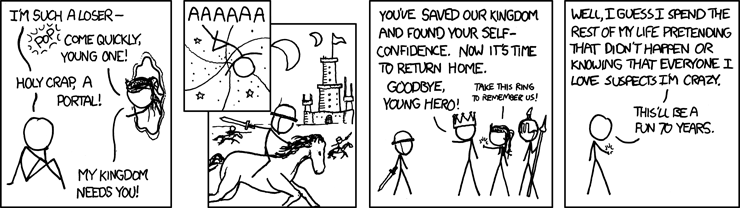
http://xkcd.com/693
(Click on the image; it's a little small to read.)
Neil Gaiman's story "The Problem of Susan" addressed this in the Narnia-verse (Lewis himself touches upon the problem in the later books), but few of the subsequent Narnia-inspired world-hopping fantasy novels really deal with the problem of post-return adjustment, especially since the protagonists often spend years of their lives in these otherworlds, only to come back the same age as when they left. One would think that there would be some period of time immediately afterwards where the protagonists couldn't help acting oddly, out of habit, and were shipped off to a psychiatrist or something. (That would make an interesting story, come to think of it.)
This is a problem often found in the work of inexperienced fantasy writers; I see this sort of thing every day in the slush pile (which is, for the uninitiated, the flood of unsolicited submissions we get in the submissions inbox). Advice/food for thought for aspiring fantasy writers, from someone who reads (and judges) your submissions:
(a) What the deuce would a magical world need from some kid (it's invariably a teenager) from Earth that a native couldn't do better (and don't give me any of that "prophecy" drivel)?
(b) Why would you ever leave your admittedly ordinary life on Earth on the request of some elf-guy who randomly appears in your bedroom? How do you know they won't just bash you over the head and eat you? I've been told I'm entirely too trusting, but even I know better than to trust strangers who break into my house.
(c) What makes you think that someone didn't just slip something into your drink? If someone tells me I'm the savior of the world and makes some pretty sparkling lights, I'd assume I ate something funny, not that I needed to travel to another dimension and face the legions of the Dark Lord, or something equally preposterous.
I'd caveat that all of this can be done well. But generally, most of the people who think they can do it well really, really can't (and the ones who can and know they can are generally pretty modest about such things).
Wednesday, July 21, 2010
Today
is the 85th anniversary of the Scopes Trial. This is one of the most famous trials in American history, pitting legendary lawyer Clarence Darrow against populist crusader William Jennings Bryan in a battle over academic freedom and separation of church and state. (To anyone who read Inherit the Wind -- which is, by the way, a wonderful book -- this may sound very familiar. It should.) Darrow's defeat was a tragedy.
Of course, without his defeat, the Church of the Flying Spaghetti Monster would never have been founded, and the world would have been the poorer for it.
Of course, without his defeat, the Church of the Flying Spaghetti Monster would never have been founded, and the world would have been the poorer for it.
Tuesday, July 20, 2010
Two Sides of a Coin
Praise and flattery are two very similar, and yet wholly different, creatures:
Veritas aut honor. Truly a difficult choice.
Just praise is only a debt, but flattery is a present.
~ Samuel JohnsonI do not often think of it this way, but it is quite true. It reminds me distinctly of the two traditions in which I am steeped. Americans believe in forthright truth and are wary of flattery, believing that the prettiest words are the most deceptive. The Chinese, on the other hand, have elevated flattery to a high art, placing their faith in the social lubricant of fine speech and disdaining those without such silvered tongues as uncultured and uncouth. Similarly, the Western world operates on a system of transaction, of payment of dues (catalogued, countersigned, and otherwise assured), whereas the Chinese believe in a system of favors, where it is more desirable to grant a favor than to suffer one given, where one's public honor trumps one's true ability when pressed to choose.
Veritas aut honor. Truly a difficult choice.
NYTimes: Robot Teachers
This is pretty awesome:
http://www.nytimes.com/2010/07/11/science/11robots.html?src=un&feedurl=http%3A%2F%2Fjson8.nytimes.com%2Fpages%2Fscience%2Findex.jsonp
Robot teachers! Who would have thought? Some of the marvels of technology, in this day and age, make me feel as though I'm living in a science fiction novel.
http://www.nytimes.com/2010/07/11/science/11robots.html?src=un&feedurl=http%3A%2F%2Fjson8.nytimes.com%2Fpages%2Fscience%2Findex.jsonp
Robot teachers! Who would have thought? Some of the marvels of technology, in this day and age, make me feel as though I'm living in a science fiction novel.
Sunday, July 18, 2010

Subscribe to:
Posts (Atom)