Thursday, July 12, 2012

Abstruse Goose: In Cabin'd Ships at Sea

Whitman in the modern age (courtesy of Brett):


http://abstrusegoose.com/477
(You may have to click on the image to make the font a more legible size.)

It frustrates me to no end when people claim that poetry written long ago is irrelevant to life today. Part of the appeal of literature is its timelessness -- that while the specific time and place depicted might be past, human nature has not changed over the centuries. (I maintain that the Oedipus Cycle is one of the original family dramas. Would anything that messed up air on modern television? (Wait, A Game of Thrones is now on HBO. I take that back.))

Seriously, if you think poetry is outdated, quote your girlfriend some Yeats or Neruda or Shakespeare. Or, if you have a boyfriend, some Anne Bradstreet or Elizabeth Barrett Browning.

Saturday, July 7, 2012

Thoughts on the Past Four Years, Part 1

Our commencement was last month. Since then, I've been traveling -- visiting with friends and relatives in California -- and moving my possessions and the detritus of the past four years from California back to New York. I just got home on Tuesday, at some ungodly hour of morning. I've spent most of my time since unpacking and rearranging my room (and evicting my sister from it, as she's apparently taken up residence while I've been in school). It's more complicated that one might think, given that I have to consolidate/shift/toss a lot of my old stuff to make room for everything I've brought back. It's probably the most thorough cleaning my room's ever gotten. I got bored (of course) and consequently nostalgic, so I thought I'd take a break and begin setting down some of the mad whirlwind of thoughts that I have regarding my time at Stanford.

It was not an easy journey, both in terms of my pursuits and my direction. I had, at various points of these past four years, been tested on all fronts: academics, extra-curriculars, people, career. (The Stanford Duck Syndrome, if you will -- paddling furiously to stay afloat, while appearing mostly calm above the surface. The acronym, SDS, also somewhat ironically doubles for the Stanford Debate Society. Go figure.) Looking back, I'm not completely satisfied with my college experience -- there are things I would have done differently, things I wish I'd known going in -- but it was a tremendous period of personal growth.

Academics were challenging throughout, much more so than high school. It seems like a no-brainer, but as one of my grade school friends likes to point out, college is often easier than high school for the specialist and harder than high school for the generalist. I was a jack-of-all-trades in grade school, equally comfortable in the humanities and the sciences (I was, for example, simultaneously captain of the math and debate teams). If only because my high school had more of a humanities bent -- it ran a bit like a small liberal arts college -- I was considered quite good at the sciences among my peers (big fish in a small pond, as it were). I actually got to Stanford thinking that I would be pre-med -- mostly because my parents thought that it suited me -- and considered majoring in math or biology. The best example: I remember taking -- and then dropping -- the hard freshman math class (the H in 51H variously stood for "honors" and "hard" and "hellish," I'm told). It was very interesting material and I met some of my closest friends there, but I just didn't have the time and energy necessary to really do well, what with the other courses I was taking (yes, even as a first-quarter freshman I insisted on maxing out my course load) and the world-class calibre of students in the class (several of them math campers, including a few who did SUMaC, both my year and other years). Dropping the class was a surprisingly difficult choice to make. It was the first time I'd really encountered what I considered to be massive failure, and I felt as though I were giving up -- that completing the class could simply have been a matter of will. Accepting personal limits was never something I've done well, or gracefully, so that in itself was a learning experience.

For most of my freshman year, my courseload consisted of techie classes punctuated with the one series of humanities classes that all of us were required to take, known as IHUM (Introduction to the Humanities). My IHUM sequence was called "Ancient Empires," covering the civilizations of antiquity and taught by the wonderful archaeologist and professor Ian Morris. I quickly discovered that IHUM was my favorite course of the year, my sanity break from all the maths and chemistry and such. I should have realized then that I wasn't doing what I really wanted to be doing -- but I didn't know what it was that I actually wanted out of my college career, and for my future beyond.

My sophomore year consisted of change -- lots of it. I was learning myself, learning my strengths and weaknesses, figuring out what it was I wanted to do with the rest of my time at Stanford and my life thereafter. I had something of a personal crisis in the middle of my sophomore year, after having already taken four quarters of pre-med classes: I realized that pre-med just wasn't for me. By then, I'd tried all of the so-called "Asian" professions at least once; I'd interned over the past few summers at a hospital, on Wall Street, and at a law firm. While I enjoyed each of the internships (more as learning experiences than as career options), I couldn't quite see myself in any of the above industries for the rest of my life. Learning what I didn't want was important -- I'm just glad that I figured out what I did want, just in time (see this post from the end of sophomore year).

I'd begun taking history and creative writing classes for fun. I wanted to do more of it, but wasn't quite ready to give up premed and dash all my parents' hopes for me. But over the summer, I found myself working at Penguin as an editorial intern, and really absolutely loving it. It was something of a coincidence -- I'd applied because I liked the idea of working with books, but I didn't know anything about the industry going into the job. By the end of the summer, I didn't want to leave.

And so I went back for seconds in 2011. In the interim, I declared my history major at the last possible moment in my junior year -- I asked Prof. Morris to be my advisor, because he's awesome and because it was fitting. His class was what first made me consider majoring in history, after all. I began taking more English classes and wanting to do that as well. It wasn't a creative writing course, but ultimately a short story class (which I may have mentioned here), that sold me on the English major. (It seems that there is a recurring trope in my life where I am convinced to declare a major after taking an amazing class in the department, and end up asking the instructor to be my advisor. Elizabeth Tallent became my English faculty advisor.)

If all of that hadn't convinced me that publishing was right for me, one particular episode of my second Penguin summer did. One day towards the end of my internship, I was very casually handed a shiny new hardcover of Those Across the River -- a book I'd first read as a submission the previous summer, which I'd really liked and talked up to a few editors I worked with. I reread it that very night. The incredible rush that comes from holding in my hands a book that I, in some tiny way, had a part in bringing to fruition -- it's a pretty heady feeling.

That's how I ended up where I am, now. A job (and hopefully a career) in publishing, a degree in history and English, and back in New York City, my hometown. It's been a wild ride, to be sure -- not all of it went as smoothly or as well as I would have liked, but I survived, and am a more complete human being for it.

More to come. (Perhaps that ending was a little too... conclusive. There's more, really.)

Sunday, June 10, 2012

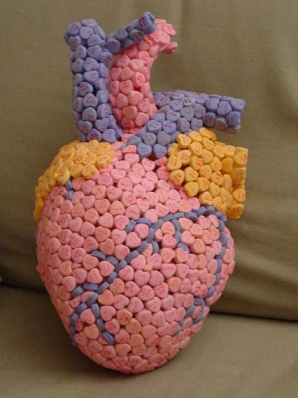
Candy Heart

This is wonderful:


http://scienceroll.com/2007/11/26/anatomical-heart-made-from-candy-hearts/

It's a model heart made from (if you can't tell from the picture) those candy hearts with the pink messages on them.

Is it just me, or does anyone else think that this would make a really cute St. Valentine's Day present (especially in the case of broke college students)? (Of course, there's the question of what to do with such an object. If it were made of entirely edible materials, I suppose one could eat it.)

Edit: And here's how to actually make something along these lines (especially with regard to preservation of the specimen) -- http://makeprojects.com/Project/How-to-Preserve-a-Candy-Portrait/395/1#.T9cQ6uLMAys

Saturday, June 9, 2012

R.I.P. Ray Bradbury

He died this week (on the 5th). The New York Times obituary:
http://www.nytimes.com/2012/06/07/books/ray-bradbury-popularizer-of-science-fiction-dies-at-91.html?_r=1&ref=arts&gwh=DAB304701677810DA93A673A1510F1D2

I first learned of it from Neil Gaiman's blog, actually. He was tapped to write a tribute piece in The Guardian, and he paints a beautiful portrait of this science fiction maestro:
http://www.guardian.co.uk/books/2012/jun/06/ray-bradbury-neil-gaiman-appreciation

We all knew that Bradbury was a pioneer of the genre. We all admired his skill, his imagination, his understanding of human nature. This reveals a side of him that, sadly, many of us never encountered -- the genuine, kind human being. People like that are precious.

Here's another:
http://www.bbc.com/future/story/20120608-meeting-the-master-ray-bradbury

I love his devotion to the book as an object (something I'm more than a little afraid that e-readers will kill off), especially seeing as he was a science fiction writer. (I have an e-reader, but I feel the same way about books, which increasingly makes me appear a troglodyte among my peers.) I love his enthusiasm. And of course, as Gaiman so eloquently depicted it, his kindness.

Rest in peace, Mr. Bradbury.

Tuesday, June 5, 2012

BBC: The Japanese Quest for the Perfect Fruit

Asian gifting (and general social niceties) taken to a horticultural extreme:
http://www.bbc.co.uk/news/world-radio-and-tv-17352173

It's an interesting social phenomenon, but seriously, that technology and effort could be put to so much better use! If horticulturalists in Japan had only chosen to attempt, say, breeding better crop plants and alleviating hunger in the developing world, imagine all the good they could be doing. It reminds me a little of the way the Japanese electronics industry developed; for a long time, they were among the most reliable manufacturers of electronics in the world, and yet, they stuck to making things like televisions, and kitchen appliances, and little toy robot things. They innovated, of course, but it was mostly on a small scale -- how to make a better circuit board and the like -- rather than dreaming big, as big as they could have. And now, given the way the Japanese economy's looking, it might be just a little too late.

Anyhow, I don't know how that turned from "look at this interesting, slightly ridiculous cultural quirk" to "let's solve all the world's problems." But -- just look at all those melons in a row!

Saturday, June 2, 2012

The Oven Bird (by Robert Frost)

I'm taking a Poetry and Poetics course this quarter, and I just finished writing a paper on this particular Frost poem. I'd never read it before this class, but I've come to really like it. (That's the funny thing about papers/assignments; by the end, you come to either love or hate whatever it is you've been working on.) Anyhow, I thought I'd share:

The Oven Bird
by Robert Frost (1916)

There is a singer everyone has heard,
Loud, a mid-summer and a mid-wood bird,
Who makes the solid tree trunks sound again.
He says that leaves are old and that for flowers
Mid-summer is to spring as one to ten.
He says the early petal-fall is past
When pear and cherry bloom went down in showers
On sunny days a moment overcast;
And comes that other fall we name the fall.
He says the highway dust is over all.
The bird would cease and be as other birds
But that he knows in singing not to sing.
The question that he frames in all but words
Is what to make of a diminished thing.

Frost, here, is lamenting the end of an era, which I thought was eminently appropriate to our impending graduation. (Does putting it in writing make it real?) Perhaps that's why the poem resonated with me so, more so than it might have at another point in my life. I know well that Frost is writing about being a middle-aged poet, thinking he's past his prime or being eclipsed by the younger generation of more experimental contemporary poets, but it's a similar sentiment. There's this sinking feeling that accompanies the idea of leaving the Stanford bubble, of being a continent away from the people I've come to know and love. It does feel like the best few years of my life might be slipping through my fingers -- though of course, I hope I'll do greater things with myself in future. I have regrets, I have anxieties, and I have the deep-seated, overwhelming sense of nostalgia for a passing age that Frost portrays so well in "The Oven Bird."

Thursday, May 31, 2012

io9: Blowfish-Man Film

This is somewhat disturbing, and so quintessentially Japanese:
http://io9.com/5914061/watch-a-man-turn-into-a-blowfish-in-one-horrifying-short?tag=trailer-frenzy

I'll admit, I watched that trailer about five times, with what I'm sure was an expression of horrified fascination on my face. The CGI is really something; it's in that zone between extremely realistic and "you know it's impossible even though your eyes tell you otherwise." It evokes the sort of feeling that Neil Gaiman's or China Miéville's writing does; the milieu is rather Lovecraftian.

Wednesday, May 30, 2012

Washington Post: Is Mitt Romney a Unicorn?

Something amusing:

http://www.washingtonpost.com/opinions/mitt-romney-a-unicorn-fighting-birthers-with-their-own-ploy/2012/05/29/gJQAvNDRzU_story.html?hpid=z2

The sad thing is that people actually take the birther thing seriously. It would be poetic justice (but even sadder) if somehow the "Mitt Romney is a unicorn" meme caught on with that crowd.

Friday, May 18, 2012

The Stanford Daily: An Interview with Vienna Teng

Vienna Teng, one of my favourite musicians in the world, is performing at TEDxStanford on Saturday. I got to interview her for The Stanford Daily; the resulting article is here:

http://www.stanforddaily.com/2012/05/18/vienna-teng-stanford-renaissance-woman/

She's extremely nice, and a great conversationalist to boot. I'm not sure what else to say about it (most of it's in the article, though of course, my editor and I had to cut quite a bit), but I think we had more in common that I thought we would, going into the interview.

Anyhow, I'll be seeing her perform this weekend. She said she'd sign my ukulele -- I'm excited!

Monday, May 7, 2012

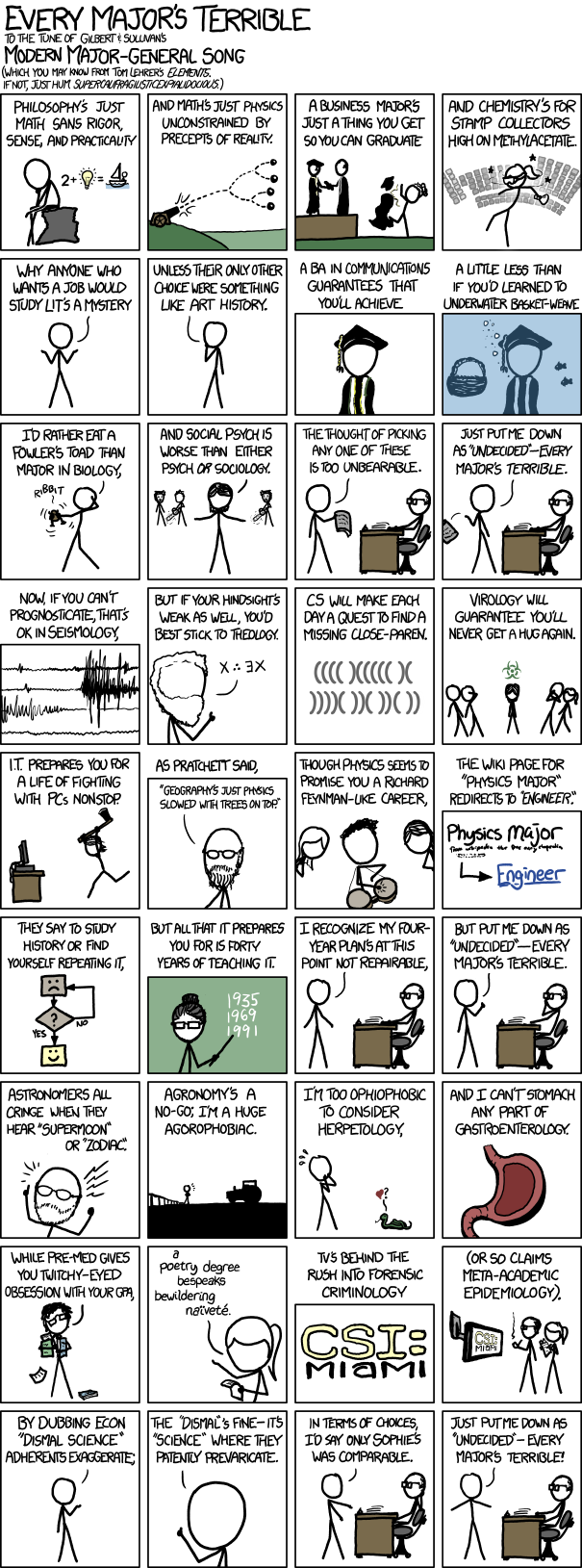
xkcd: The Modern Major-General on Higher Education

Today's xkcd:


Did you sing it? All the way through?

I thought it was rather clever. There's one spot (that I noticed, at least) that didn't quite scan, but it's still a really impressive filk!

Also, I was reminded of the song "What Do You Do With a B.A. in English?" from Avenue Q.